When a 2-tonne forklift isn't quite enough — and a 5-tonne machine is far more than you need — the 3-tonne category is where most Melbourne warehouses, manufacturing facilities, and logistics operations land. It's the workhorse capacity for general-purpose handling: standard pallets, full-height racking, loading dock operations, and mixed indoor/outdoor use.
This guide covers everything you need to make the right 3-tonne electric forklift decision for your Melbourne business, including real specifications, current pricing, total cost comparisons with diesel, and how the lithium-ion advantage plays out at 2026 Australian fuel prices.
Is a 3-Tonne Forklift the Right Capacity for Your Operation ?
Before comparing models, it's worth confirming that 3 tonnes is actually the right specification. Upsizing unnecessarily adds cost; undersizing creates safety and compliance risks under Australian Standard AS 2359.
Choose 3-tonne if your operation involves:
- Pallets loaded to 1,000–2,500kg (with safety margin built in)
- Mixed loads: standard 1,200kg pallets plus occasional heavier items
- Loading and unloading rigid trucks and semi-trailers at dock height
- Outdoor yard work on reasonably even surfaces
- Warehouses with racking up to 6m lift height
Consider moving up (4t–5t) if you regularly handle:
- Steel coils, concrete products, or dense industrial materials above 2,500kg
- Containers or bulk bags at ports or hardstand areas
- Consistent heavy lifts in demanding outdoor environments
Consider stepping down (1.8t–2.5t) if:
- Your actual loads rarely exceed 1,500kg
- Your warehouse has tight aisle constraints (smaller counterbalance = better manoeuvrability)
- You're primarily doing indoor pallet movement with standard stock
The EP EFXZ-301: EPower's 3-Tonne Melbourne Fleet Workhorse
EPower's primary 3-tonne option is the EP EFXZ-301 — a refurbished lithium-ion counterbalance forklift built on a proven 3-tonne platform and updated with modern battery technology.
Key Specifications
| Specification | EFXZ-301 |
|---|---|
| Load capacity | 3.0 tonnes |
| Lift height options | 3,000mm – 6,000mm |
| Battery | 80V / 205Ah lithium-ion |
| Drive system | Electric (AC motor) |
| Fleet technology | Telematics-ready |
| Operator requirement | LF licence (SafeWork Victoria) |
| Suitable environment | Indoor and mixed indoor/outdoor |
Why the EFXZ-301 Suits Melbourne Operations
The 80V/205Ah lithium-ion battery system in the EFXZ-301 provides a meaningful upgrade over lead-acid alternatives at the 3-tonne class. Higher voltage = faster charge acceptance and more stable power delivery under heavy load — relevant for operations running multiple shifts or working at the upper end of the rated capacity.
The telematics-ready architecture is worth noting for fleet operators: it allows GPS tracking, impact detection, and utilisation reporting to be added without hardware modifications — useful if you're managing multiple units across a Melbourne distribution network.
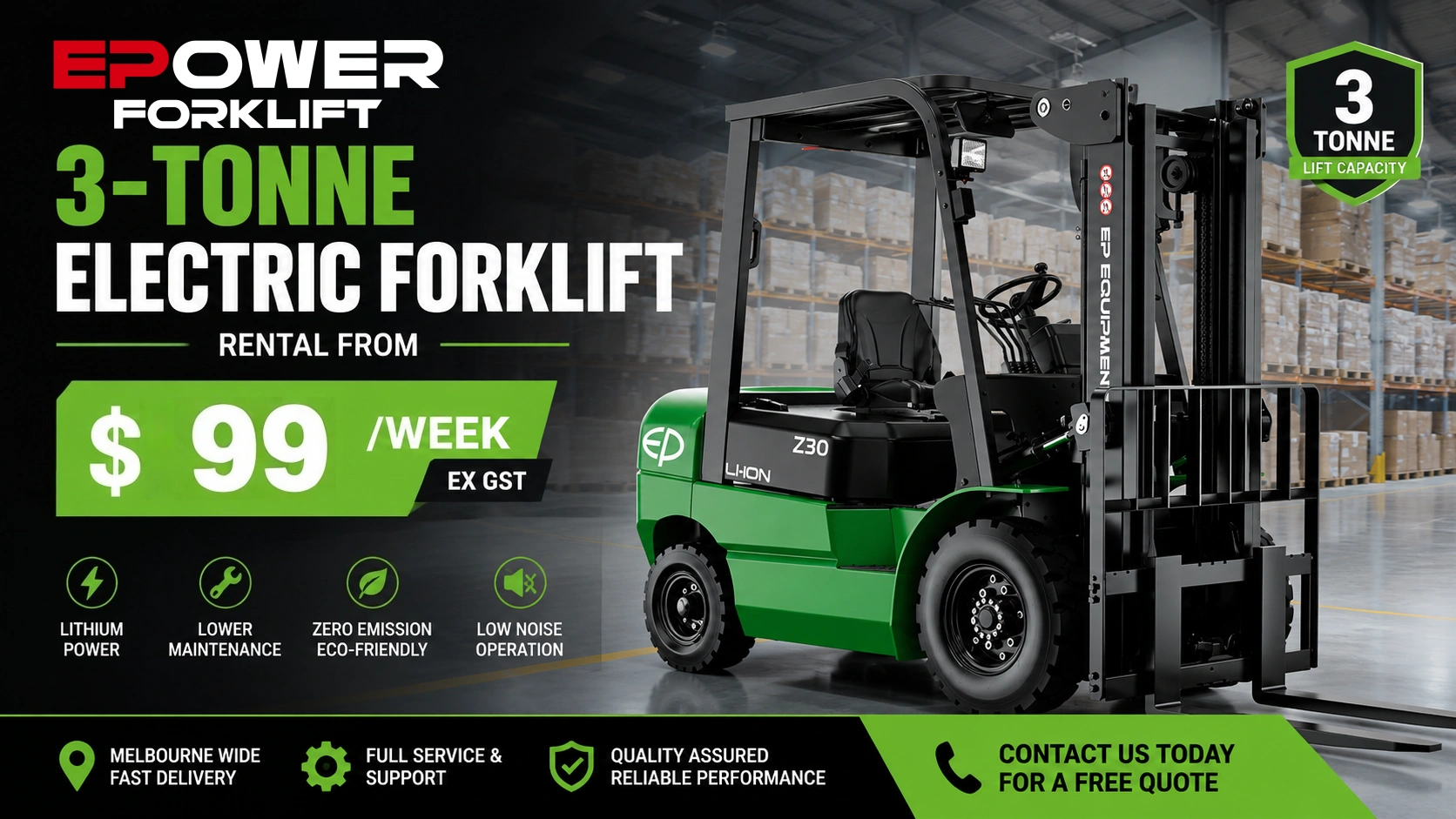
Rental price: from $99/week Ex GST
3-Tonne Electric Forklift: How Much Does It Cost to Run in Melbourne?
Purchase or rental price is only part of the equation. For a 3-tonne forklift running a standard single shift in Melbourne, the operating cost gap between diesel and lithium-electric is substantial — and it's widened significantly at 2026 fuel prices.
Energy Cost Comparison (3-Tonne, Single Shift, Melbourne)
| Cost item | Diesel (3T) | Lithium electric (3T) |
|---|---|---|
| Fuel/energy cost per hour | $9–11 (at $3.29/L diesel, Apr 2026) | $1.50–2.50 (grid electricity) |
| Annual energy cost (250 days, 8hr shift) | $18,000–$22,000 | $3,000–$5,000 |
| Annual maintenance | $3,500–$6,000 | $500–$1,500 |
| Total annual operating cost | $21,500–$28,000 | $3,500–$6,500 |
Energy cost estimates based on AU diesel average $3.29/L (April 2026) and commercial electricity tariffs. A 3-tonne diesel forklift consumes approximately 2.5–3 litres per hour under typical warehouse conditions. Maintenance estimates based on industry averages for 3-tonne class in the Australian market.
Payback Period on the Electric Premium
Lithium-electric 3-tonne forklifts typically carry a purchase premium of $8,000–$12,000 over a comparable diesel model. At current Australian fuel prices, that premium is recovered quickly:
| Conservative | High-use | |
|---|---|---|
| Annual total saving (energy + maintenance) | $15,000 | $22,000 |
| Electric purchase premium | $12,000 | $8,000 |
| Payback period | ~10 months | ~5 months |
For Melbourne businesses running double shifts or a fleet of 3-tonne units, the economics improve further — each additional shift multiplies the per-hour energy saving without changing the upfront cost difference.
What to Look for in a 3-Tonne Electric Forklift
Not all 3-tonne electric forklifts are the same. These are the specifications that matter most for Melbourne operations.
Battery Voltage and Capacity
At 3 tonnes, 80V battery systems are the standard for serious operations. Higher voltage delivers:
- More consistent torque under load (important when lifting at or near rated capacity)
- Faster charge acceptance during opportunity charging breaks
- Better thermal stability in multi-shift use
The EFXZ-301's 80V/205Ah system (approximately 16.4 kWh) provides adequate capacity for a standard 8-hour shift with a margin for heavier-use days.
Lift Height Options
Most Melbourne warehouses with 3-tonne forklifts are working to 5–6m. Confirm your racking height before specifying mast configuration — over-specifying adds cost and reduces residual value; under-specifying creates operational constraints you can't easily remedy.
Available lift heights for 3-tonne class counterbalance forklifts typically range from 3,000mm to 6,000mm. For high-bay operations above 6m with 3-tonne loads, a heavy-duty reach truck or heavy counterbalance may be more appropriate.
Indoor vs Outdoor Capability
The standard EFXZ-301 is rated for mixed indoor/outdoor operations on hard-standing surfaces. It is not rated for:
- Rough terrain or uneven ground (that's the EFX rough-terrain category)
- Cold storage environments below 0°C without cold-spec modification
- Continuous outdoor use in heavy rainfall without appropriate protection measures
If your Melbourne operation involves significant outdoor work on uneven surfaces — building sites, landscaping yards, agricultural properties — discuss rough-terrain requirements with EPower before specifying.
Compliance and Licensing
All 3-tonne counterbalance forklifts require an LF (Forklift) High Risk Work Licence, issued by WorkSafe Victoria. This applies to electric models identically to diesel. There are no exceptions based on capacity category or power source for sit-down counterbalance forklifts.
Key compliance obligations under AS 2359 (Powered Industrial Trucks) that apply to 3-tonne electric forklifts:
- Daily pre-operation inspection with documented defect reporting
- Load rating placards must be visible and not obscured
- Rated capacity must not be exceeded under any circumstance
- Battery charging areas must be ventilated (minor consideration for lithium-ion vs. lead-acid, but still applicable)
- Maintenance records must be retained for workplace safety audits
Buy or Rent a 3-Tonne Electric Forklift in Melbourne?
For a 3-tonne unit — the most common workhorse capacity — the rental vs. purchase decision often comes down to cash flow position and how long you expect to need the machine.
Rental Makes Sense If:
- Your business is growing and equipment needs may change within 2–3 years
- You want to preserve capital for core business investment
- You want maintenance managed externally with no surprises
- You're not certain whether 3 tonnes is the right permanent specification
EPower rental terms for 3-tonne units:
- Short-term: monthly/quarterly rates available
- Long-term: 12–60 month agreements
- Incentives: 3-year hire = 1 month free; 5-year hire = 2 months free
- Full warranty applies during rental period
- 6-monthly scheduled maintenance at $249/service (arranged by EPower)
- On-site repair: first hour $180, subsequent hours $120 (Ex GST)
Starting rental price: $99/week Ex GST (EFXZ-301)
Purchase Makes Sense If:
- You expect to operate the same machine for 5+ years
- You want the asset on your balance sheet
- Your operation is stable and capacity requirements are well-established
- You prefer full ownership and no ongoing lease obligations
EPower's rent-to-own programme also provides a middle path: start on a rental agreement and transition to purchase once operational requirements are confirmed.
Compare rental and purchase options with EPower
EPower's 3-Tonne Forklift Warranty: What's Covered
All EPower counterbalance forklifts — including 3-tonne class units — are covered under EPower's Australian warranty policy (V1.4):
| Component | Warranty period |
|---|---|
| Whole machine (motor, controller, hydraulics, axle, electrics) | 36 months or 3,000 hours |
| Battery cells | 84 months or 10,000 hours |
| Battery electrical parts (BMS, charger, wiring) | 24 months or 2,000 hours |
The 84-month (7-year) battery cell warranty is particularly significant for 3-tonne buyers. At that capacity, battery replacement is a substantial cost event — having manufacturer-backed coverage for 10,000 operating hours eliminates the largest unpredictable cost in the ownership lifecycle.
Warranty requires 6-monthly scheduled maintenance ($249/service). Units purchased or rented through EPower receive maintenance scheduling as part of the service relationship.
EPower 3-Tonne Forklift Service: Melbourne Locations
EPower's three Melbourne service locations provide coverage across the key industrial corridors where 3-tonne forklifts are most commonly deployed:
- Truganina (West Melbourne): 30 Apex Dr, Truganina VIC 3029 — covers Altona, Laverton, Sunshine, Hoppers Crossing industrial precincts
- Epping (North Melbourne): Unit 3, 17 Trafalgar Road, Epping VIC 3076 — covers Campbellfield, Somerton, Thomastown, Broadmeadows
- Dandenong South (Southeast Melbourne): 17 Crompton Way, Dandenong South VIC 3175 — covers Dandenong, Keysborough, Braeside, Moorabbin industrial areas
On-site service is available across Greater Melbourne and Victoria. Response scheduling is handled through sales@epowerforklift.com.au or 1800-997-167.
Frequently Asked Questions
How much does a 3-tonne electric forklift cost in Australia?
New 3-tonne electric forklifts typically range from $35,000 to $65,000 Ex GST depending on specification, battery capacity, and mast configuration. EPower's EFXZ-301 — a refurbished 3-tonne lithium-ion unit — is available to rent from $139/week Ex GST, making it accessible without a large upfront investment. Contact EPower on 1800-997-167 for current purchase pricing.
What's the difference between a 3-tonne and 2.5-tonne electric forklift?
The core difference is rated load capacity and the physical counterweight required to achieve it. A 3-tonne unit has a heavier counterweight and typically a larger footprint than a 2.5-tonne model, which affects turning radius and aisle width requirements. If your loads consistently reach 2,500kg or above, the 3-tonne class provides the required safety margin under AS 2359. If your loads are typically well below 2,000kg, a 2.5-tonne unit may offer better manoeuvrability at lower cost.
Can a 3-tonne electric forklift be used outdoors in Melbourne?
Yes, with conditions. Standard counterbalance electric forklifts including the EFXZ-301 are rated for mixed indoor/outdoor use on hard-standing surfaces. They are not suitable for rough terrain, uneven ground, or sustained outdoor exposure in heavy rainfall without appropriate specification. For building sites, vineyard operations, or outdoor hardstand areas with surface irregularities, EPower's rough-terrain EFX series is the appropriate option.
How long does a 3-tonne electric forklift battery last per shift?
At 3 tonnes with an 80V/205Ah lithium-ion battery (approximately 16.4 kWh usable), a single shift of 8 hours at moderate intensity is comfortably achievable. Lithium-ion systems support opportunity charging during breaks — even a 30-minute charge during a lunch break meaningfully extends available operating time for higher-utilisation applications. EPower's EFXZ-301 battery cells are warranted for 84 months or 10,000 operating hours.
Do I need a special licence to operate a 3-tonne electric forklift in Victoria?
Yes. All sit-down counterbalance forklifts — regardless of capacity or power source — require an LF High Risk Work Licence issued by WorkSafe Victoria. There is no reduced licensing requirement for electric models. Licences are issued after completing an approved training course through a registered training organisation (RTO). Operators must hold a valid licence before operating any forklift on a Victorian worksite.
Is the EFXZ-301 available for immediate delivery in Melbourne?
Availability varies depending on current stock levels. EPower maintains rental and sales inventory across its three Melbourne locations. Contact the EPower sales team on 1800-997-167 or at sales@epowerforklift.com.au for current stock status and delivery timeframes for your specific Melbourne location.
Get a Quote on a 3-Tonne Electric Forklift for Melbourne
Whether you're replacing a diesel 3-tonne, expanding a fleet, or equipping a new Melbourne facility, EPower's team can help you confirm the right specification and the right commercial arrangement.
Call 1800-997-167 — Monday to Friday, 9:30am–5:30pm
Email: sales@epowerforklift.com.au
Submit an online enquiry and a specialist will respond within one business day.
Or visit one of our Melbourne locations in Truganina, Epping, or Dandenong South to see current 3-tonne stock.