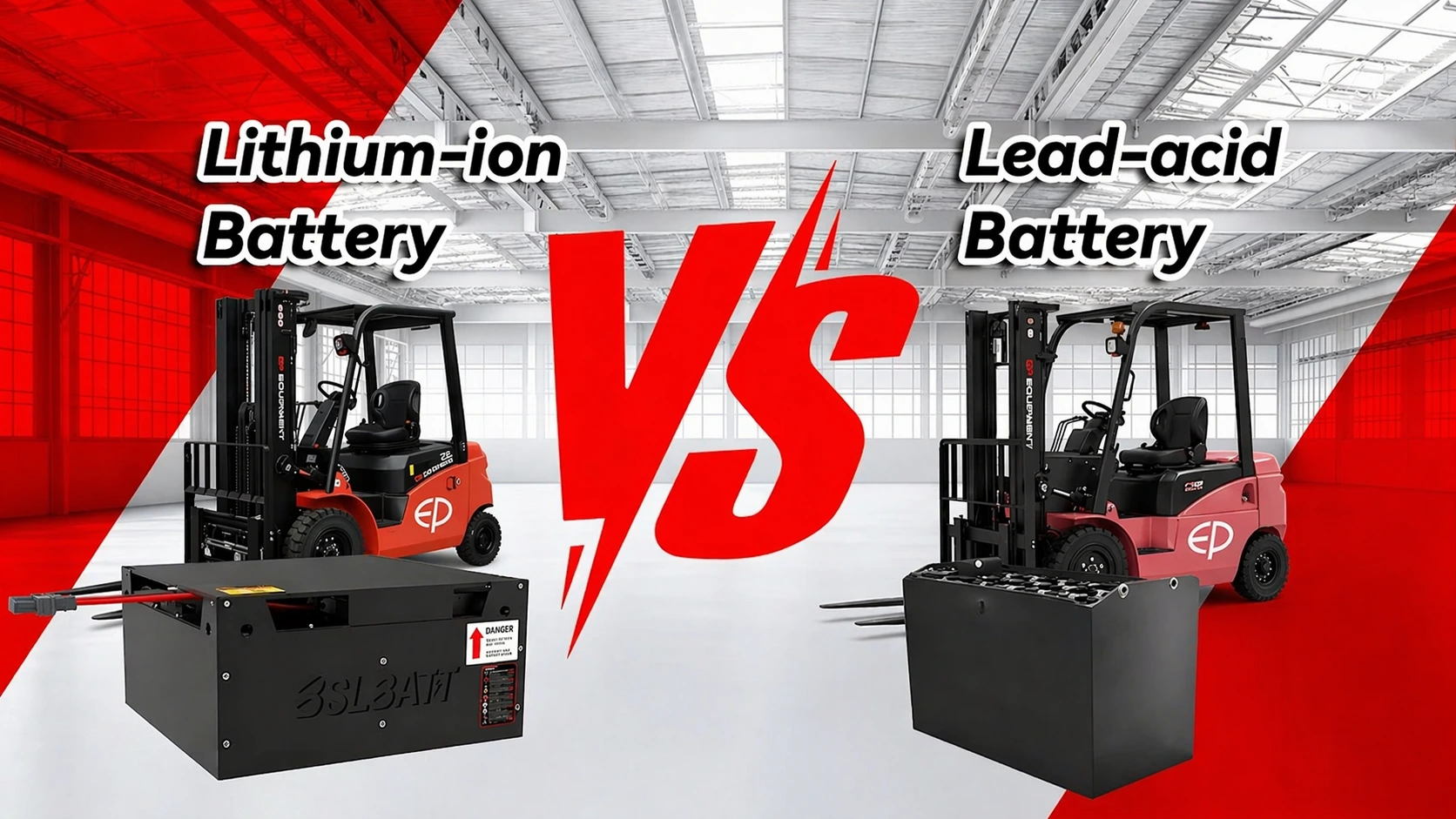
Electric forklift batteries come in two types — lead-acid and lithium-ion — with very different maintenance needs. Lead-acid batteries require regular watering, cleaning, equalization, and strict charging routines. Lithium-ion batteries are largely maintenance-free thanks to their built-in BMS. All electric forklifts in the EPower Forklift range use lithium-ion batteries for lower upkeep and longer lifespan.
Lead-acid maintenance includes daily checks, watering every 5–10 cycles, monthly terminal cleaning, and quarterly equalization. Lithium-ion is simpler: basic daily checks, weekly connector inspections, and proper charging habits.
Charging plays a critical role. Lead-acid batteries follow a fixed 6-8-4 cycle and should not be opportunity charged. Lithium-ion batteries support flexible charging during breaks, making them better suited for multi-shift operations.
Poor maintenance leads to reduced performance, downtime, and safety risks. Under Australia’s WHS regulations, businesses must ensure safe charging areas and proper PPE for operators.
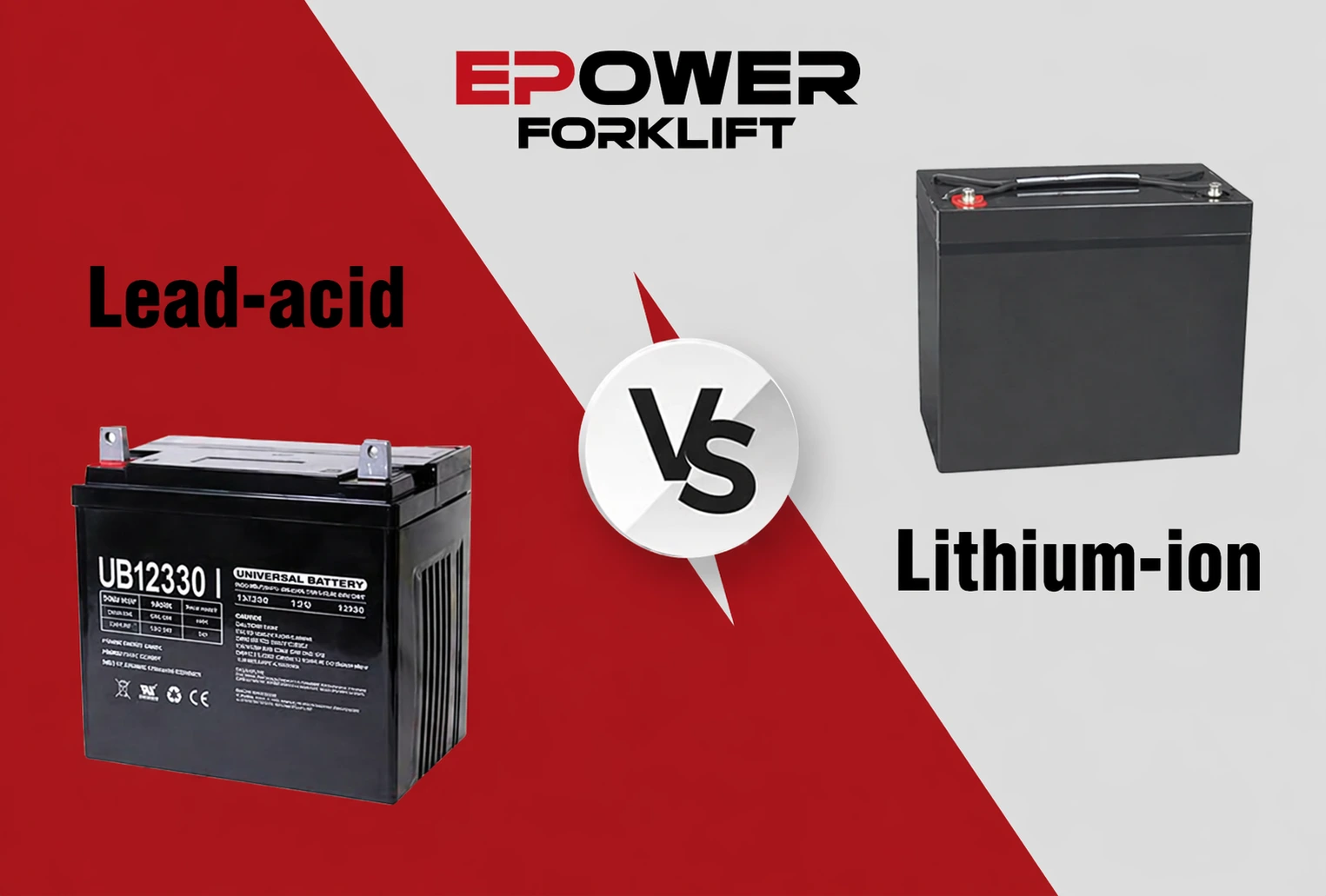
What Is the Difference Between Lead-Acid and Lithium-Ion Forklift Batteries?
Lead-acid and lithium-ion forklift batteries differ across three critical dimensions: internal chemistry, maintenance demands, and operational flexibility — with lithium-ion outperforming lead-acid on all three counts for modern warehouse applications.
To understand why their maintenance requirements diverge so sharply, it helps to understand how each battery type works at a basic level.
How Does a Lead-Acid Forklift Battery Work and What Maintenance Does It Require?
A lead-acid forklift battery generates power through a chemical reaction between lead plates and a liquid electrolyte solution of water and sulfuric acid. This open-cell chemistry is what drives its maintenance burden: the electrolyte evaporates during charging, acid stratification occurs over time, and sulfate crystals build up on the plates if charging is inconsistent.
These physical processes require direct human intervention to reverse:
Watering tops up evaporated electrolyte to protect the plates from air exposure
Cleaning removes acid residue that causes corrosion and self-discharge
Equalization applies a controlled overcharge to dissolve sulfation and rebalance acid concentration across cells
Without these interventions on schedule, a lead-acid battery degrades permanently and irreversibly. Most lead-acid forklift batteries provide approximately 1,500–2,000 charge cycles under proper maintenance — roughly five years of service life in a single-shift operation.
How Does a Lithium-Ion Forklift Battery Work and Why Does It Need Less Maintenance?
A lithium-ion forklift battery moves lithium ions between sealed electrodes through a solid or gel electrolyte — a closed system that generates no gas, no liquid evaporation, and no sulfation. The Battery Management System (BMS) embedded in every lithium-ion pack continuously monitors cell voltage, temperature, and state of charge, automatically balancing cells and preventing overcharge or deep discharge.
In practical terms, the BMS performs the functions that a lead-acid operator must do manually — making lithium-ion batteries as close to maintenance-free as industrial batteries get. Lithium-ion forklift batteries typically deliver 3,000–5,000 charge cycles and a service life of eight to ten years, significantly outperforming lead-acid under equivalent operating conditions.
What Does a Complete Lead-Acid Forklift Battery Maintenance Checklist Look Like?
A complete lead-acid forklift battery maintenance checklist covers four frequency tiers — daily, weekly/per-cycle, monthly, and quarterly — with each tier targeting the specific degradation processes inherent to lead-acid chemistry.
The table below summarises the full checklist before each task is explained in detail.
| Frequency | Task |
|---|---|
| Daily (pre-shift) | Visual inspection of case, terminals, vent caps; charge level check |
| Every 5–10 charge cycles | Water cells with distilled water (after full charge only) |
| Monthly | Clean terminals and case top; neutralise acid residue |
| Quarterly | Equalization charge; electrolyte specific gravity reading |
This table outlines the lead-acid forklift battery maintenance checklist by frequency, covering the four key task tiers from daily inspections to quarterly equalization.
What Should Be Checked on a Lead-Acid Forklift Battery Before Every Shift?
Before every shift, operators should complete the following checks:
- Case condition — inspect for cracks, bulging, or wet spots indicating electrolyte leaks
- Terminal connections — check for corrosion (white or blue powdery buildup) and ensure connections are tight
- Vent caps — confirm all caps are present, undamaged, and seated correctly
- Charge level — verify the battery is sufficiently charged for the upcoming shift; do not operate below 20% state of charge
- Cable condition — inspect cables and connectors for fraying, cracking, or loose fittings
Any defect identified during pre-shift inspection should be reported immediately and the forklift taken out of service until the issue is resolved by a competent technician.
How Often Should You Water a Lead-Acid Forklift Battery?
Yes, watering a lead-acid forklift battery is mandatory — and it must be done correctly. Check fluid levels approximately every five charge cycles and top up as needed, using only distilled or deionised water.
Three rules govern safe and effective watering:
- Water only after a full charge — adding water before charging causes overflow as the electrolyte expands during the charge cycle
- Fill to cover the plastic battery element — do not overfill; leave space for expansion
- Use only distilled or deionised water — tap water contains minerals that contaminate electrolyte and accelerate plate damage
New batteries may need topping up every ten charges initially. If a battery is consuming water at an unusually high rate, this signals it is being overcharged and the charge rate should be adjusted downward.
How Often Should You Clean a Lead-Acid Forklift Battery and How Is It Done?
Clean the top surface of the battery case monthly to remove acid residue that accumulates through normal gassing during the charge cycle. Left uncleaned, this residue creates a conductive circuit between the steel case and lead terminals — causing self-discharge and accelerated corrosion.
Cleaning procedure:
- Ensure all vent caps are secured before starting
- Apply a diluted baking soda and water solution to neutralise acid deposits
- Wipe down with a damp cloth and rinse with clean water
- Dry thoroughly before returning the battery to service
- Inspect terminals; apply anti-corrosion terminal spray if buildup is present
Every few months, a full battery wash using a Battery Wash Cabinet is recommended for operations with heavy battery usage.
What Is Battery Equalization and Do All Lead-Acid Forklift Batteries Need It?
Equalization is a controlled overcharge applied to a lead-acid battery to dissolve sulfate crystal buildup on the plates (sulfation) and reverse acid stratification — the condition where acid concentration is higher at the bottom of the cell than at the top. Wet cell (flooded) lead-acid batteries typically require equalization approximately once per week.
Not every lead-acid battery requires equalization — sealed VRLA (valve-regulated lead-acid) batteries, for example, must never be equalized as they are not designed to handle the excess gassing it produces. Always check the manufacturer's specification before adding equalization to your maintenance routine. Over-equalizing is as damaging as neglecting it entirely.
What Does an Electric Forklift Battery Maintenance Checklist Look Like for Lithium-Ion?
A lithium-ion forklift battery maintenance checklist is significantly simpler than its lead-acid equivalent — no watering, no equalization, no acid cleaning — focused instead on physical inspection, connector care, and charging discipline.
For operators transitioning from lead-acid to lithium-ion fleets, this simplicity is one of the most immediate operational benefits.
What Daily and Weekly Checks Are Required for a Lithium-Ion Forklift Battery?
Daily checks (operator-level):
- Check state of charge on BMS display — confirm sufficient charge for the upcoming shift
- Inspect battery casing for physical damage, cracks, or deformation
- Check connector pins for debris, corrosion, or bent contacts
- Confirm BMS indicator shows no fault or warning codes
Weekly checks:
- Inspect charging cable for wear, fraying, or damaed insulation
- Clean connector contacts with a dry cloth or approved contact cleaner
- Confirm BMS software is logging charge cycles correctly (where digital tracking is in place)
Does a Lithium-Ion Forklift Battery Need Watering or Equalization?
No — a lithium-ion forklift battery requires neither watering nor equalization. Unlike lead-acid, lithium-ion cells use a sealed, solid or gel electrolyte that does not evaporate and does not stratify. Cell balancing — the function that equalization serves in lead-acid — is performed automatically and continuously by the BMS without any operator intervention. This eliminates two of the most labour-intensive and error-prone tasks in lead-acid battery maintenance entirely.
How Should You Charge a Lithium-Ion Forklift Battery to Maximise Its Lifespan?
Charge a lithium-ion forklift battery by following four key guidelines to protect cycle count and long-term capacity:
- Opportunity charge freely — top up during operator breaks, meal breaks, or shift changeovers without penalty to cycle life
- Avoid discharging below 20% — deep discharge stresses lithium cells and reduces long-term capacity
- Avoid prolonged storage at 100% — if a machine is being stored, maintain charge at 50–80% state of charge
- Use only the manufacturer-specified charger — incorrect voltage or amperage damages the BMS and voids warranty
What Are the Correct Charging Practices for Electric Forklift Batteries?
Lead-acid batteries require strict charging discipline — charge only at 20% remaining, never interrupt a charge cycle, and allow a full cooldown before reuse. Lithium-ion batteries offer flexible charging — opportunity charging is not only permitted but encouraged for multi-shift operations.
| Charging Parameter | Lead-Acid | Lithium-Ion |
|---|---|---|
| Recommended charge trigger | At 20% remaining | Any time (opportunity charging OK) |
| Charge cycle duration | ~8 hours | 1–3 hours (fast charge capable) |
| Cooldown required before use | Yes — minimum 4 hours | No |
| Opportunity charging | Not recommended | Yes — no cycle penalty |
| Charge interruption | Damaging to battery | No negative effect |
This table compares the charging requirements of lead-acid and lithium-ion forklift batteries across five key parameters, highlighting the greater operational flexibility of lithium-ion.
What Charging Mistakes Shorten Lead-Acid Forklift Battery Life?
Four charging mistakes consistently shorten lead-acid battery lifespan in warehouse operations:
- Opportunity charging — each connection to a charger consumes one full charge cycle regardless of the depth of discharge; a battery opportunity charged three times in a day uses three cycles instead of one
- Overcharging — generates excessive heat, accelerates water consumption, and causes plate damage
- Undercharging — leaves sulfation partially unreversed after each cycle, permanently reducing capacity over time
- Using incorrect charger voltage — even a small voltage mismatch degrades cells and risks thermal events
Can You Opportunity Charge a Lithium-Ion Forklift Battery During Breaks?
Yes — opportunity charging is one of the defining operational advantages of lithium-ion forklift batteries, and it is actively recommended for multi-shift warehouse operations. Because lithium-ion batteries do not count a partial top-up as a full charge cycle, operators can connect during a 15-minute break, a lunch period, or between shifts to keep state of charge consistently high — eliminating the need for battery swap infrastructure and reducing the total number of batteries required per shift pattern.
What Are the Safety Requirements for Forklift Battery Maintenance in Australia?
Australian operators must meet four core safety requirements when maintaining electric forklift batteries: provide appropriate PPE for all personnel, establish a compliant designated charging area, follow no-smoking and no-metal-jewellery protocols, and maintain accurate maintenance records — all of which are mandated under the WHS Act 2011 and Safe Work Australia's Code of Practice for managing plant risks.
When selecting an electric forklift for your Australian operation, Epower Forklift recommends considering lithium-ion models not just for their lower maintenance burden, but also for their significantly safer handling profile — no sulfuric acid exposure, no hydrogen gas generation during charging, and no risk of electrolyte spillage.
What Personal Protective Equipment Is Required When Servicing Lead-Acid Forklift Batteries?
Operators and maintenance personnel working with lead-acid batteries must wear the following PPE at all times during watering, cleaning, and inspection tasks:
- Chemical splash goggles — not standard safety glasses; goggles provide sealed eye protection against acid spray
- Acid-resistant gloves — rubber or neoprene; not fabric or leather
- Rubber apron — protects clothing and skin from electrolyte splashes
- Face shield — required when performing equalization or handl
Contact with sulfuric acid electrolyte causes serious chemical burns to skin and permanent eye damage. An OSHA-compliant eyewash station must be immediately accessible in any area where lead-acid batteries are serviced.
What Should a Compliant Forklift Battery Charging Area Include Under Australian WHS Rules?
A compliant forklift battery charging area in Australia must include:
- Mechanical ventilation — lead-acid batteries emit hydrogen gas during charging; accumulation above 4% concentration creates an explosion risk
- Hydrogen gas detector — mandatory in enclosed charging rooms
- Eyewash station — with continuous flow, accessible within 10 seconds of the work area
- Fire extinguisher — Class C (electrical) rated
- Acid spill kit — neutralising agent (baking soda or commercial acid neutraliser), absorbent material, disposal bags
- Clear signage — no smoking, electrical hazard warning, eyewash station location, forklift traffic zones
- Emergency phone access — a fixed or mobile phone within reach of the charging area at all times
Lithium-ion charging areas have significantly reduced requirements — no hydrogen gas ventilation is needed, and acid PPE and spill kits are not required — further simplifying compliance for operators running lithium-ion fleets.
What Else Should Australian Operators Know to Extend Forklift Battery Life?
Beyond the standard checklist, three areas separate operators who consistently maximise battery lifespan from those who face premature replacements: recognising early failure signs, avoiding the most common maintenance mistakes, and knowing when maintenance is no longer the right answer.
What Are the Warning Signs That a Forklift Battery Is Failing?
Six indicators signal a forklift battery is approaching end of life and requires professional assessment:
- Inability to hold charge through a full shift — the most common and reliable early indicator of capacity loss
- Excessive heat during or after charging — signals shorted cells or incorrect charge rate
- Hesitant acceleration at full charge — insufficient current output from worn cells
- White powdery buildup on terminals — sulfation causing resistance and reducing power transfer
- Swollen or deformed casing — indicates internal gas buildup or thermal event; take out of service immediately
- Abnormal voltage drop under load — identified through load testing; significant drop confirms cell degradation
What Are the Most Common Forklift Battery Maintenance Mistakes to Avoid?
The six most damaging and most common battery maintenance mistakes in Australian warehouse operations are:
- Opportunity charging a lead-acid battery — cycle count destruction disguised as convenience
- Using tap water instead of distilled water — mineral contamination permanently damages lead plates
- Watering before a full charge — causes electrolyte overflow and plate exposure
- Skipping equalization on wet cell batteries — allows progressive sulfation to reduce capacity irreversibly
- Ignoring maintenance logs — removes the ability to identify patterns, predict failures, and demonstrate WHS compliance
- Charging lithium-ion with an incompatible charger — damages BMS and voids manufacturer warranty
When Should You Replace a Forklift Battery Instead of Continuing to Maintain It?
Replace a forklift battery when any of three thresholds are met: capacity has dropped below 80% of its rated output, the cost of repair or reconditioning exceeds 50% of a replacement battery's purchase price, or the battery has exceeded its design cycle life — typically five years for lead-acid and eight to ten years for lithium-ion under normal single-to-double-shift operation.
In Australia, spent lead-acid batteries are classified as hazardous waste and must be disposed of through a licensed battery recycler — they cannot be placed in general waste. Lithium-ion batteries are similarly subject to regulated disposal and should be returned to the manufacturer or a certified e-waste facility.
For Australian operators evaluating their next battery investment, choosing a lithium-ion electric forklift from the outset — rather than maintaining an ageing lead-acid fleet — is often the most cost-effective long-term decision. Epower Forklift's range is built around lithium-ion technology specifically for this reason: fewer maintenance tasks, longer service life, safer operation, and lower total cost of ownership across the life of the machine.
Ready to upgrade your fleet? Contact us now!