In day-to-day warehouse operations, the 2-ton capacity range is one of the most commonly used categories in material handling. Equipment in this class is designed to lift and transport loads of up to 2,000 kg (4,400 lb), making it suitable for palletised goods, cartons, and general warehouse logistics across distribution centres, manufacturing facilities, and storage operations.
For most businesses, a 2-ton electric solution offers the ideal balance between lifting power, maneuverability, and energy efficiency. It is strong enough for standard pallet loads while remaining compact enough to operate safely within indoor aisles and racking systems.
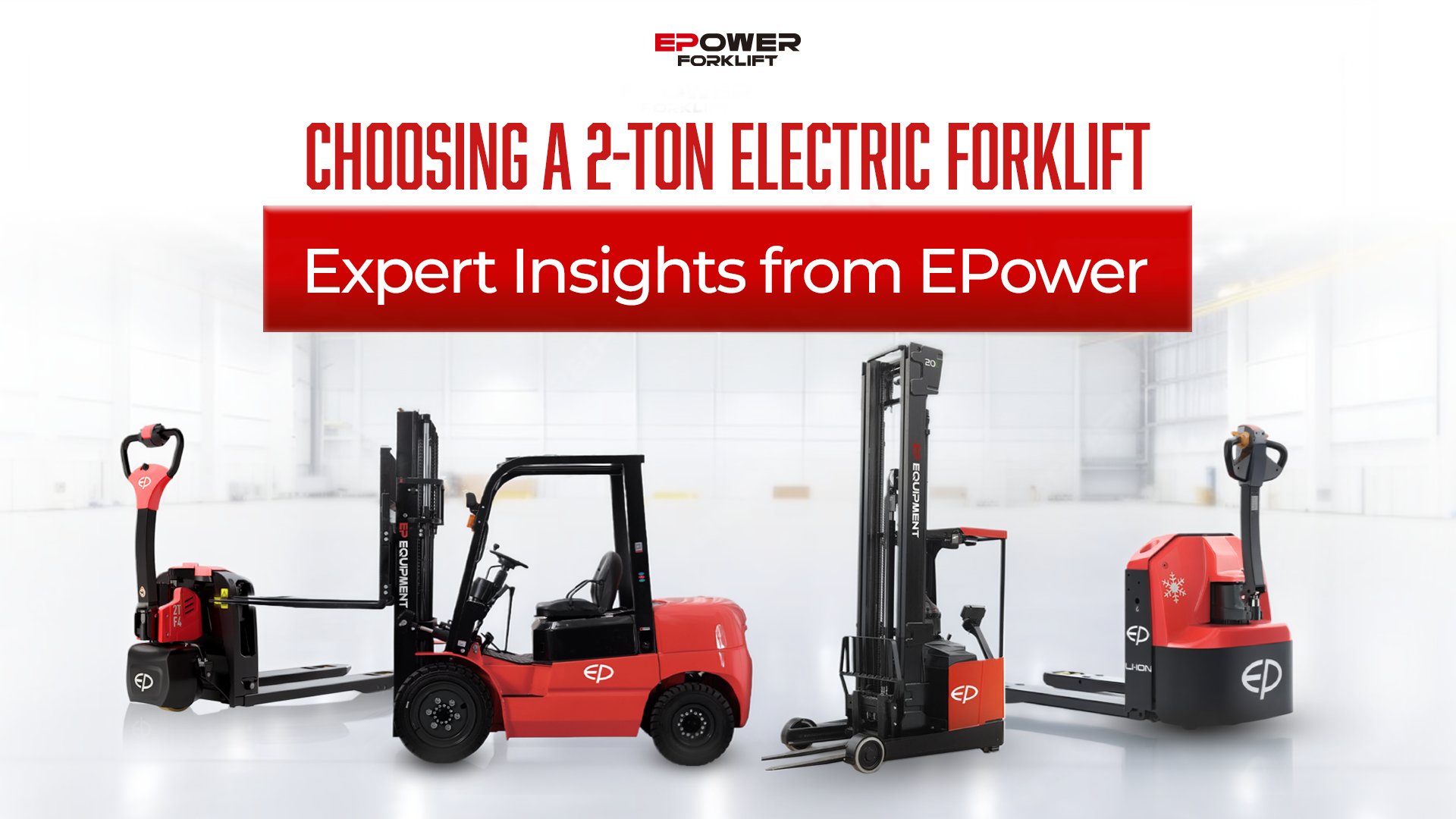
At EPower Forklift, we supply a comprehensive range of lithium-powered equipment covering not only 2-ton counterbalance forklifts, but also reach trucks and warehouse pallet solutions within the same capacity class. The models below represent the most suitable options for businesses seeking efficient, low-maintenance lithium equipment in this segment.
| Model | Product type | Price (Exc. GST) | Key Strengths |
|---|---|---|---|
| EP CPD20TVL | 3-wheel lithium counterbalance forklift | From $28,xxx | Tight turning radius, agile steering, compact design |
| EP TDL201 | 3-wheel lithium counterbalance forklift (rider) | From $38,xxx | Spacious operator area, durable chassis |
| EP CQD20L | Electric reach truck (sit-down) | From $42,xxx | Up to ~12 m lift, precise stacking control |
| EP F4-201 | Pedestrian electric pallet truck | From $3,0xx | Lightweight, removable battery, low maintenance |
| EP KPL201 | Ride-on electric pallet truck | From $12,xxx | Higher travel speed (~10 km/h), ergonomic controls |
| EP WPL202 | Pedestrian lithium pallet truck | From $6,8xx | Ultra-slim chassis, easy maneuver in tight spots |
Why are 2-ton electric forklifts standard equipment for warehouses?
The 2-ton electric forklifts sit at the sweet spot of capacity, size, and cost that matches the overwhelming majority of warehouse tasks - from pallet handling to racking operations. Standard pallet loads in logistics typically range from 500 kg to 1,500 kg. A 2-ton capacity provides a safe working margin without unnecessarily increasing equipment size, energy consumption, or acquisition cost unnecessarily. Choosing a higher-capacity forklift often leads to underutilized equipment and a higher total cost of ownership, while a lower-capacity option may create safety and performance limitations.
Critically, forklift capacity is rated at a standard 500mm load centre. As lift height increases or load dimensions extend beyond that centre point, effective capacity decreases. The 2-ton class is engineered to maintain warehouse racking demand, making it the right-sized machine for the job, not an oversized one.
Why lithium 2-ton forklifts matter?
Electric power is the only source of power in enclosed warehouse environments. Zero direct emissions, significantly lower noise levels, and no heat output, making electric forklifts the standard for any indoor operation. Particularly indoor-grade, cold-storage, and pharmaceutical facilities where air quality and temperature control are non-negotiable. Moreover, lithium-ion batteries have become the preferred choice because the performance gap over lead-acid is measurable across three dimensions:
- Cycle life: Lithium-ion delivers 2,500–3,500 charge cycles versus 1,000–1,500 for lead-acid — roughly two to three times longer service life before replacement is needed.
- Opportunity charging: Unlike lead-acid batteries, lithium-ion batteries can be partially charged during breaks without damaging cell chemistry. This eliminates the 8–10 hour full charge requirement and makes multi-shift operation viable from a single battery, with no swap infrastructure required.
- Energy efficiency: Lithium-ion operates at approximately 95–98% charge/discharge efficiency, compared to 75–80% for lead-acid, translating to around 30% less electricity consumed per shift for equivalent work output.
The upfront cost of a lithium-ion configuration is higher. In most warehouse operations running more than a single shift, that premium is recovered within two to three years through reduced energy costs, lower maintenance requirements, and eliminated battery replacement cycles.
How to choose the right forklift type based on your working environment?
Selecting the right forklift goes beyond capacity. Aisle width, stack height, travel distance, and ambient conditions each determine which machine delivers safe, productive, and cost-efficient operation. Here is a practical framework across the four environments that define most warehouse and industrial operations.
Solutions for narrow-aisle warehouses
If your warehouse aisles are tight, maneuverability becomes the priority. In this case, compact counterbalance forklifts or pallet trucks and reach trucks are more suitable.
- Reach trucks work in aisles from ~2.3–2.7 metres and are the standard solution for high-bay distribution centres
- Three-wheel electric counterbalance forklifts offer a tighter turning radius, practical for aisles from ~2.7–3.0 metres with mixed load requirements
Choosing a bulky forklift in a narrow aisle environment will reduce efficiency and increase the risk of operational errors.
Demand analysis for high-level stacking storage
For warehouses aiming to maximize vertical space, lifting height is the key decision factor. Reach trucks are typically the most effective solution for stacking above 6 meters. They are designed to operate in narrow aisles while maintaining stability at height. Investing in high-level stacking can:
- Increase storage density by 60–80%
- Reduce the need for warehouse expansion
- Improve overall space utilization
However, this requires selecting equipment specifically designed for vertical handling rather than general-purpose forklifts.
Optimization strategies for long-distance horizontal transport
Specialised stacking equipment is not designed for long-distance travel; using it that way wastes expensive assets and increases cycle times. Electric pallet trucks are better suited for this scenario as they reduce energy consumption per movement cycle, increase travel speed for repetitive tasks, and lower operator fatigue.
Considerations for special environments
Special environments require additional attention to equipment specifications. In cold storage, battery performance must remain stable at low temperatures, and electrical systems need proper insulation.
For outdoor applications, equipment must handle uneven surfaces and weather exposure, and durability and protection levels become critical.
Using standard indoor forklifts in these conditions often leads to higher maintenance costs and reduced lifespan.
Detailed analysis of six EP 2-ton electric forklift models
EPower provides six 2-ton electric forklift models grouped by application type. This analysis focuses on how each model performs in a real warehouse environment, helping you identify the most suitable option based on layout, workload, and operational priorities.
Counterbalance forklift series
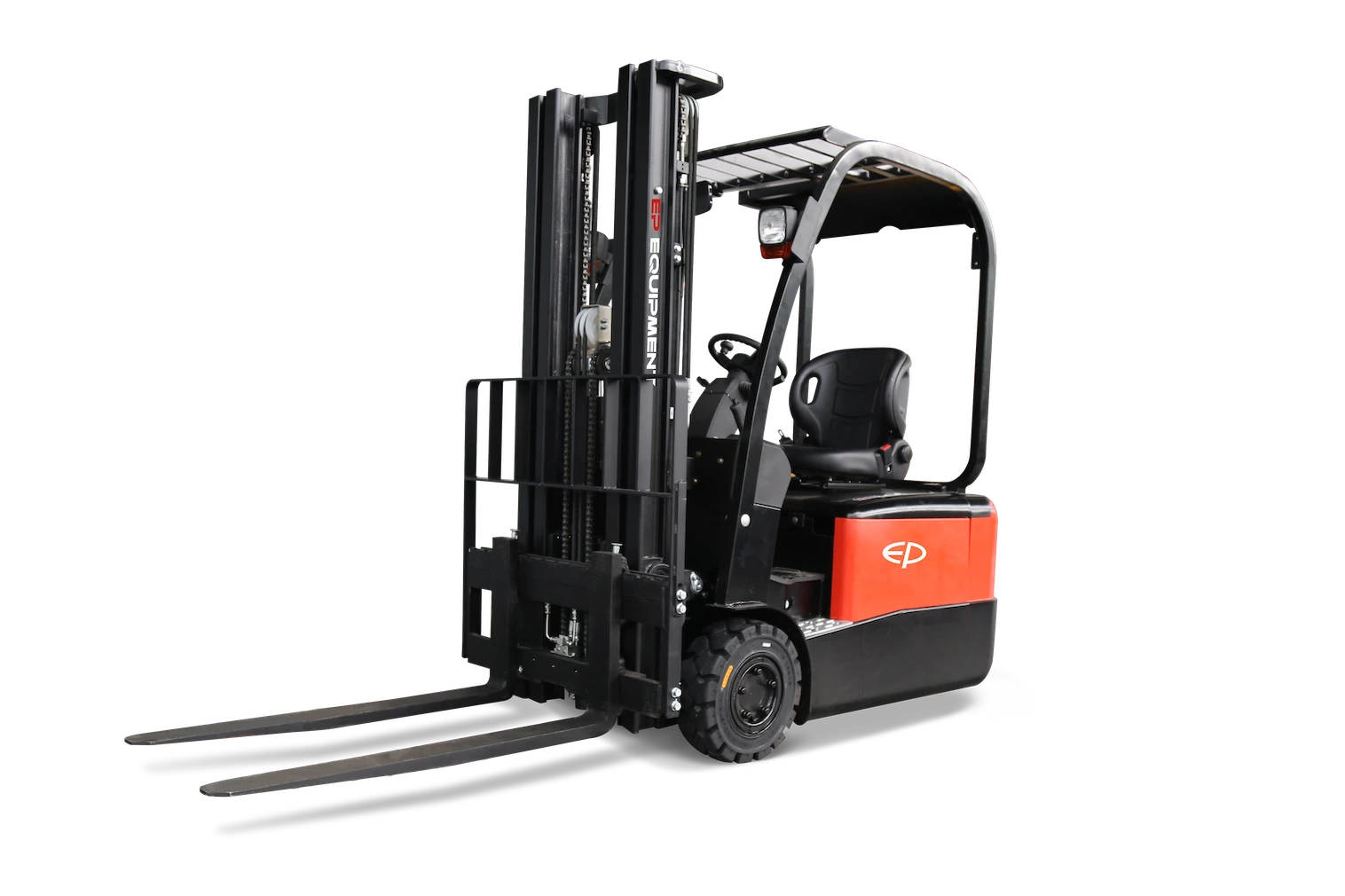
CPD20TVL - Compact three-wheel design
When businesses ask for a compact yet capable 2-ton forklift, the CPD20TVL is often one of the first models we discuss. It’s particularly well suited for indoor warehouses, distribution centres, and loading dock operations where maneuverability directly impacts productivity.
The 3-wheel design gives it a noticeably tighter turning radius compared to traditional 4-wheel forklifts, making it ideal for narrow aisles and high-density storage layouts. Instead of sacrificing space or lifting capacity, operators can move efficiently within confined environments.
Powered by an 80V lithium battery, the CPD20TVL offers consistent output, opportunity charging, and virtually no battery maintenance. For businesses transitioning from diesel or lead-acid units, this means lower running costs, less downtime, and simpler daily operation. While it performs best indoors, it can comfortably handle light outdoor work and wet conditions when required.
Overall, this model suits companies looking for a practical, long-term solution that balances agility, performance, and cost efficiency.
Price: From $28,xxx (Exc. GST)
Key specifications:
- Three-wheel drive
- Service weight: 3429 kg
- Battery system: 80V
- Turning radius: 1585mm
- Lifting height: 3000-6000mm
EP TDL201 – High-performance three-wheel configuration
The TDL201 is a strong option for operations that need reliable 2-ton lifting performance but want something more agile than a full-sized counterbalance forklift.
Its 3-wheel layout allows it to navigate tighter warehouse layouts, loading docks, and side-bay truck operations with ease. Compared to heavier forklifts, it feels more responsive in confined areas while still delivering stable handling during daily pallet movement.
The 48V lithium-ion battery supports opportunity charging and eliminates fuel or emission concerns, making it suitable for both indoor and covered outdoor workflows. Dual 5.4 kW AC drive motors provide smooth acceleration and consistent power throughout the shift, while the hydraulic steering system ensures precise control without adding unnecessary maintenance complexity.
For businesses seeking a balanced mix of performance, operator comfort, and energy efficiency in a 2-ton category, the TDL201 represents a dependable and practical choice.
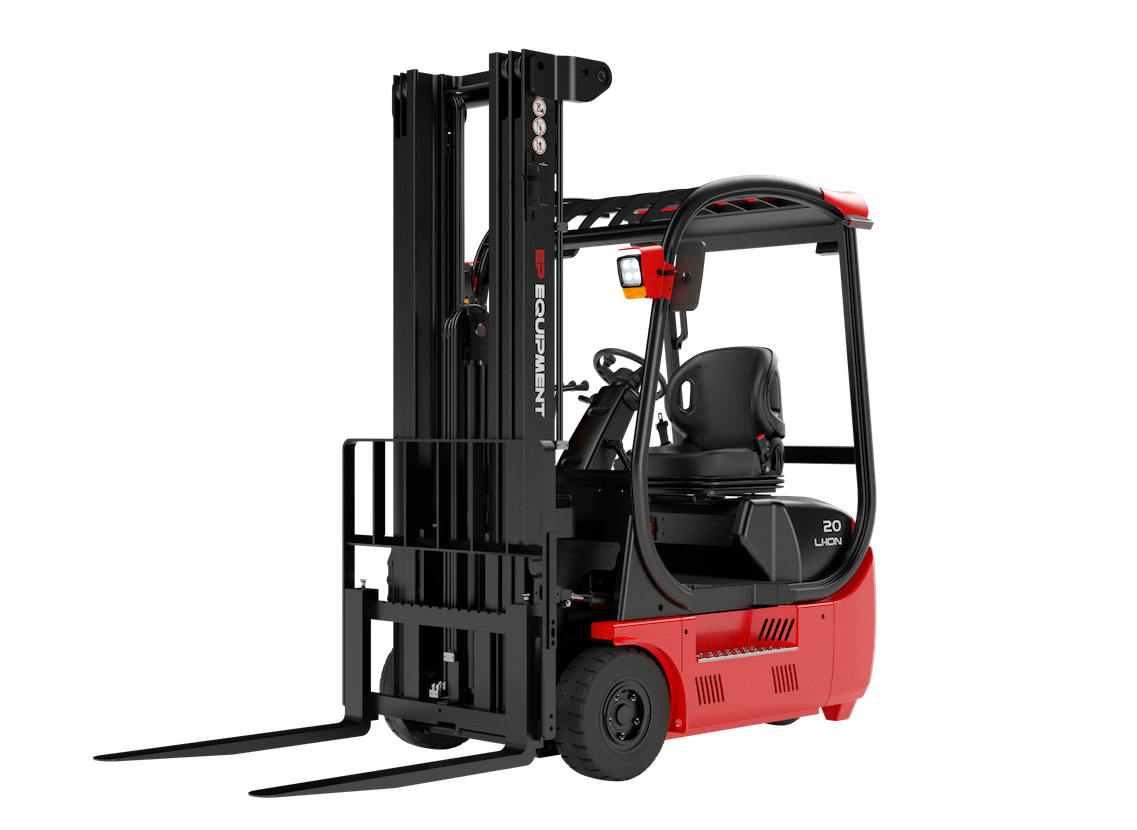
Price: From $38,xxx (Exc. GST)
Key specifications:
- Load capacity: 2000kg
- Service weight: 3575kg
- Battery system: 48V
- Turning radius: 1605mm
- Lifting height: 4800-5500mm
Reach Truck Series
CQD20L - Expert in high-level stacking
If vertical storage is your priority, the CQD20L reach truck is designed specifically for that challenge.
In high-rack warehouses where floor space is limited, maximizing lift height becomes essential. The CQD20L allows operators to stack at greater heights with stability and precision, helping businesses increase storage density without expanding their footprint.
Lithium power ensures steady performance even during high-lift operations, which is critical in intensive stacking environments such as distribution centres and high-bay warehouses. Operator visibility is also a key advantage, thanks to its ergonomic layout and mast design that improves sightlines during stacking.
For operations focused on vertical efficiency rather than horizontal transport, this model delivers strong performance without the premium pricing typically associated with high-reach equipment.
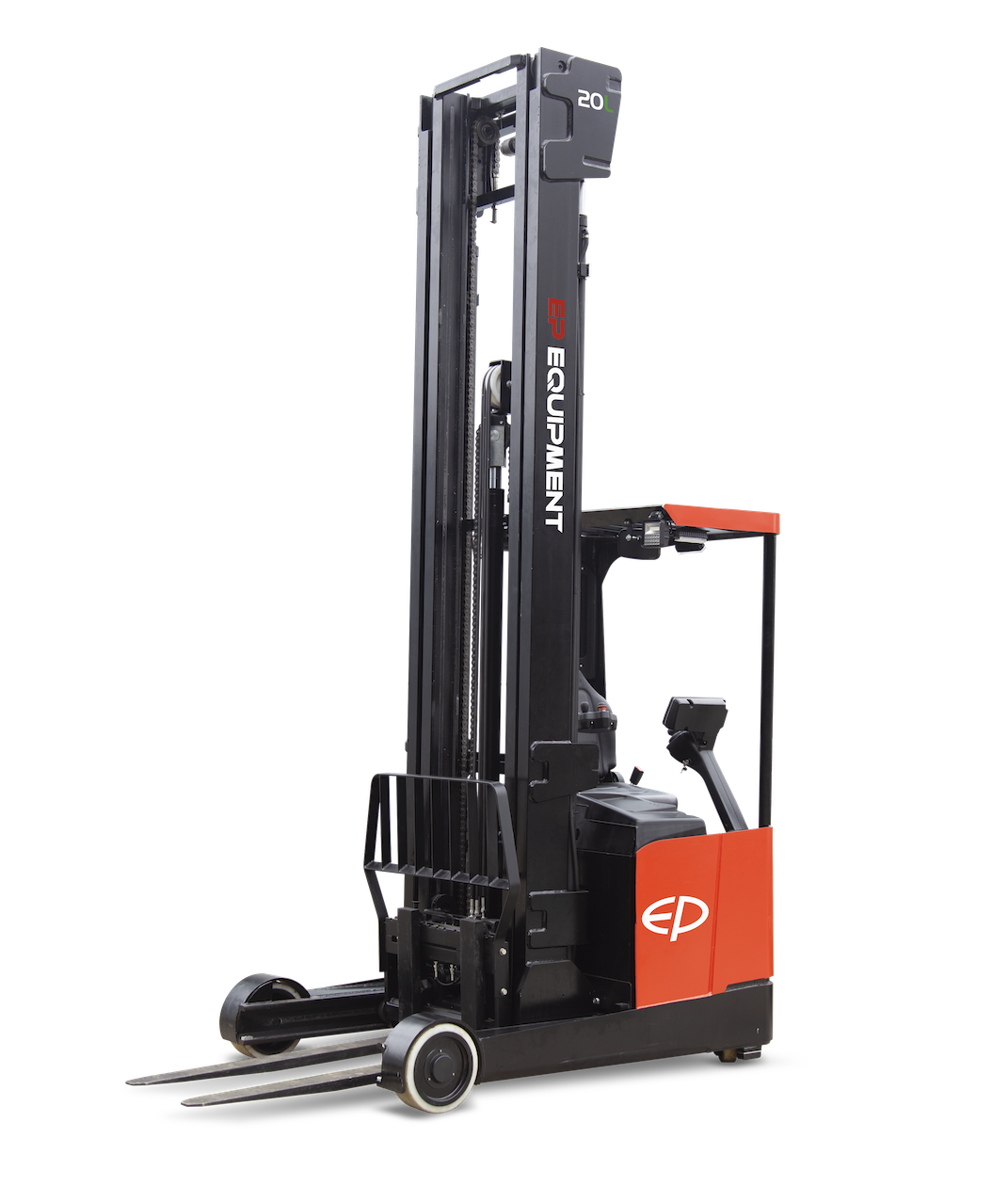
Price: From $42,xxx (Exc. GST)
Key Specifications:
- Battery system: 48 V lithium-ion (high-capacity option available)
- Maximum lift height: up to 12,000 mm
- Turning radius: approximately 1770 mm
- AC drive and lift motors
Pallet Jack Series
F4-201 - Lightweight and flexible option
The F4-201 is built for light to medium-duty pallet transport where simplicity and flexibility matter most.
We often recommend this model to retail storage facilities, production areas, and smaller warehouses that require frequent pallet movement but don’t need ride-on equipment. Its compact footprint makes it easy to maneuver in tight aisles and confined spaces.
One of its standout features is the removable lithium battery system. Operators can swap batteries easily, charge in different locations, and utilize opportunity charging throughout the shift. This flexibility is particularly useful for businesses without dedicated charging rooms.
With durable construction, an ergonomic tiller handle, and optional stabilizing wheels for heavier pallets, the F4-201 offers a practical and budget-friendly solution for everyday warehouse tasks.
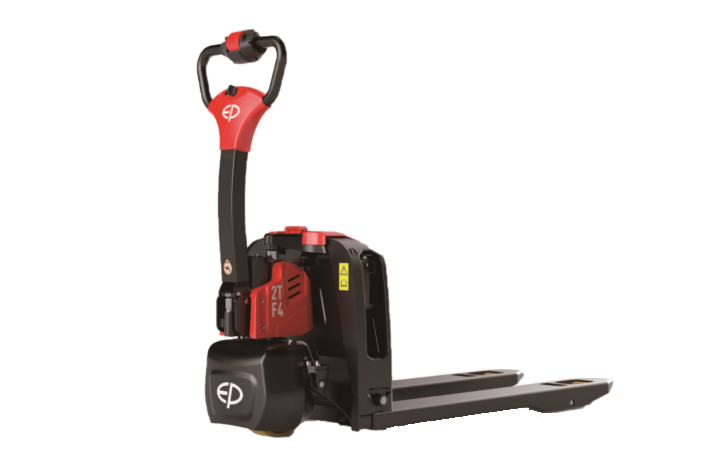
Price: From $3,0xx (Exc. GST)
Key specifications:
- Service weight: 140kg
- Turning radius: 1360mm
- Battery: 48V (Extra battery option available)
- Lifting height: 85-105mm
- Travel speed: 4.5 km/h
- Max load working hours: 2-4h
KPL201 - Heavy-duty efficient solution
For larger facilities where operators travel longer distances, the KPL201 provides a noticeable upgrade in productivity.
Its ride-on platform reduces operator fatigue during extended shifts, while the higher travel speed improves throughput across wide warehouse floors, freight terminals, and logistics hubs. Despite its performance capabilities, it remains simple to operate and does not require a forklift license in many applications.
The lithium-ion battery system delivers extended runtime with fast opportunity charging and zero maintenance. Safety is enhanced through electric power steering and automatic corner speed reduction, ensuring stable handling even when fully loaded.
In environments where pallet movement is frequent and distances are longer, the KPL201 offers both comfort and operational efficiency.
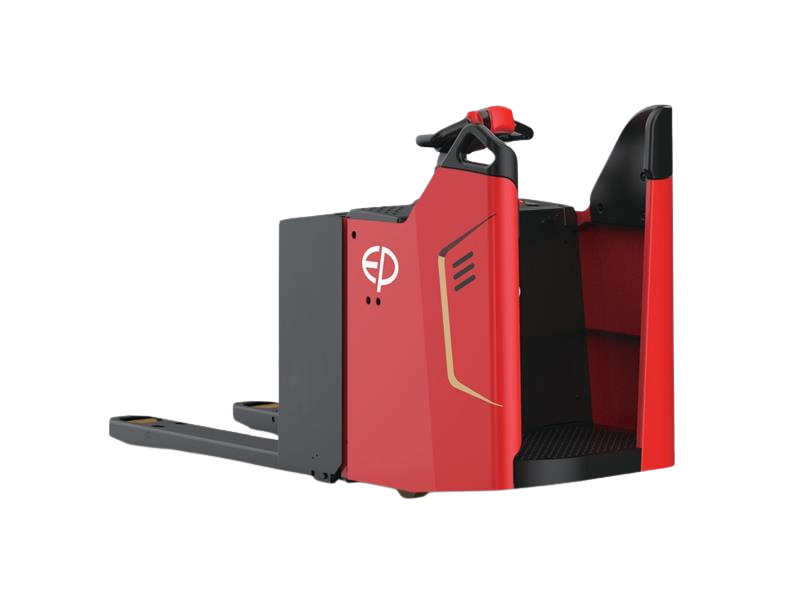
Price: From $12,xxx (Exc. GST)
Key specifications:
- Lifting heights: 85-125mm
- Service Weight: 765kg(Li-ion)/838kg(Lead Acid)
- Turning Radius: 2217mm
- Travel Speed: 10 km/h
- Battery: 24V
- Refrigerated Warehouses Version Available
WPL202 - Versatile all-round model
The WPL202 is a versatile walkie pallet truck designed for everyday warehouse and truck loading tasks.
Its slim chassis makes it easy to operate inside trailers, narrow aisles, and production lines. For businesses handling frequent loading and unloading, this compact size improves maneuverability without compromising stability.
The lithium-ion battery supports opportunity charging and ensures consistent availability throughout the workday. Upgraded synchronized castor wheels improve balance on uneven floors and ramps, enhancing safety and load control.
For operations in refrigerated or cold storage environments, optional cold-storage configurations — including a heated battery system and low-temperature hydraulic oil — allow the WPL202 to operate reliably down to –20°C.
Overall, it’s a dependable, flexible solution for horizontal pallet transport in both standard and temperature-controlled facilities.
![[Hình ảnh]](/clients/epblogs/media/assets/66d29d85-bdd7-4f03-ade5-2f86cc941fa1)
Price: From $6,8xx (Exc. GST)
Key Specifications
- Lifting height: 85-125mm
- Battery system: 24 V / 100 Ah lithium-ion
- 24V/30A Integrated Charger
- Travel speed: 6 km/h
- Turning Radius: 1320mm
- Built-in charger
Frequently Asked Questions (FAQ)
Is the operational cost of a 2-ton electric forklift less than its diesel counterpart?
Electric forklift, especially lithium-ion models, typically reduce operating costs through:
- Lower energy cost per hour
- No fuel consumption
- Reduced maintenance (no engine, oil, or fuel system)
Especially, businesses in Victoria transitioning from diesel to electric forklifts can get a grant of up to $300,000 from the VFDC program.
Can a 2-ton electric forklift be used outdoors?
Yes, but with limitations. Electric forklifts can handle light outdoor tasks and wet conditions, especially models with higher voltage systems (48V–80V). However, for rough terrain or heavy outdoor use, a diesel forklift or heavy-duty electric model may be more suitable.
Should I choose a 3-wheel 2-ton electric forklift or a 4-wheel one?
It depends on your working environment:
- Choose a 3-wheel forklift if your warehouse has narrow aisles and requires high maneuverability
- Choose a 4-wheel forklift if you need better stability for outdoor use or handling uneven surfaces
For most indoor, high-density warehouses, 3-wheel models are the more efficient option.
Contact EPower for free on-site measurement and professional model selection services