Electric forklifts typically need servicing every 500 operating hours, while internal combustion models require maintenance every 250–300 hours. For low-usage operations, at least one service per year is still necessary. At EPower Forklift, the 500-hour mark is the baseline, with more frequent servicing recommended for heavy or multi-shift use.
A standard maintenance schedule includes five levels: daily checks, 250-hour inspections, 500-hour servicing, 1,000-hour deep inspections, and a 2,000-hour annual overhaul. Each stage focuses on key components to keep the forklift safe and efficient.
Service frequency also depends on usage intensity, working conditions, and equipment age. Multi-shift operations, harsh environments like cold storage or dusty sites, and older machines all require more frequent maintenance.rs as a standard baseline, while IC and LPG forklifts require service every 250–300 hours due to their more complex fluid and filter systems. At minimum, every forklift regardless of type should receive a professional service at least once per year, even if the hour threshold hasn't been reached.
To understand why this matters, it helps to recognise that "service frequency" is not a fixed number — it is a threshold that shifts depending on how hard the machine works and in what conditions. Specifically, two measurement approaches are used across the industry: usage-based intervals (tracked in operating hours) and time-based intervals (tracked in days or months). Usage-based scheduling is more precise and is the method recommended by Epower Forklift, as it directly reflects the mechanical stress placed on the equipment.
Is It Better to Service a Forklift Based on Hours or Calendar Time?
Yes, servicing a forklift based on operating hours is more accurate and more cost-effective than fixed calendar scheduling, for three key reasons: it reflects actual mechanical wear, prevents both over-servicing and under-servicing, and aligns with manufacturer warranty requirements.
Calendar-based servicing can lead to unnecessary service costs for lightly used machines, or — more dangerously — missed service milestones for heavily used ones. A forklift clocked at 800 hours in six months needs service twice over regardless of the calendar. Importantly, on electric forklifts, "operating hours" are measured using drive motor and hydraulic running hours, not key-on hours. This distinction matters because a machine may be powered on for administrative or charging purposes without accumulating true operational wear. Fleet managers should confirm with their service provider that hour tracking methodology matchese manufacturer's specification for their electric model.
How Often Should an Electric Forklift Be Serviced Compared to a Gas or Diesel Model?
Electric forklifts win on service frequency — requiring full service every 500 hours — while gas and diesel (IC) models need attention every 250–300 hours, and LPG models fall in a similar range due to combustion-related wear.
This difference comes down to mechanical complexity. IC forklifts run on combustion engines that generate heat, soot, and chemical by products requiring frequent fluid changes, filter replacements, and spark plug checks. Electric forklifts, by contrast, have significantly fewer moving parts — no engine oil, no radiator coolant, no exhaust system — which translates directly into longer intervals between professional services. The table below summarises the core comparison:
| Feature | Electric Forklift | IC / LPG Forklift |
|---|---|---|
| Standard service interval | Every 500 hours | Every 250–300 hours |
| Engine oil changes required | No | Yes |
| Hydraulic filter replacement | Yes (500h) | Yes (250–300h) |
| Emissions-related checks | No | Yes (annual) |
| Battery maintenance | Yes (regular) | No |
| Estimated annual service frequency (single shift) | 1–2x | 2–4x |
This table compares service frequency and maintenance requirements between electric and IC/LPG forklifts across key operational criteria.
For Australian businesses evaluating total cost of ownership, this difference in service frequency is a material financial consideration — fewer service visits means lower labour costs, less scheduled downtime, and more predictable maintenance budgets. It is one of the core reasons the Epower Forklift electric range continues to gain traction with warehouse and logistics operators across the country.
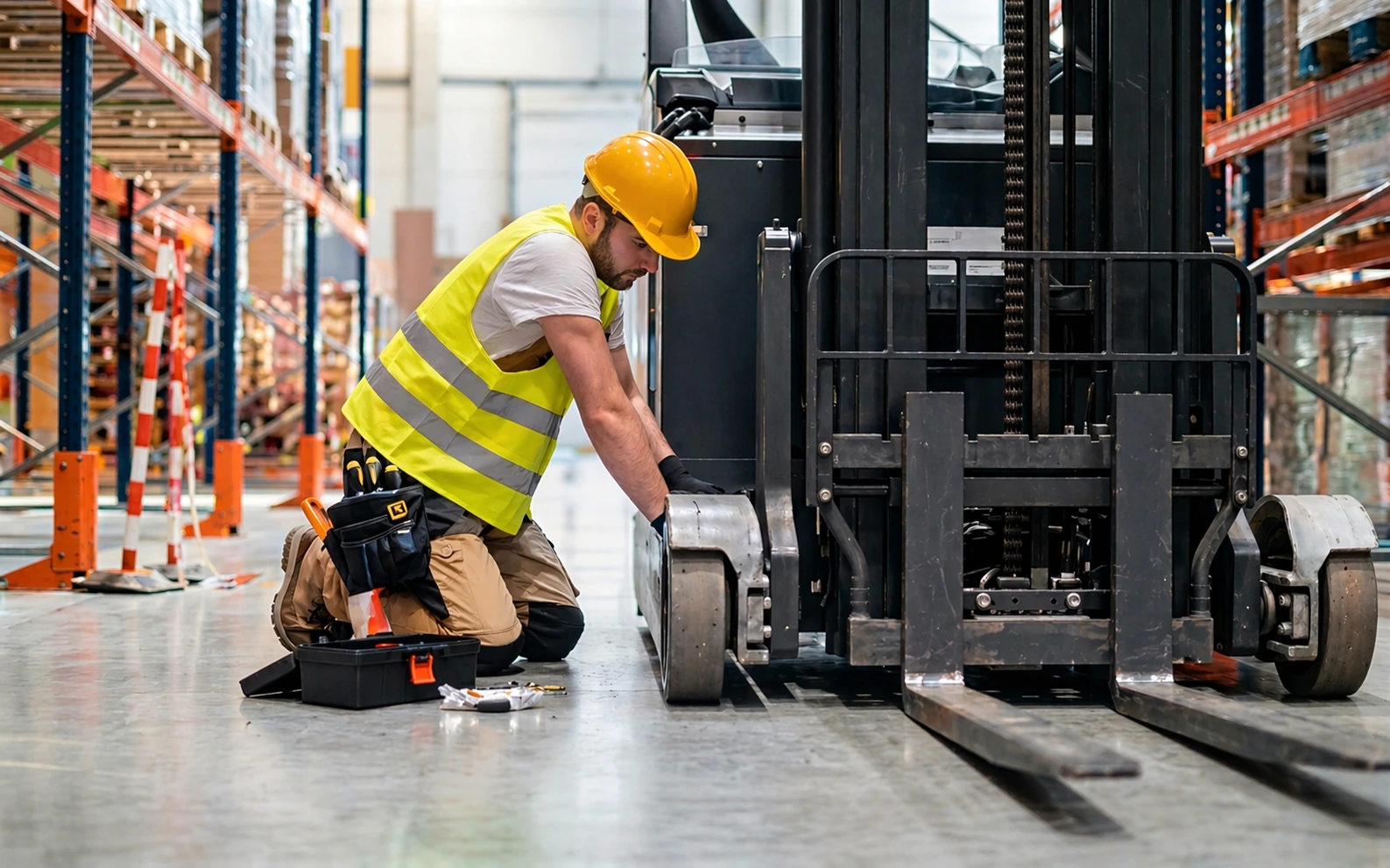
What Does a Complete Electric Forklift Maintenance Schedule by Hours Look Like?
A complete electric forklift maintenance schedule by hours includes five tiers: daily pre-shift inspections, **250-hour minor service, 500-hour full service, 1,000-hour deep inspection, and a 2,000-hour annual overhaul **— with each tier building on the last in scope and complexity.
Understanding what happens at each tier helps fleet managers allocate budgets accurately, plan operational downtime strategically, and avoid the reactive repair costs that come from skipped service windows. Below is a breakdown of each service tier with its corresponding tasks.
What Should Operators Check Before Every Shift on an Electric Forklift?
Daily pre-shift inspections are mandatory under OSHA guidelines and Safe Work Australia's Code of Practice — and on an electric forklift, the checklist includes several battery and electrical-specific items that differ from IC machine checks.
Operators should verify the following before every shift:
- Battery charge level — confirm sufficient charge for the full shift; do not operate on a charge below 20% as this accelerates battery degradation
- Battery water level (lead-acid models) — check electrolyte levels and top up with distilled water if required
- Battery connections and casing — inspect for corrosion, loose terminals, or physical damage
- Hydraulic fluid level — check reservoir and inspect for leaks around hoses and cylinders
- Tyre condition — check for cuts, chunking, or uneven wear on both drive and steer tyres
- Fork condition — inspect for cracks, bends, or wear at the heel; verify fork tip alignment
- Brakes — test service brake and parking brake before moving the machine
- Warning systems — confirm horn, reverse alarm, and lights are operational
- Overhead guard and seatbelt — check for structural integrity and ensure seatbelt latches correctly
- Mast and carriage — check for unusual binding, inspect chain condition and lubrication
Epower Forklift Australia provides all electric forklift customers with a tailored operator checklist guide specific to their model, simplifying daily pre-shift compliance and supporting WHS recordkeeping requirements.
What Maintenance Is Required at the 250-Hour and 500-Hour Service Intervals?
At 250 hours, electric forklifts require a minor service covering fluid top-offs, component inspections, and battery system checks; at 500 hours, a full service is required — this is the primary scheduled maintenance milestone for electric forklifts and encompasses hydraulic, electrical, and mechanical systems.
250-Hour Minor Service tasks include:
- Check and top off hydraulic fluid
- Inspect and clean battery terminals and connections
- Check brake pad thickness and brake fluid level
- Inspect tyres for wear and correct inflation
- Lubricate mast channels, carriage rollers, and lift chains
- Check steering responsiveness and hydraulic lift function
- Inspect overhead guard and operator restraint systems
500-Hour Full Service tasks include (in addition to all 250-hour checks):
- Replace hydraulic oil filter
- Inspect and service the complete hydraulic system — cylinders, hoses, control valves
- Full electrical system inspection — wiring integrity, fuse condition, motor brush wear
- Mast assembly inspection — roller clearances, chain tension, tilt cylinder function
- Drive motor and brake system inspection
- Battery performance load test (capacity vs rated output)
- Torque check on all critical fasteners
- Full safety systems check — SAS (stability assist systems) if fitted, speed limiters, proximity sensors
According to guidelines from forklift manufacturers including Toyota Material Handling and Crown Equipment, following these service intervals precisely is required to maintain warranty coverage and ensure continued compliance with applicable safety standards.
What Does the 1,000-Hour and 2,000-Hour Electric Forklift Service Include?
At 1,000 hours, a comprehensive deep inspection addresses hydraulic system integrity, mast assembly condition, and worn component replacement; at 2,000 hours (or annually), a full overhaul including diagnostic testing, safety system certification, and complete fluid replacement is required.
1,000-Hour Deep Inspection includes:
- Full hydraulic system teardown inspection — pump condition, valve wear, cylinder seals
- Mast and carriage complete inspection — replace worn rollers, worn chain links, or bent components
- Electrical system deep inspection — motor insulation resistance test, controller diagnostics
- Replace transmission fluid (if applicable to model)
- Inspect and test all safety interlocks and load management systems
- Review and action any recurring fault codes from onboard diagnostics
2,000-Hour / Annual Full Overhaul includes:
- Replace all fluids and filters (hydraulic, brake, gear)
- Full battery capacity and cell balance test; replace battery if below 80% rated capacity
- Complete diagnostic scan and fault code clearance
- Comprehensive safety system certification — lights, alarms, seatbelts, guards
- Operator compartment inspection — pedals, controls, display function
- Issue service certification documentation for WHS compliance records
Epower Forklift recommends retaining service records for every milestone — particularly 1,000-hour and 2,000-hour services — as these records form part of your compliance documentation under Safe Work Australia's forklift maintenance requirements and may be required in the event of a workplace incident investigation.
What Factors Affect How Often an Electric Forklift Should Be Serviced?
Four main factors affect how often an electric forklift needs servicing: shift pattern and daily usage intensity, operating environment conditions, equipment age, and application type — with each factor capable of shortening the standard 500-hour interval significantly.
Understanding these variables allows fleet managers to build a realistic service schedule rather than defaulting to a one-size-fits-all approach. Specifically, businesses running high-intensity operations in challenging environments may need to service their electric forklifts up to twice as often as the baseline recommendation.
Does Shift Pattern and Daily Usage Hours Change the Service Schedule?
Yes, shift pattern directly changes how quickly an electric forklift reaches its 500-hour service milestone — a forklift running two shifts per day will reach that threshold approximately twice as fast as a single-shift machine, requiring double the annual service visits. For practical planning purposes, consider the following scenarios for a typical electric forklift accumulating 8 hours of run time per shift:
| Shift Pattern | Approx. Hours/Year | Service Visits Required (500h interval) |
|---|---|---|
| Single shift (1 × 8h/day) | ~2,000 hours | 4 services/year |
| Double shift (2 × 8h/day) | ~4,000 hours | 8 services/year |
| Triple shift / 24h operation | ~6,000 hours | 12 services/year |
This table shows estimated annual service frequency based on shift pattern, assuming a 500-hour service interval for electric forklifts operating 250 days per year.
Warehouse and 3PL logistics operations — which make up a significant portion of Epower Forklift 's customer base — frequently run double-shift operations, particularly during peak periods. For these businesses, building a service schedule around operational hours rather than calendar months is not optional; it is the only accurate way to stay ahead of maintenance requirements.
Does the Operating Environment Affect Electric Forklift Service Frequency?
Yes, operating environment significantly increases electric forklift service frequency — particularly in dusty, damp, or temperature-controlled environments — because these conditions accelerate wear on electrical components, battery systems, and hydraulic seals that are central to electric forklift performance.
Electric forklifts are more sensitive to environmental conditions than IC machines in specific ways. Unlike combustion engines that generate their own heat, electric drive motors and battery packs are vulnerable to moisture ingress, temperature extremes, and contamination from fine particles. In dusty manufacturing environments, air filters and cooling vents require more frequent clearing. In cold storage facilities (operating at 0°C to -25°C), battery performance can drop by 20–40% compared to ambient temperature operation, requiring more frequent charge cycles and accelerating battery wear. Operators in these environments should discuss a modified service schedule with their provider — typically moving to 350–400 hour intervals rather than the standard 500-hour baseline.
Do Older Electric Forklifts Need More Frequent Servicing Than New Models?
Yes, electric forklifts older than five years generally require more frequent servicing than newer models, primarily due to battery degradation, accumulated wiring wear, and motor component fatigue that increase the likelihood of unplanned failures between standard service windows.
As an electric forklift ages, its battery gradually loses capacity — typically retaining around 80% of original capacity at the five-year mark under normal use. Below 80% capacity, performance becomes unpredictable and the risk of mid-shift battery failure increases. Additionally, wiring insulation becomes brittle over time, motor brushes wear down, and hydraulic seals become prone to leaking. For machines beyond five years of operation, Epower Forklift Australia recommends reducing service intervals to every 350–400 hours and scheduling a comprehensive battery health assessment annually. In some cases, the cost of increased servicing on an ageing fleet makes a strong financial case for upgrading to newer electric models with modern battery management systems and longer service intervals.
What Happens If You Don't Service Your Electric Forklift on Schedule?
Skipping scheduled electric forklift maintenance leads to three predictable outcomes: unplanned mechanical breakdown, increased risk of workplace safety incidents, and significantly higher repair costs — all of which are avoidable with a consistent service program. The consequences are not theoretical. In Australia, forklift-related incidents account for a disproportionate share of serious workplace injuries each year, and a significant proportion of these incidents involve equipment that has not been properly maintained. Beyond the human cost, the financial exposure for businesses — through repair bills, worker's compensation claims, WHS fines, and operational downtime — far exceeds the cost of routine servicing.
Can Skipping Electric Forklift Maintenance Cause Safety Incidents?
Yes, skipping electric forklift maintenance can directly cause safety incidents — brake failure, mast malfunction, and electrical faults are among the most common failure modes in under-serviced machines, all of which can result in serious injury to operators and bystanders.
Safe Work Australia's data on powered industrial truck incidents consistently identifies mechanical failure as a contributing factor in forklift accidents. Specific risks in under-serviced electric forklifts include:
- Brake failure — worn brake pads or degraded brake fluid reduce stopping distance, especially on ramps
- Mast chain failure — under-lubricated or over-worn lift chains can snap under load, causing dropped loads
- Electrical fault — degraded wiring or loose battery connections can cause sudden loss of power or, in rare cases, electrical fires
- Tyre failure — chunked or worn solid tyres reduce stability, increasing tip-over risk
- Battery thermal event — severely degraded batteries operating outside safe parameters are a recognised fire risk
Under the WHS Act 2011 and associated Regulations, operators have a duty to ensure plant and equipment is maintained in a condition that is safe and without risks to health. Failure to maintain a service log, or allowing equipment to operate beyond service thresholds, can result in improvement notices, prohibition notices, and substantial financial penalties from SafeWork inspectors.
How Does Regular Servicing Reduce the Total Cost of Owning an Electric Forklift?
Regular servicing reduces total cost of electric forklift ownership by preventing expensive emergency repairs, extending equipment lifespan, and maximising uptime — with preventive maintenance costs consistently coming in significantly lower than reactive repair costs over a machine's operational life.
The financial logic is straightforward: a 500-hour service on an electric forklift typically costs between AUD $300–$600 for a routine visit. An unplanned hydraulic system failure, by contrast, can cost AUD $2,000–$8,000 depending on the extent of damage — not counting the cost of hiring a replacement machine during downtime. A forklift that is consistently serviced to schedule will also last significantly longer; well-maintained electric forklifts regularly reach 10,000–15,000 hours of operational life, compared to 6,000–8,000 hours for machines with inconsistent maintenance histories.
One of the reasons businesses choose Epower Forklift is the lower total cost of ownership inherent in electric forklift technology — and a consistent service schedule is what protects that advantage over the long term.
What Else Should Australian Businesses Know About Electric Forklift Servicing?
Australian businesses should also understand three additional dimensions of electric forklift servicing that go beyond the hour-based schedule: the specific WHS compliance obligations that apply under Australian law, the realistic cost of professional servicing in the local market, and the value of structured maintenance contracts for protecting fleet uptime and budget predictability.
These factors are particularly relevant for operations managers and safety officers who need to align their maintenance program with both regulatory requirements and financial planning — not just mechanical best practice.
What Are the Workplace Health and Safety (WHS) Requirements for Forklift Servicing in Australia?
Under the WHS Act 2011 and Safe Work Australia's Managing Risks of Plant in the Workplace Code of Practice, businesses operating forklifts are legally required to implement a documented maintenance schedule, conduct pre-operational inspections before each shift, ensure all repairs are performed by competent (authorised) persons, and retain maintenance records.
Specifically for forklifts, Safe Work Australia requires:
- Pre-shift inspection — operators must conduct a visual and operational check before each shift and record the results
- Scheduled maintenance — plant must be maintained in accordance with manufacturer specifications; deviations must be documented and justified
- Competent persons only — service and repair work must be carried out by individuals with the appropriate qualifications and experience; untrained operators must not attempt mechanical repairs
- Maintenance logbook — a written or digital record of all inspections, services, and repairs must be maintained and made available to inspectors on request
- Defect reporting — any forklift identified as defective during pre-shift inspection must be taken out of service immediately and tagged out until repaired by a competent person
Non-compliance with these requirements can result in enforcement action by state and territory WHS regulators (WorkSafe Victoria, SafeWork NSW, WorkSafe Queensland, etc.), including improvement notices, prohibition orders, and fines of up to AUD $50,000 for body corporates under some jurisdictions.
How Much Does an Electric Forklift Service Cost in Australia?
A routine electric forklift service in Australia typically costs between AUD $300 and $600 for a standard 500-hour visit, rising to AUD $800–$2,000 for a comprehensive 1,000-hour or annual overhaul — with significant variation based on machine model, service provider, and geographic location.
For budget planning purposes, the following cost ranges apply across the Australian market:
| Service Type | Estimated Cost (AUD) | Frequency (single shift) |
|---|---|---|
| Daily inspection (in-house) | Minimal (labour only) | Every shift |
| 250-hour minor service | $150 – $350 | Every 3–4 months |
| 500-hour full service | $300 – $600 | Every 6–8 months |
| 1,000-hour deep inspection | $600 – $1,200 | Annually (approx.) |
| 2,000-hour annual overhaul | $1,000 – $2,500 | Every 12–18 months |
This table provides indicative electric forklift service cost ranges in the Australian market by service type. Actual costs vary based on machine model, location, and service provider.
These figures are indicative and reflect the Australian market as of 2025. Costs in regional areas may be higher due to technician travel charges. Businesses operating large fleets can often negotiate volume pricing with service providers, or access preferential rates through a structured maintenance contract.
Is a Forklift Service and Maintenance Contract Worth It for Your Australian Warehouse?
Yes, a forklift maintenance contract is worth it for most Australian warehouse operations — particularly those running multiple shifts or multi-machine fleets — because it converts unpredictable reactive repair costs into a fixed, budgetable monthly expense while guaranteeing priority service response when issues arise.
There are two fundamentally different approaches to forklift maintenance, and the financial and operational outcomes are markedly different:
Reactive maintenance (break-fix model): Service is only called when something fails. Cost per incident is high (AUD $1,500–$8,000+), downtime is unplanned, and there is no compliance documentation trail. This approach may appear cost-effective in the short term but consistently results in higher total expenditure over a forklift's lifetime.
Proactive maintenance contract (planned maintenance model): Scheduled services are conducted at regular hour-based intervals by certified technicians. Costs are predictable, compliance documentation is automatically generated, and minor issues are identified before they become major failures. Priority callout provisions mean breakdowns — when they do occur — are resolved faster.
Epower Forklift offers tailored service programs designed around your fleet size and operational hours, so your electric forklifts stay running when your business needs them most. Whether you operate two machines in a single warehouse or a mixed fleet across multiple sites, a structured maintenance program is the most reliable way to protect your investment and maintain WHS compliance.
Do Electric Forklifts Used in Cold Storage or Food & Beverage Facilities Need a Different Service Schedule?
Yes, electric forklifts operating in cold storage or food and beverage environments require a modified service schedule — typically reducing the standard 500-hour interval to 350–400 hours — because low temperatures, condensation, and hygiene-driven washdown processes accelerate component wear in ways that standard schedules do not account for.
Specifically, cold chain environments present three distinct challenges for electric forklifts:
Battery performance degradation: Lead-acid and lithium-ion batteries both lose effective capacity in low temperatures. At 0°C, a standard lead-acid battery may deliver only 70–80% of its rated capacity. At -20°C, that figure can drop to 50–60%. This means charge cycles are shorter, batteries work harder, and degradation accelerates — all of which bring forward the need for battery servicing and replacement.
Moisture and condensation damage: Moving between cold storage environments and ambient-temperature loading docks creates rapid temperature cycling that causes condensation to form on electrical components, connectors, and circuit boards. Without more frequent inspection and protective maintenance (contact cleaner, dielectric grease on terminals), this moisture accelerates corrosion and increases the risk of electrical faults.
High-pressure washdown exposure: Food and beverage facilities require regular equipment washdowns for hygiene compliance. High-pressure water ingress into motor housings, electrical enclosures, and hydraulic systems is a leading cause of premature component failure in these environments. Forklifts in these applications should use IP54 or higher-rated electrical enclosures where possible, and seals should be inspected at every 250-hour service rather than only at full 500-hour visits.
If your operation runs in a temperature-controlled or hygiene-critical environment, speak with an Epower Forklift specialist about a customised maintenance schedule for your electric fleet — one that accounts for the specific stresses your machines face every shift.