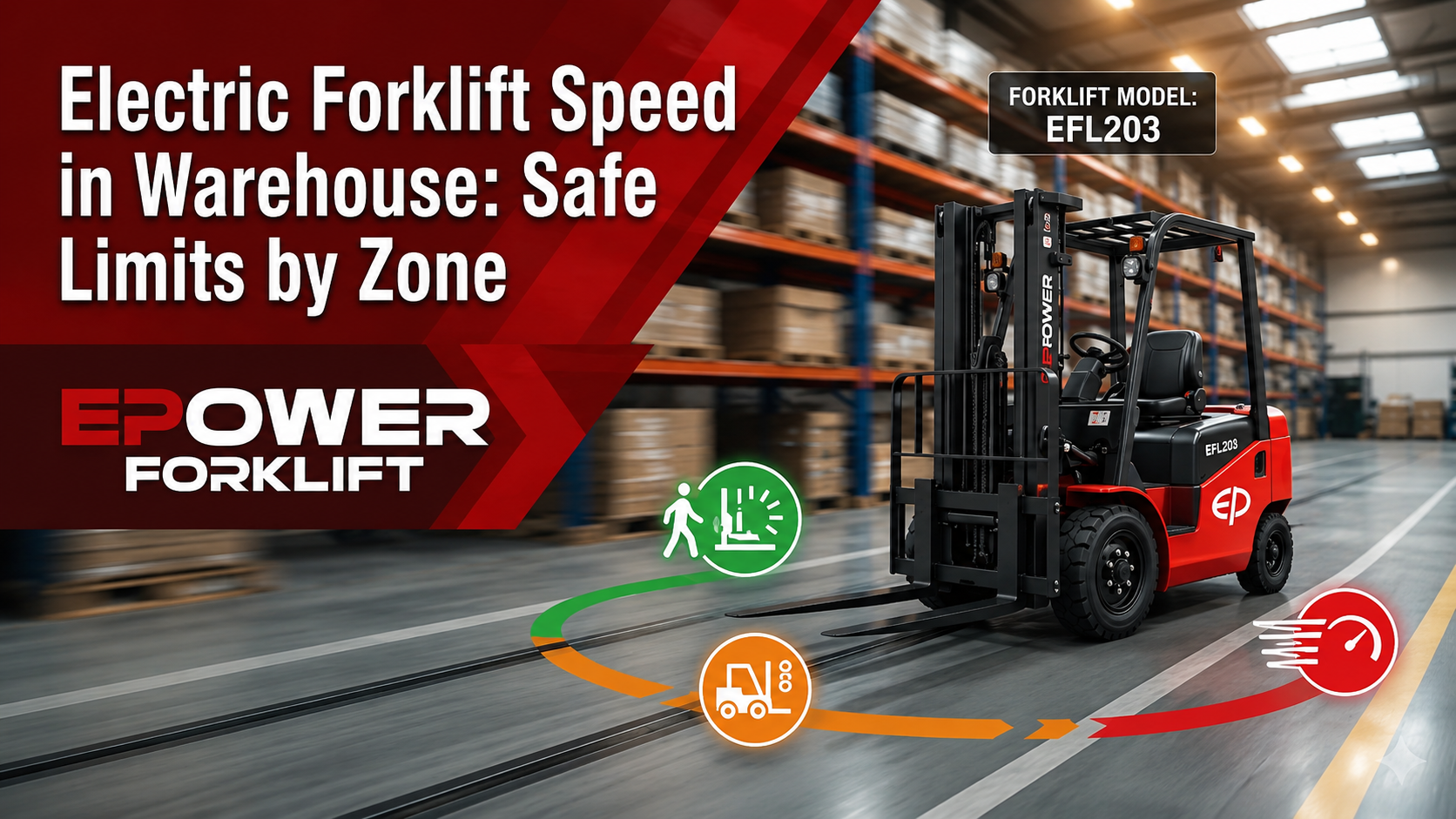
Forklift speed is one of the most important controls in warehouse traffic management. A loaded electric forklift travelling through a general aisle, a loading dock, a pedestrian crossing, or a blind corner does not create the same level of risk in every zone. Sightlines, pedestrian exposure, floor condition, load weight, braking performance, and operator reaction time all affect what a safe speed looks like.
Electric forklifts also introduce a specific operational factor that warehouse managers should not overlook: they are much quieter than LPG or diesel forklifts, especially at low speeds. That reduced engine noise is an advantage for indoor comfort and emissions control, but it can also reduce the passive warning pedestrians receive when a forklift approaches from behind or around a corner.
There is no single forklift speed limit that applies to every Australian warehouse. Instead, each site should set and document its own speed limits based on layout, traffic movement, pedestrian interaction, surface condition, and task risk. The speed limits below should be considered practical starting points for site-specific risk assessments, rather than universal legal limits.
| Warehouse Zone | Recommended Starting Limit | Main Risk Factor |
|---|---|---|
| Clear general warehouse aisle | Up to 10 km/h | Braking distance, oncoming traffic, aisle intersections |
| Shared pedestrian and forklift zone | Around 6 km/h | Pedestrian reaction time and mixed traffic |
| Blind corner or marked pedestrian crossing | Around 4 km/h or full stop where required | Limited sightline and reduced reaction time |
| Loading dock | Around 6 km/h | Dock transitions, trailer movement, pedestrian activity |
| Ramp or incline | Around 5 km/h | Stability, gradient, load shift, traction |
| Narrow aisle | Around 6 km/h | Racking proximity, limited manoeuvring space |
Actual safe speeds may need to be lower depending on load weight, tyre condition, brake condition, floor surface, gradient, visibility, pedestrian exposure, and site layout. A documented speed policy should always be supported by signage, operator training, traffic separation, supervision, and where appropriate, speed-limiting technology.
Why Electric Forklift Speed Matters in Warehouse Operations
Electric forklift speed matters because stopping distance, stability risk, and pedestrian reaction time all change rapidly as speed increases.
A forklift carrying a load is not comparable to a small vehicle moving through an open road environment. It often operates in confined aisles, close to racking, pedestrians, stock, dock edges, trailers, doors, and blind intersections. Even a modest increase in speed can significantly reduce the operator’s ability to stop in time or maintain stability during a turn.
As a practical guide, a loaded forklift travelling around 10 km/h may require several metres to come to a complete stop, depending on floor condition, tyre condition, brake performance, load weight, and operator reaction time. That distance may be acceptable in a clear aisle with good sightlines, but it can be unsafe near a blind corner, pedestrian crossing, loading dock, or ramp.
Electric forklifts require particular attention in speed management because they accelerate smoothly and quietly — operators may not perceive speed building in the same way as with combustion models, and pedestrians receive less passive warning as the forklift approaches. That quieter operation is a genuine advantage for indoor air quality and comfort, but in shared zones it means speed limits, horn use, blue lights, floor markings, and physical traffic separation become more important, not less.
Recommended Electric Forklift Speed Limits by Warehouse Zone
The safest approach is to set forklift speed limits by zone rather than applying one speed across the entire facility. A clear aisle, a dock face, a ramp, and a pedestrian crossing each have different risk profiles.
General Warehouse Aisles: Up to 10 km/h
In clear general warehouse aisles with good sightlines and no pedestrian traffic, a starting limit of up to 10 km/h may be appropriate for many electric forklift operations. This assumes a dry, level floor, controlled traffic flow, good visibility, trained operators, and properly maintained brakes and tyres.
This limit should not apply automatically at aisle ends, rack intersections, doorways, or areas where pedestrians may cross. If the operator cannot see far enough ahead to stop safely, the forklift should slow before reaching the hazard.
A speed limit only works when it matches sightline distance. Mirrors, floor markings, pedestrian exclusion zones, and speed signs should be used together. None of these controls should be relied on alone.
Shared Pedestrian and Forklift Zones: ~6 km/h
In shared pedestrian and forklift zones, a lower starting limit of around 6 km/h is more appropriate. These are areas where people on foot may work near forklift routes, such as packing areas, dispatch zones, staging areas, and shared access lanes.
The purpose of a lower limit is to give both the operator and pedestrians more time to react. Because electric forklifts are relatively quiet at low speed, pedestrians may not notice the forklift until it is close. In these zones, speed control should be supported by marked walkways, exclusion areas, warning lights, horn procedures, and pedestrian awareness training.
Where pedestrian exposure is high, physical separation should be prioritised over speed control alone. Barriers, dedicated walkways, one-way traffic routes, and controlled crossing points are usually stronger controls than relying only on signs.
Blind Corners and Pedestrian Crossings: ~4 km/h
At blind corners, rack ends, doorways, and marked pedestrian crossings, a starting limit of around 4 km/h or a full stop may be required, depending on the site. These areas are high risk because the operator may have little or no sight line before the forklift reaches the conflict point.
At these points, the issue is not only braking distance. It is the absence of reaction time. If a pedestrian steps into view at the same moment the forklift reaches the crossing, even a trained operator may not have enough time to respond.
Sites should consider stop lines, convex mirrors, pedestrian gates, audible warnings, blue lights, floor markings, and mandatory horn use before entering blind intersections. In high-risk areas, a full stop rule may be more appropriate than a low-speed rule.
Loading Docks: ~6 km/h
On loading docks, a starting limit of around 6 km/h is generally more appropriate than general aisle speed. Dock areas combine several hazards: dock levellers, trailers, reversing trucks, pedestrians, surface transitions, limited space, and changing traffic patterns.
Forklifts can become unstable when crossing dock plates or entering trailers at speed, especially if the surface transition is uneven or the trailer moves. Dock areas should have clear traffic rules, wheel restraint or chocking procedures where applicable, edge protection, communication with drivers, and restricted pedestrian access.
Speed limits on docks should be supported by dock-specific induction and supervision. A loading dock is not simply another warehouse aisle.
Ramps and Inclines: ~5 km/h
On ramps and inclines, a starting limit of around 5 km/h is often more appropriate because the gradient changes the forklift’s stability profile. When a forklift travels uphill or downhill with a load, the centre of gravity shifts, and the effect of braking, steering, and load movement becomes more pronounced.
Actual safe speed on a ramp depends on gradient, surface traction, load weight, load height, tyre condition, and whether the forklift is travelling loaded or unloaded. Operators should follow site procedures for direction of travel on inclines and avoid sudden braking, sharp turns, or turning across the slope.
Ramp rules should be clearly documented because ramp incidents can escalate quickly. Once stability is lost on an incline, recovery is difficult.
Narrow Aisles: ~6 km/h
In narrow aisles, a starting limit of around 6 km/h may be appropriate, but the final limit should depend on aisle width, racking clearance, pallet overhang, traffic direction, operator visibility, and the type of forklift used.
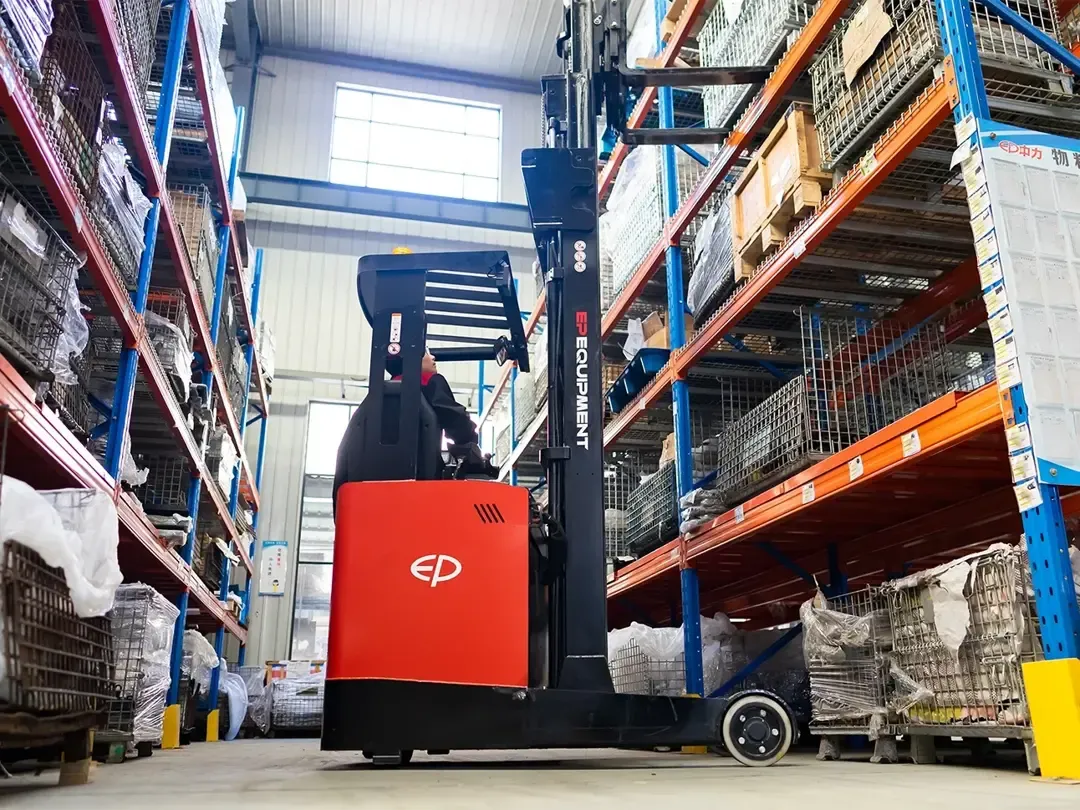
Narrow aisles create a different risk from pedestrian zones. The main issue is limited manoeuvring space and the potential for racking, stock, or pallet damage. Where reach trucks or other narrow-aisle equipment are used, the speed policy should align with the manufacturer’s operating guidance and the warehouse traffic management plan.
What Happens When Forklift Speed Is Too High ?
Excessive forklift speed increases risk in three main ways: it increases stopping distance, reduces stability during turning or ramp travel, and reduces the time available for operators and pedestrians to react.
Stopping distance does not increase in a simple linear way. In general physics terms, kinetic energy increases with the square of speed, which means a small increase in speed can create a much larger increase in the energy that must be controlled during braking. In practice, the final stopping distance will also depend on floor condition, tyres, brakes, gradient, load weight, and operator reaction time.
Stability is also affected by speed. When a loaded forklift turns, lateral force pushes the load outward. If the combined effect of load, speed, turning radius, and surface condition moves the centre of gravity outside the stability triangle, a tip-over can occur quickly. Reducing cornering speed is one of the simplest ways to reduce this risk.
Pedestrian reaction time is the third issue. In shared zones, the person most at risk may not be the operator; it may be a picker, packer, truck driver, visitor, or contractor walking near the forklift route. Because electric forklifts are relatively quiet, pedestrians may not hear the forklift early enough to move clear. Lower speed limits increase the available reaction window and reduce impact severity if contact occurs.
EPower technical note: Speed limits should never be treated as a stand-alone control. They work best when combined with route design, traffic separation, mirrors, lighting, signage, operator training, and enforcement.
What Makes Electric Forklifts Different from Combustion Forklifts?
Electric forklifts differ from LPG and diesel models in several ways that affect speed management.
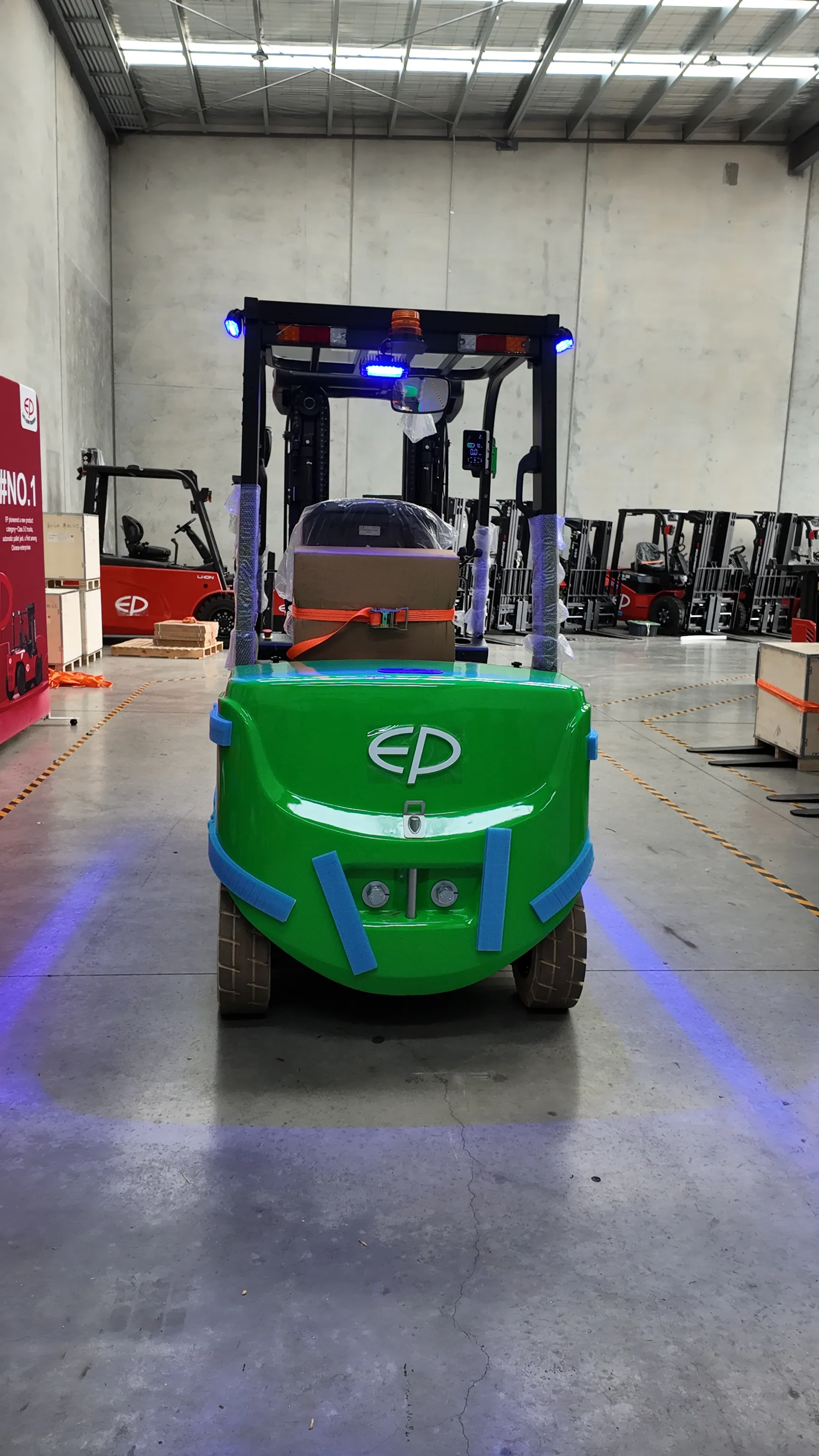
The first difference is noise. Electric forklifts are typically quieter, especially at low speeds. This can improve the working environment, but it also means pedestrians may receive less warning from engine noise. Sites using electric forklifts should consider whether additional warning systems, such as blue lights, pedestrian alarms, or horn procedures, are required in shared zones.
The second difference is acceleration. Electric motors can deliver torque quickly and smoothly, which may make acceleration feel less dramatic to the operator even when speed builds quickly. Operator training should therefore focus on controlled acceleration, especially near pedestrians, docks, intersections, and racks.
The third difference is regenerative braking. Many electric forklifts use regenerative braking, where the motor helps slow the forklift when the accelerator is released. This can improve deceleration in normal conditions, but it does not eliminate stopping distance. Operators should never assume an electric forklift stops instantly. Mass, momentum, load position, floor surface, tyres, brakes, and reaction time still apply.
Is There a Legal Speed Limit for Forklifts in Australian Warehouses?
There is no single national speed limit that applies to all forklifts in all Australian warehouses. However, the absence of one fixed number does not mean forklift speed is unregulated.
Under Australian WHS duties, the PCBU must manage risks so far as is reasonably practicable. In practical terms, this means the site should identify forklift traffic hazards, assess pedestrian interaction, set appropriate controls, train operators, supervise compliance, and keep records that show the system is being implemented.
If an incident occurs and the site has no documented speed policy, no traffic management plan, no signage, no training record, and no evidence of enforcement, it may be difficult for the PCBU to demonstrate that reasonably practicable measures were taken.
Penalties for WHS breaches vary by jurisdiction and can change over time. For this reason, site managers should refer to the current WHS legislation and regulator guidance that applies in their state or territory, and seek qualified legal or safety advice where required.
The absence of a single legal speed limit does not remove the employer’s duty to manage forklift speed. It places responsibility on the site to set, communicate, and enforce speed limits that match the actual risks of the facility.
How to Set Forklift Speed Limits Across a Warehouse
Setting forklift speed limits should begin with a traffic management review. The site should be mapped into zones based on how forklifts, pedestrians, trucks, and goods move through the facility.
Start by reviewing the floor plan and identifying general aisles, narrow aisles, loading docks, ramps, pedestrian crossings, shared work areas, blind intersections, doorways, and outdoor routes. Each zone should then be assessed for sightline distance, pedestrian exposure, floor condition, traffic volume, load type, and surface transitions.
Once the zones are identified, assign a speed limit to each one. The recommended limits in this article can be used as starting points, but the final speed policy should reflect the actual site. A facility with frequent pedestrian movement, poor visibility, wet surfaces, or high-value stock may require lower limits than a facility with separated traffic and clear sightlines.
The speed zone plan should be documented as part of the site’s traffic management or WHS system. It should also be reviewed when the layout changes, racking is moved, pedestrian routes are added, dock operations change, or new forklift types are introduced.
How to Enforce Forklift Speed Limits
A speed policy is only effective if operators can see it, understand it, and are held to it. Enforcement should combine signage, training, supervision, and, where appropriate, technology.
Signage should be placed before the zone transition rather than inside the zone. Operators need time to slow down before entering a shared pedestrian area, dock, ramp, or blind intersection. Signs should be visible from the operator’s seated position, and floor markings should reinforce the message where wall signs may be blocked by racking or stock.
Training should be site-specific. General forklift training is not enough if operators do not understand the speed zones in the actual warehouse where they work. Every operator should be shown the speed zone map, trained on the limit for each area, and made aware of horn rules, pedestrian crossings, ramp procedures, dock rules, and incident reporting expectations.
Supervision and record-keeping are also important. If speed rules are not monitored, operators may gradually return to old habits. Near misses, complaints, product damage, and racking impacts should be reviewed because they may indicate that the speed policy is not working or is not being followed.
Technology can add another layer of control. Many electric forklifts can be fitted with speed-limiting devices that cap maximum speed. Some systems can also reduce speed automatically in designated zones using RFID or similar technology. This is particularly useful where pedestrian exposure is high or where previous self-enforcement has been unreliable.
For sites where operator self-enforcement is difficult, speed-limiting technology can be a strong engineering control. Before purchase, buyers should confirm whether the selected electric forklift model supports speed limiter compatibility or zone-based speed control.
Can You Install a Speed Limiter on an Electric Forklift?
Yes, speed limiters are available for many electric forklifts and can be used as part of a broader WHS risk control strategy. Once configured, a speed limiter can prevent the forklift from exceeding a set maximum speed, regardless of accelerator input.
More advanced systems can apply different speed limits in different areas. For example, a forklift may be allowed to travel faster in a clear general aisle but automatically reduce speed when entering a pedestrian zone, loading dock, or high-risk intersection.
Speed limiters should not replace traffic management. They should support it. A site still needs clear pedestrian routes, safe intersections, operator training, signage, maintenance, and supervision. However, for facilities with high forklift traffic, mixed pedestrian zones, or repeated speeding issues, speed-limiting technology can significantly improve consistency.
For EP Equipment models purchased through EPower Forklift, customers should speak with the EPower team about speed limiter compatibility, aftermarket options, and whether zone-based control is appropriate for the site.
Conclusion: Safe Forklift Speed Is a Site-Specific Control
Safe electric forklift speed is not one number for every warehouse. It depends on the zone, the load, the surface, the sightline, the pedestrian exposure, and the way the forklift is used.
As a practical starting point, many sites may use limits such as up to 10 km/h in clear general aisles, around 6 km/h in shared zones and loading docks, around 4 km/h or full stop at blind corners and crossings, and around 5 km/h on ramps. These limits should be adjusted through a site-specific risk assessment and supported by signage, training, supervision, and technology where required.
Electric forklifts offer major advantages for indoor operations, including lower emissions, quieter operation, and smoother control. Those same characteristics require careful speed management in pedestrian areas because reduced engine noise can reduce passive warning.
Epower Forklift can help warehouse operators assess electric forklift suitability, speed limiter compatibility, site traffic risks, and equipment options for safer, more efficient material handling.
Contact Epower Forklift to discuss electric forklift options, speed control requirements, or site-specific equipment recommendations.