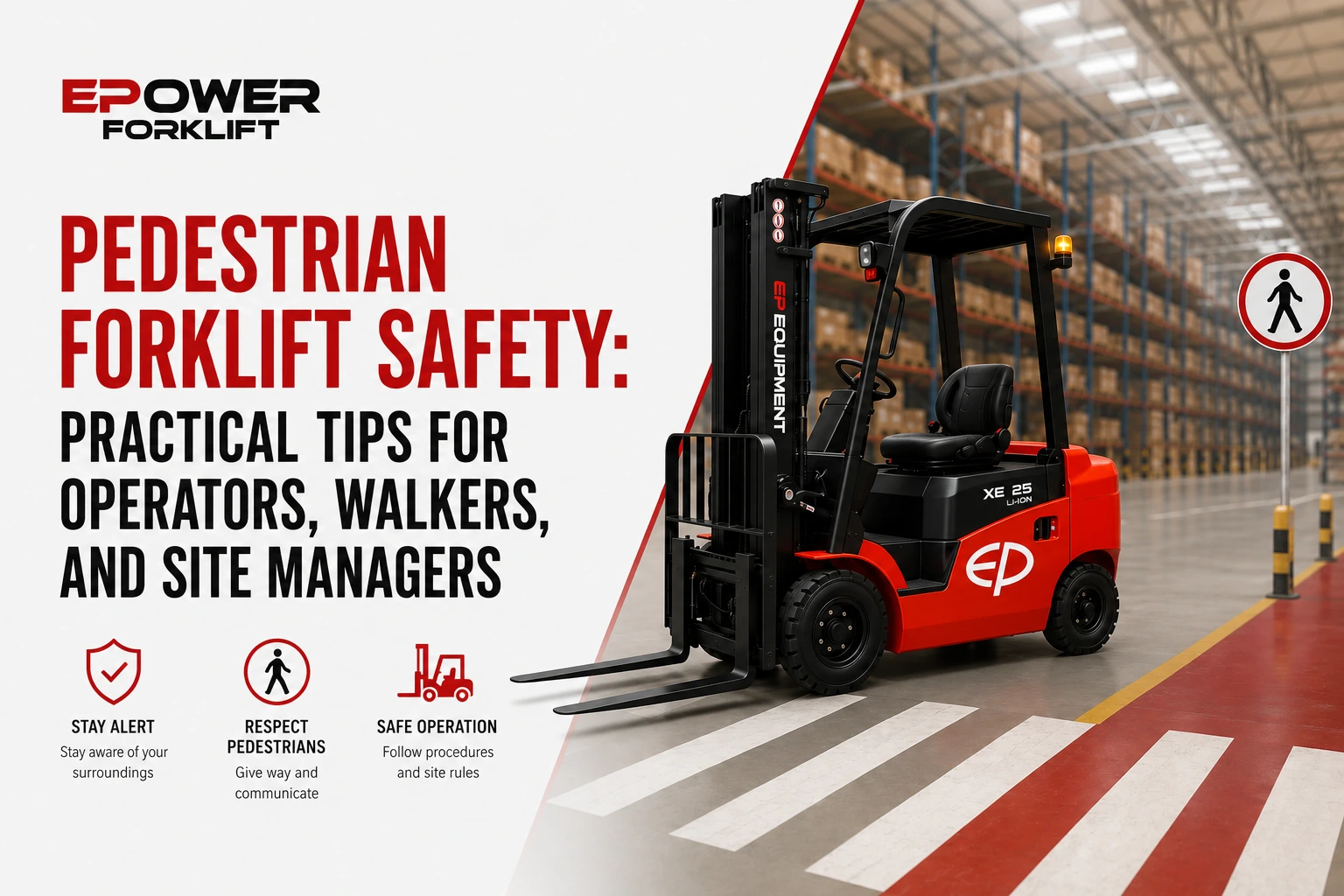
Pedestrians — not operators — account for the majority of serious forklift fatalities in Australian warehouses. A forklift weighing 4,000 kg travelling at 6 km/h delivers impact force equivalent to a car hitting at 30 km/h. The physics are not forgiving, and the incidents are not random. They follow predictable patterns: shared spaces without physical separation, operators assuming pedestrians can see them, pedestrians assuming operators can see them, and sites that updated their fleet to electric without updating their safety protocols.
Responsibility for pedestrian forklift safety is split across three groups. Operators control the machine. Pedestrians control their own behaviour. Site managers control the system. All three must function together — a failure in any one group produces incidents regardless of how well the other two perform.
Electric forklifts remove the one passive warning system pedestrians historically relied on: engine noise. Below 15 km/h, an electric forklift is quieter than a shopping trolley.
A warehouse that transitions from LPG forklift to electric forklift often removes its pedestrians' primary audible warning without even realising it. As the fleet changes, pedestrian safety protocols must evolve as well.
This guide covers the specific responsibilities and practical actions for each group, with particular focus on the hazard profile of electric forklifts.
Why Is Pedestrian Forklift Safety a Critical Issue in Australian Warehouses?
Forklifts are involved in approximately 4,500 serious workplace injuries annually in Australia, and pedestrians represent the majority of fatalities, not operators. The reason is structural: operators sit inside a protective overhead guard. Pedestrians have nothing.
The sites with the worst pedestrian safety records are not the busiest. They are the ones where pedestrian and forklift traffic share space without physical separation. Awareness training and signage do not prevent incidents in genuinely shared spaces — they reduce the probability slightly while the structural hazard remains. Physical separation eliminates the structural hazard.
Electric forklifts compound the risk in a specific way. A diesel or LPG forklift produces continuous engine noise that gives pedestrians passive, ambient awareness of nearby activity. An electric forklift at low speed produces nothing. A pedestrian working with their back to traffic, in a shared zone, with a nearby electric forklift approaching at 8 km/h, has zero audible warning until the forklift is within arm's reach.
EPower Forklift's expert note: "When a site transitions from LPG to electric forklifts, the noise reduction is immediately noticeable. What is not immediately noticeable is that every pedestrian on that site has just lost their primary audible warning system. The safety protocols need to change at the same time the fleet changes — not after the first near-miss."
What Are the Forklift Operator's Responsibilities for Pedestrian Safety ?
Operators have the most direct control over pedestrian risk — and the most significant blind spots. Five responsibilities define safe operator behaviour in shared spaces: blind spot management, communication protocols, speed discipline, right of way compliance, and pre-start verification of safety devices.
How Should Forklift Operators Manage Blind Spots and Visibility?
Blind spots on forklifts are larger and more dangerous than most operators are trained to appreciate — and they are model-specific. Generic forklift training uses a standardised diagram. The actual blind spots on a reach truck are completely different from those on a counterbalance unit.
For the electric forklift types Epower Forklift distributes, the critical blind spots are:
- Counterbalance forklift****: dead zone directly ahead when carrying a load above 1.5 metres — the load and backrest create a complete forward visual wall; significant blind spot at rear-left when reversing
- Reach truck****: mast and load backrest block low forward vision — a pedestrian crouching or bending at ground level in the travel path can be invisible to the operator
- Order picker****: operator is elevated; pedestrians standing directly beside the unit fall outside the operator's downward sightline entirely
- Pallet truck****: operator stands behind the load — forward vision is blocked by the pallet itself at standard pallet height
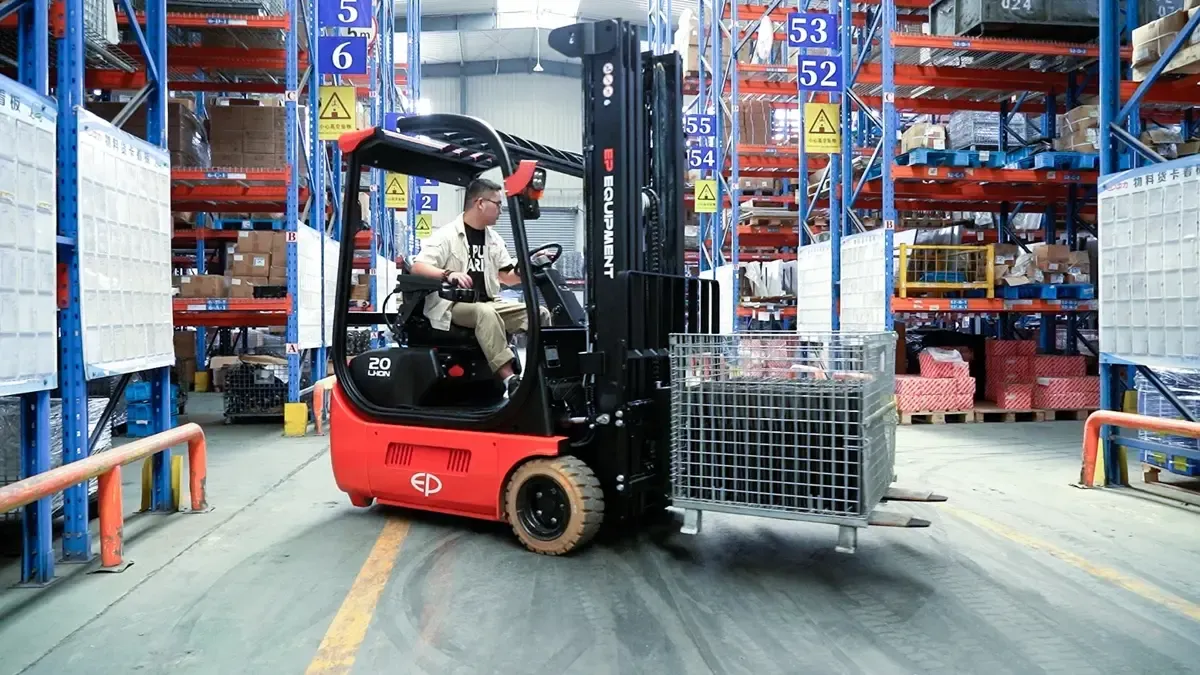
Three actions manage blind spot risk. First, when load height exceeds 1.5 metres on a counterbalance unit, travel in reverse so the operator faces the direction of movement. Second, approach all aisle intersections and blind corners at walking pace with horn sounded before the turn, not during it. Third, use a spotter in any zone where load height combined with aisle width creates a genuine sightline problem that mirrors alone cannot solve.
Blind spot risk is model-specific. Before operating any forklift type in a shared pedestrian area, the operator should physically walk the blind spot perimeter of that model — not rely on a generic training diagram. The blind spots of a reach truck and a counterbalance are completely different and require different management strategies.
What Communication Protocols Should Operators Follow in Shared Zones?
Three protocols apply in any zone where pedestrians and forklifts share space.
Eye contact and confirmed signal. Looking at a pedestrian is not the same as establishing eye contact. The operator must stop, make direct eye contact, and wait for the pedestrian to give a clear acknowledgement signal — a nod, a raised hand, or a step back — before proceeding. Moving forward while the pedestrian is still in motion, even if they appear to be clearing the path, is not compliant behaviour.
Horn protocol before entry, not during. Horn signals warn pedestrians that a forklift is approaching a shared point. The horn must sound before the operator enters a blind corner, crosses an aisle intersection, passes through a doorway, or begins reversing. Sounding the horn after entering the zone is a panic response, not a safety protocol. On electric forklifts, where the forklift itself produces no warning noise, some Australian sites now require a continuous low-speed alert in shared zones as a supplementary measure.
Full stop for right of way. Pedestrians have the right of way in all shared zones under SafeWork Australia guidance. The operator must come to a complete stop and remain stationary until the pedestrian has fully cleared the area. Creeping forward while a pedestrian is still moving is a documented contributor to incidents — the pedestrian changes pace or direction unexpectedly, and the operator has no stopping margin.
What Should Pedestrians Do to Stay Safe Around Forklifts?
SafeWork Australia data shows that experienced workers — not new hires — account for a disproportionate share of pedestrian forklift incidents. The mechanism is complacency. Workers who have operated safely alongside forklifts for months begin to trust their own judgment about when it is safe to cross, cut through, or walk near operating machinery. That trust is not warranted.
Why Should Pedestrians Never Assume a Forklift Operator Can See Them?
A pedestrian can see an operator clearly and still be completely invisible to that operator. The dead zone in front of a counterbalance forklift carrying a load above 1.5 metres covers the full forward arc. A pedestrian standing directly in front of the load, in clear sight of the overhead guard, is behind a wall from the operator's perspective.
The electric forklift version of this hazard runs in reverse: the pedestrian cannot hear the forklift approaching from behind. There is no engine noise, no tyre squeal, no audible deceleration. The forklift enters the pedestrian's proximity zone silently. At 8 km/h, the forklift covers 2.2 metres per second. By the time a pedestrian registers something in peripheral vision and reacts, the margin is gone.
The rule is unconditional: never enter a forklift operating area without confirmed eye contact from the operator. This applies when the forklift appears stationary — electric forklifts move from rest to operating speed with no audible warning and no mechanical startup sequence.
Note: An electric forklift at 6 km/h produces less noise than a shopping trolley. In a busy warehouse, a pedestrian with their back turned has zero audible warning. Never enter a forklift operating area without confirmed eye contact. This applies even when the forklift appears stationary — electric units move silently from rest.
What Are the Rules for Pedestrians Crossing Forklift Operating Areas?
Five rules apply to any pedestrian crossing a forklift operating zone.
- Use designated crossing points only
Crossing points are located at positions with the best sightlines and the lowest forklift traffic. Cutting through mid-aisle saves 20 to 30 seconds and removes every protection the crossing point provides. If the designated route is so inconvenient that workers routinely bypass it, the route design needs to change — that is a site management problem, not a worker compliance problem.
- Stop, look both ways, and establish eye contact before stepping
A forklift at 10 km/h needs 4 to 6 metres to stop. Standing at a crossing point does not stop the forklift. Eye contact and an acknowledged signal from the operator does.
- Never walk behind a reversing forklift
The reverse alarm confirms the forklift is moving backward. It does not confirm the operator has seen you. The rear-left blind spot on most counterbalance forklifts covers a significant arc that the operator cannot clear with a mirror check alone.
- No phones or headphones in forklift operating areas
Distracted pedestrians have a reaction time 40 to 50% slower than alert pedestrians. At 6 km/h, a forklift travels 1.67 metres per second. A half-second reaction delay is the difference between a near-miss and a strike.
- Wear high-visibility vests at all times in forklift operating zones
Hi-vis vests increase an operator's peripheral detection range by approximately 40% compared to standard warehouse clothing. This is not a PPE formality — it directly extends the window in which an operator can identify and respond to a pedestrian in their path.
What Are the Site Manager's Responsibilities for Pedestrian Forklift Safety?
The operator and the pedestrian can only manage risk within the system that the site manager designs. If the system is poorly designed, incident rates remain high regardless of how well-trained both groups are. Site managers hold the primary WHS liability — PCBU duty under WHS Regulations 2011 cannot be delegated to operators or workers.
How Do You Design an Effective Pedestrian Separation System in a Warehouse?
The most common design failure is drawing pedestrian walkways on a floor plan based on convenience rather than actual movement patterns. Workers bypass routes that add significant time or distance. Before designing separation systems, observe where pedestrians actually travel for one full shift. Design the safe route to align with natural movement, then add barriers where the routes must diverge from forklift zones.
Apply the hierarchy of controls in order:
- Eliminate shared space entirely where possible. Schedule forklift operations and pedestrian access in separate time windows. Not always operationally viable, but where it is, it is the only control that produces zero pedestrian-forklift interaction.
- Substitute by redesigning workflows to remove the need for pedestrians to enter forklift zones. Move picking stations, workstations, and rest areas outside forklift operating areas.
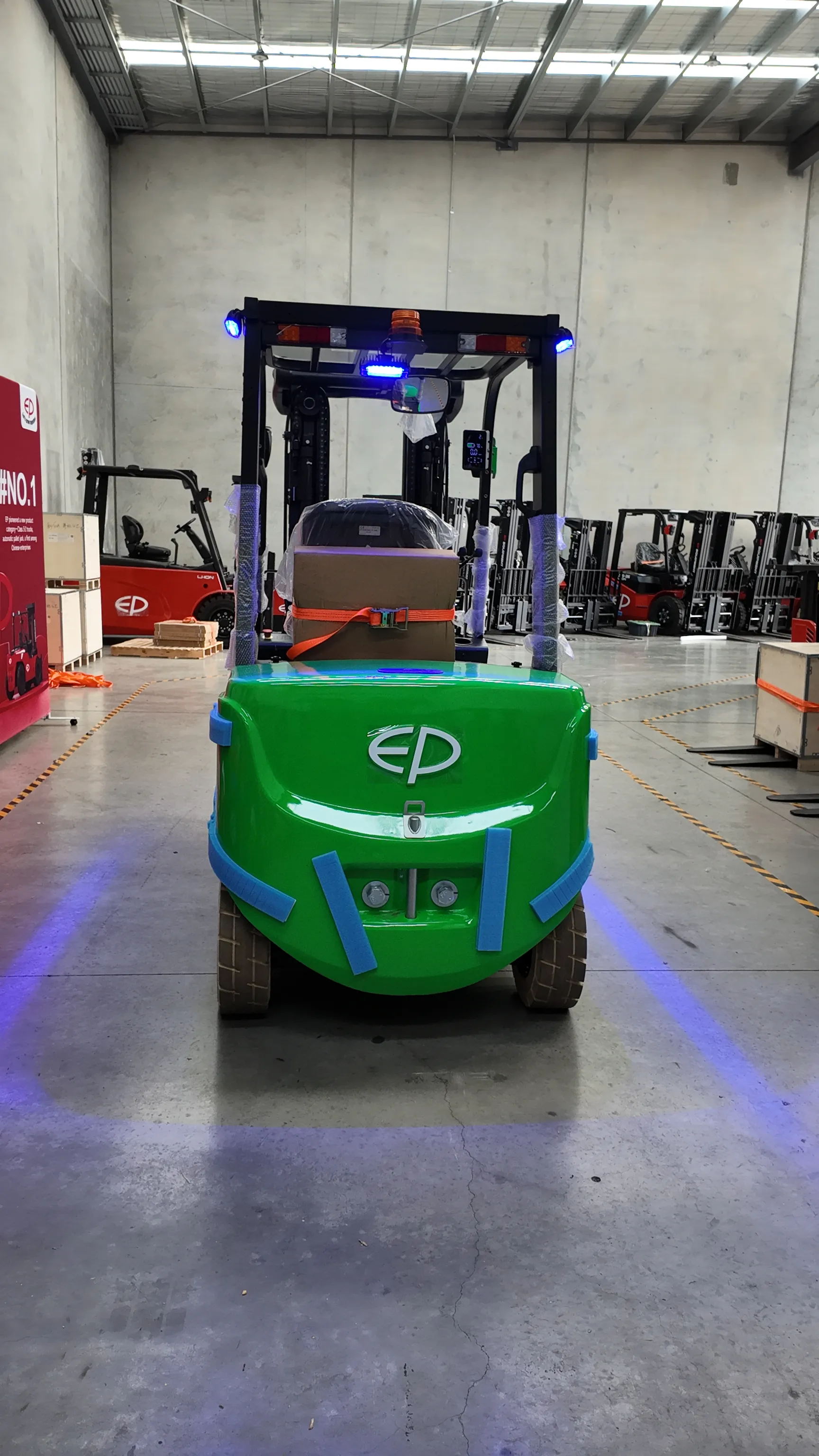
- Engineering controls are the most effective practical measure. Physical barriers — bollards at a minimum 900mm height, safety rails, swing gates at exclusion zone entry points — physically prevent forklifts from entering pedestrian areas and vice versa. Convex mirrors at blind corners extend operator sightlines. Blue safety lights projected from the forklift onto the floor warn pedestrians of an approaching unit before it is visible. Floor markings at 100mm minimum width define walkways visually, but must be combined with at least one physical barrier element at high-risk points.
- Administrative controls — speed limits, horn protocols, training, signage — depend entirely on human compliance. They are necessary but insufficient as standalone measures.
- PPE — hi-vis vests, safety footwear — reduces severity and improves detection. It does not prevent the interaction.
What Training and Documentation Does a Site Manager Need for WHS Compliance?
Four documents form the minimum WHS-compliant pedestrian safety record for an Australian warehouse.
- Traffic Management Plan (TMP)
A formal document describing forklift routes, pedestrian routes, crossing points, exclusion zones, speed limits by zone, and communication protocols. This is the first document a WHS inspector requests when investigating a forklift pedestrian incident. It must be dated, signed, and reviewed whenever the facility layout changes.
Not sure whether your current forklift model and site layout meet WHS pedestrian separation requirements? EPower can assess your warehouse traffic flow and recommend the right electric forklift configuration before you buy — not after your first near-miss.
- Site induction records
Every worker, contractor, and visitor who enters the forklift operating area must be inducted on site-specific pedestrian safety rules and sign to confirm receipt. Verbal briefings without signatures have no evidentiary value in a WHS prosecution.
- Near-miss reporting log
Every near-miss must be recorded with the date, location, description, people involved, root cause assessment, and documented corrective action taken. A near-miss log demonstrates proactive safety management — the absence of one demonstrates the opposite.
- Pre-start checklist records
Horn, lights, reverse alarm, and blue safety light must pass pre-start inspection every shift. If a pedestrian incident occurs and the pre-start record for that shift is missing or shows the relevant safety device was not checked, the PCBU has no defence.
How Do Physical Controls and Technology Reduce Pedestrian Forklift Incidents?
Physical separation is the primary control. Technology is the last line of defence for the cases where people enter hazardous zones despite physical controls. Both are needed — technology without physical separation does not produce safe outcomes.
What Physical Barriers and Zone Controls Work Best in Warehouses?
The table below compares the four most common physical controls by effectiveness and appropriate use case.
| Control Type | Effectiveness | Best Application | Key Limitation |
|---|---|---|---|
| Bollards and safety rails | Highest — physical stop | Fixed pedestrian zones, picking stations, and workstations | Difficult to reposition; requires planning before installation |
| Swing gates and chain barriers | High at entry points | Exclusion zone entrances, cold store access | Controls entry only — does not manage behaviour within the zone |
| Convex mirrors | Medium — improves sightline | Blind corners, aisle intersections | Must be maintained and correctly positioned; can be obscured by stock |
| Floor markings | Visual only | General walkways, crossing points | Entirely reliant on compliance — no physical prevention |
One critical failure pattern: barriers are installed correctly, then moved temporarily to accommodate an oversized delivery. The temporary removal becomes permanent. Barrier integrity must be audited on a scheduled basis — not assumed to remain in place after installation.
Can Proximity Warning Technology Prevent Pedestrian Forklift Collisions?
Yes, but only as a supplementary control on top of physical separation — not as a standalone solution. Sites that deploy proximity technology without physical separation retain high incident rates because the technology warns of interactions that should not be occurring in the first place.
Three proximity warning technologies are currently deployed in Australian warehouses:
UWB (Ultra-Wideband) sensors deliver the highest accuracy — detecting pedestrians within a defined radius to approximately 30cm precision. The system alerts the operator via an audible buzzer and warning light; advanced configurations slow or stop the forklift automatically when a pedestrian enters the critical zone.
RFID tag systems require pedestrians to wear a tag. The forklift reader detects the tag and triggers an alert. Lower cost than UWB but dependent on all pedestrians wearing tags — contractors and visitors require active management.
Camera and AI vision systems require no wearable device. Cameras on the forklift or facility detect people and alert the operator. Suitable for environments with visitors and contractors who cannot be relied on to wear tags.
Electric forklifts are particularly well-suited to proximity warning deployment. The absence of engine noise means system alerts are clearly audible to both operator and pedestrian without competition from drivetrain noise. Sensor accuracy is also higher in electric operating environments because engine vibration does not interfere with sensor readings.
EP Equipment models support aftermarket proximity warning installation. If your site is planning to deploy proximity technology, confirm compatibility with your specific model before purchase — not after.
How Do You Build a Pedestrian Forklift Safety Culture That Lasts Beyond Induction?
Safety culture is not produced by induction sessions. It is produced by what leadership does when no one is watching. A site manager who walks through the forklift zone without using the designated walkway has communicated more about site safety culture than any training session.
Three indicators measure whether a safety culture is functioning. First, near-miss reporting rate: a genuinely safe site generates more near-miss reports, not fewer, because workers report rather than ignore. Second, time-to-correct defects after pre-start checks: a functional safety culture corrects defects within the shift, not at the end of the week. Third, unsolicited safety suggestions from floor workers: when operators and pedestrians raise safety concerns without being asked, the culture is working.
Why Is Near-Miss Reporting More Valuable Than Incident Reporting?
Near-misses are the leading indicator of serious incidents. Heinrich's Triangle shows that every serious incident is preceded by approximately 29 minor incidents and 300 near-misses in the same system. A site without near-miss reports is not safer — it has not built a reporting culture. PCBU should actively reward near-miss reporting and investigate each one with the same rigour applied to actual incidents. A near-miss that is investigated and corrected eliminates the same hazard that would have produced an injury.
What Are the WHS Legal Obligations for Pedestrian Safety in Australian Warehouses?
Under WHS Regulations 2011, the PCBU must identify all pedestrian-forklift interaction points, implement the hierarchy of controls to eliminate or minimise risk, maintain a current Traffic Management Plan, and ensure all workers, including contractors and visitors, are inducted on pedestrian safety procedures. All near-misses and incidents must be investigated with documented corrective actions. Failure to meet these obligations is a Category 2 offence — fines reach $1.5 million for a body corporate and $300,000 for an individual.
Conclusion: Building a Safer Pedestrian Forklift Safety System
Pedestrian forklift safety is not solved by a single rule, sign, or training session. It depends on a complete system: clear traffic routes, physical separation, trained operators, alert pedestrians, working warning devices, and management that reviews near-misses before they become injuries. This becomes even more important when a site transitions to electric forklifts, where lower noise levels can reduce pedestrians’ natural awareness of nearby equipment.
For warehouse managers, the safest approach is to treat pedestrian protection as part of the forklift selection and site design process, not as an afterthought. The right electric forklift, combined with a practical Traffic Management Plan, appropriate safety technology, and disciplined daily checks, can significantly reduce the risk of pedestrian incidents while keeping warehouse operations efficient.
EPower Forklift can support businesses in selecting electric forklift models and safety configurations that better match their warehouse layout, traffic flow, and pedestrian risk profile.