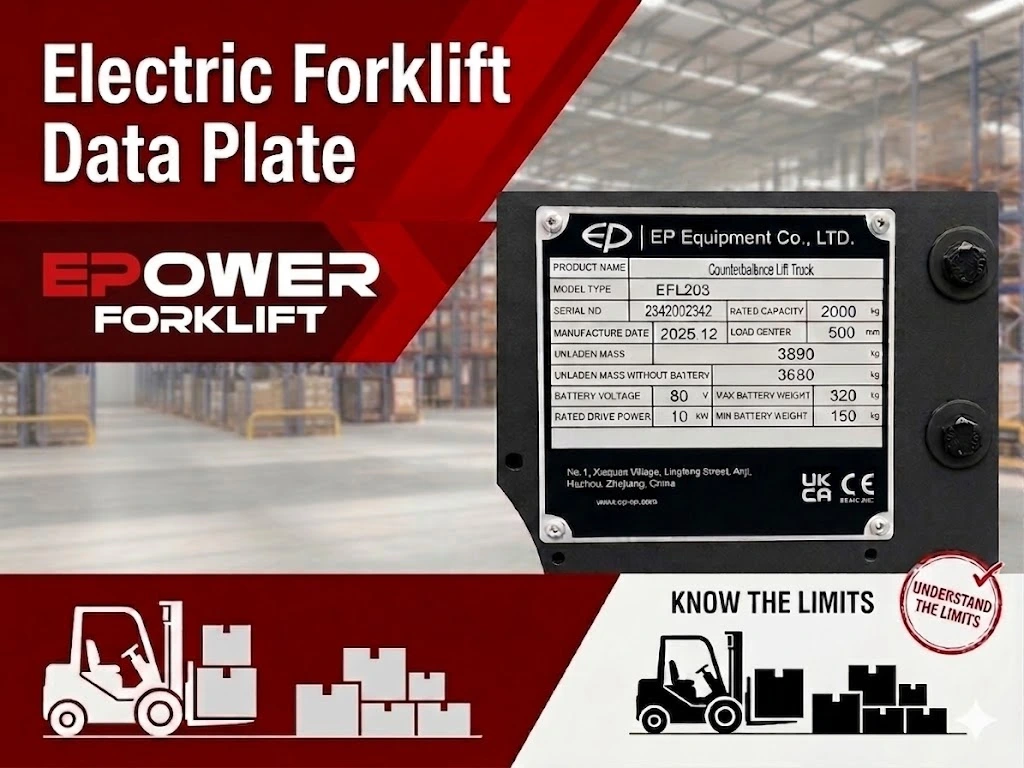
The data plate is the most important safety document on any forklift — and the most consistently misread. Operators see a single capacity number and treat it as an absolute. It is not. That number only applies under a precise set of conditions, and the moment those conditions change, so does the safe working load. Every overloading incident, every tip-over caused by an oversized pallet, every attachment-related collapse traces back to the same root cause: the operator did not correctly read the data plate.
The load capacity chart, the load centre figure, and the attachment rating are the three specifications that change under real operating conditions. Understanding how each one works — and how they interact — is what separates an operator who reads a data plate from one who understands it.
Australian law adds a compliance dimension that makes this knowledge non-negotiable. Under Work Health and Safety Regulations 2011 (as amended in 2025), every electric forklift must carry a legible, manufacturer-issued data plate. Operating without one is a legal breach regardless of how well the operator knows the machine.
This guide explains every specification on an electric forklift data plate, with particular reference to EP Equipment models distributed by EPower Forklift across Australia.
What Is an Electric Forklift Data Plate and Where Is It Located?
An electric forklift data plate is a permanently fixed metal plate fitted by the manufacturer that states the unit's specifications, operating limits, and configuration — the machine's legally binding identity document.
It is known by several names: data plate, rating plate, nameplate, capacity plate. All refer to the same physical item. Regardless of what it is called on your site, its legal status is identical — it must be present, legible, and accurate before the electric forklift enters service.
On most forklifts, the data plate is mounted on the overhead guard support column or instrument panel, positioned so the operator can read it from the seated position without dismounting. On EPower forklifts, the data plate is typically located on or near the front pillar of the overhead guard — readable from the operator seat without dismounting.
In 2023, SafeWork Australia recorded multiple forklift tip-over incidents directly attributed to load centre miscalculation — not mechanical failure, not operator inexperience, but a misread data plate. The operator saw the rated capacity, lifted the load, and did not account for the extended load centre. The machine was within its weight limit and still became unstable.
What Information Is on an Electric Forklift Data Plate?
A forklift data plate contains six core specifications: rated capacity, load centre, lift height, mast type, model and serial number, and forklift weight. Each specification defines a boundary of safe operation — none of them can be read in isolation.
What Does Rated Capacity Mean on a Forklift Data Plate?
Rated capacity is the maximum load weight the electric forklift can safely lift under standard conditions: mast vertical, load centre at 500mm per AS 2359 standard, and lift height at the rated configuration.
It is the figure operators that most frequently misapply. Seeing "2,000 kg" on the plate, they treat it as an unconditional limit. It is not. Rated capacity is a conditional figure — it applies only at the exact parameters stated on the plate. Change the load centre, change the lift height, or add an attachment, and the safe working load changes immediately.
The rated capacity is the most misread figure on any data plate. Operators see 2,000 kg and assume the electric forklift can always carry 2,000 kg regardless of conditions. It cannot — that figure only applies at the exact conditions stated on the plate.
A common situation: a warehouse operator is moving a double-stacked pallet of bagged product — total weight 1,800 kg, within the rated capacity of their 2,000 kg counterbalance forklift. What they haven't accounted for is that the double-stacked load sits 750mm from the fork face, not 500mm. At that load centre, the actual safe working load on the same machine drops to approximately 1,500 kg. The load is 300 kg over the real safe limit — on a forklift that, on paper, appears to have capacity to spare.
What Is Load Centre and Why Does It Change the Electric Forklift's Capacity?
Load centre is the horizontal distance from the face of the forks to the centre of gravity of the load. The Australian standard load centre is 500mm — the distance assumed when the rated capacity figure is calculated.
When a load's centre of gravity sits further than 500mm from the fork face — because the load is unusually long, wide, or unevenly distributed — the effective load centre increases. As load centre increases, the electric forklift's rated capacity decreases. The further the load's weight sits from the forks, the greater the tipping moment acting on the machine.
A practical example: a lithium forklift rated at 2,000 kg at 500mm load centre may only safely carry 1,600 kg when the load centre increases to 600mm. That 400 kg difference is not a safety margin — it is the point at which the machine becomes unstable.
This is the specification most consistently ignored on real job sites, and the one most directly responsible for tip-over incidents involving oversized or irregularly shaped loads.
What Do Lift Height and Mast Type Tell You on the Data Plate?
Lift height is the maximum elevation of the forks measured from floor level to the top of the fork face at full extension. Mast type — simplex, duplex, triplex, or quad — determines both the maximum lift height and the free lift height available before the mast begins to extend above its collapsed position.
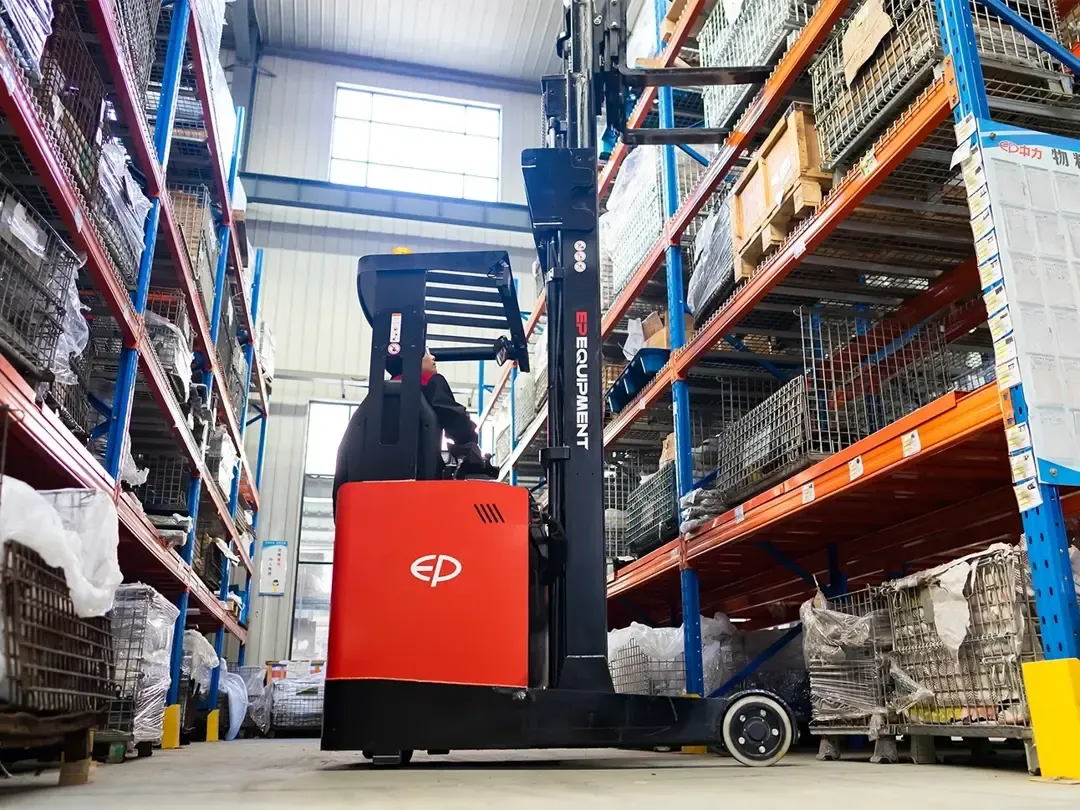
Mast type matters for facilities with restricted overhead clearance. A triplex mast on a reach truck, for example, provides significant free lift — the forks rise several hundred millimetres before the outer mast sections begin to telescope. This allows operation in facilities where the overall mast height would otherwise foul on overhead structures.
Rated capacity also decreases as lift height increases. A forklift rated at 2,500 kg at 3,000mm lift height will carry a lower safe load at 6,000mm. This relationship is shown on the load capacity chart, which is the most operationally critical section of the data plate.
How Does Load Centre Affect Rated Capacity in Practice?
Load centre is the variable that most operators fail to account for during daily operations. Rated capacity states the maximum under standard conditions. Load centre determines what the maximum actually is for the specific load in front of you.
Understanding load centre is where most forklift overloading incidents begin. It is the single most misunderstood concept on the data plate — and the one that causes the most tip-overs when loads are wider, longer, or heavier toward the far end of the forks.
How Do You Read an Electric Forklift Load Capacity Chart?
A load capacity chart is a two-axis table printed on the data plate that shows the safe working load at combinations of lift height and load centre. The vertical axis lists lift height increments. The horizontal axis lists load centre increments. The intersection gives the actual permitted load for that specific combination of conditions.
The table below illustrates how capacity changes across typical operating conditions for a 2,500 kg-rated electric forklift:
| Load Centre | Lift Height 3,000mm | Lift Height 4,500mm | Lift Height 6,000mm |
|---|---|---|---|
| 500mm | 2,500 kg | 2,200 kg | 1,900 kg |
| 600mm | 2,100 kg | 1,850 kg | 1,600 kg |
| 700mm | 1,750 kg | 1,550 kg | 1,350 kg |
The table shows that the same forklift rated at 2,500 kg can only safely carry 1,350 kg when the load centre extends to 700mm and the lift height reaches 6,000mm. That is a 46% reduction from the rated capacity figure — on the same machine, in the same shift.
Reading the chart correctly requires the operator to identify both the actual load centre of the load being carried and the lift height required to place it. Neither can be estimated — both must be measured or confirmed against the load's specifications before lifting.
How Do Attachments Change the Rated Capacity on the Data Plate?
Every attachment fitted to an electric forklift — side-shifter, fork positioner, clamp, rotator — adds weight to the carriage and shifts the effective load centre further from the fork face. Both effects reduce the safe working load below what the base data plate states.
When an attachment is fitted, the original data plate no longer applies. Each attachment must carry its own data plate, issued by the attachment manufacturer, stating the de-rated capacity for that attachment on that electric forklift model. The operator must read the attachment data plate — not the forklift data plate — when determining the safe working load during any lift performed with that attachment in use.
If an attachment does not have its own data plate, it must not be used. This is a legal requirement under AS 2359.2 in Australia — not a recommendation. An attachment without a data plate has no verified capacity rating and cannot be legally operated.
What Are the Legal Requirements for Forklift Data Plates in Australia?
Three layers of Australian legislation govern forklift data plates: AS 2359.2-2013, WHS Regulations 2011, and SafeWork Australia's General Guide for Industrial Lift Trucks.
- AS 2359.2-2013 requires that all powered industrial trucks and materials handling equipment be fitted with a manufacturer-issued rating plate. The plate must state the unit's rated capacity, load centre, lift height, mast type, model, and serial number. Every attachment used with the forklift must carry a separate, manufacturer-issued data plate stating its de-rated capacity for that specific configuration.
- WHS Regulations 2011 place the duty on the PCBU to ensure the plant is operated within its safe limits. A forklift without a legible, accurate data plate cannot be confirmed as operating within safe limits — making its use a direct breach of PCBU duty. This is a Category 2 offence carrying penalties up to $1.5 million for a body corporate.
- SafeWork Australia specifies that the data plate must remain legible at all times. Painting over it, allowing it to corrode to the point of illegibility, or covering it with stickers or tape are all compliance breaches. A data plate that cannot be read in normal operating light conditions must be replaced before the forklift returns to service.
When purchasing or accepting delivery of an electric forklift, verify that the data plate is present, legible, and matches the unit's actual configuration before the machine enters your fleet. EPower ensures all units leave our yard with compliant, manufacturer-issued data plates correctly fitted and legible.
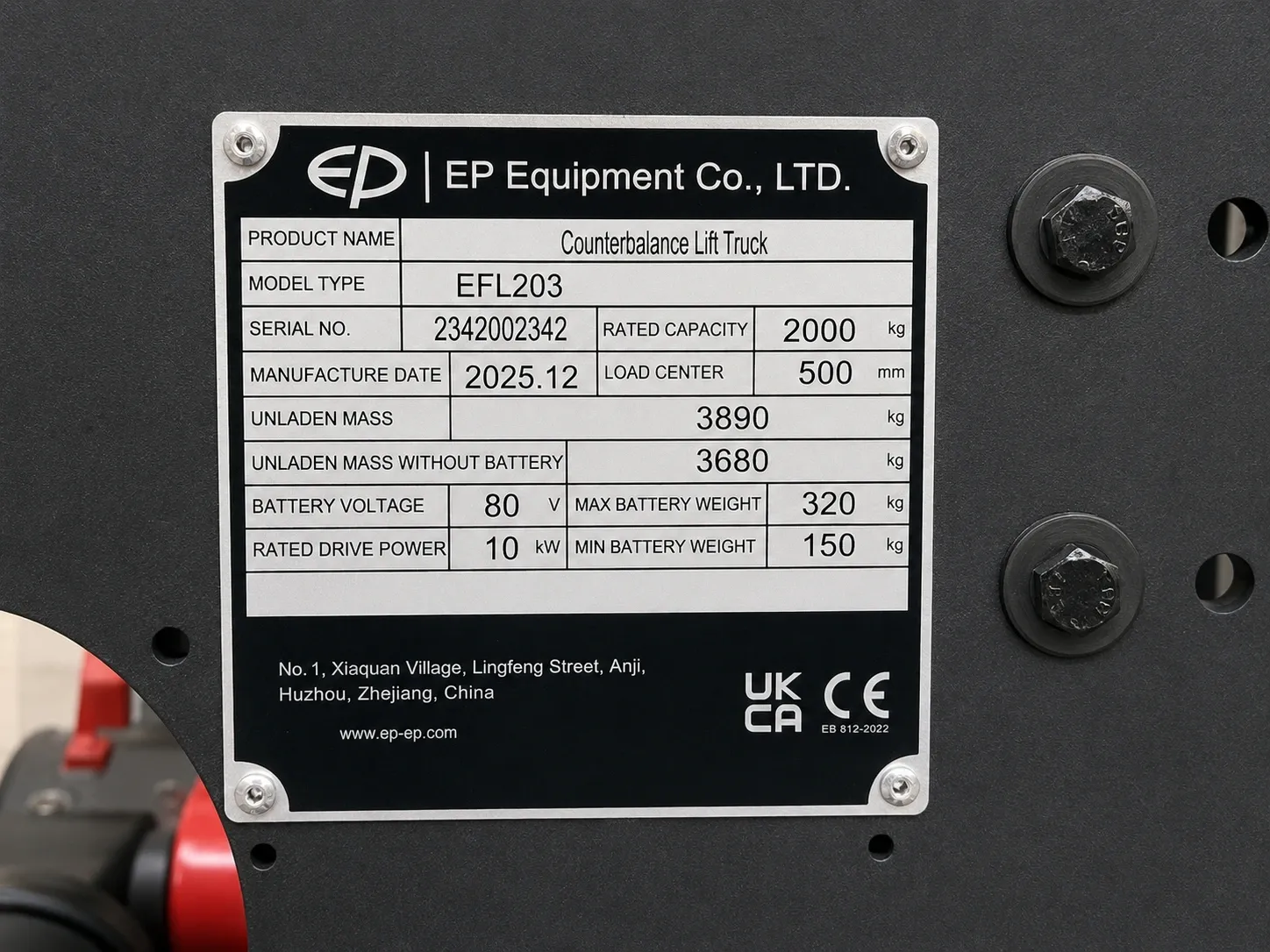
How to Read an EP Equipment Data Plate — A Field Example
The EP Equipment data plate follows the same legal requirements as any forklift operating in Australia, but it includes several fields that go beyond the minimum requirements under AS 2359.2. Understanding these additional fields is particularly important when inspecting a second-hand EP unit before it enters your fleet.
Using the EP EFX5-351 as a reference, here is what each field tells you.
Standard Fields — Present on All Compliant Forklifts
- Rated Capacity / Load Center — 3,500 kg at 500mm. This is the conditional figure. It only applies with the mast vertical, no attachment fitted, and the load centre at exactly 500mm. Any deviation changes the safe working load.
- Serial No. — Used to verify the plate matches the machine. On a second-hand unit, cross-check this against the frame stamping. A mismatch means the plate has been transferred from another machine — a serious compliance and safety issue.
- Manufacture Date — 2025.03 on this unit. For second-hand purchases, this date determines remaining service life and tells you which version of AS 2359 applied at the time of manufacture.
EP-Specific Fields — Not Standard on Most Competitor Plates
- Unladen Mass Without Battery (5,085 kg) vs Unladen Mass (5,480 kg) — The 395 kg difference is the battery weight. On a second-hand unit, weigh the machine and compare against these two figures. If the actual weight falls outside this range, the battery has been replaced with a non-original unit, which affects counterbalance stability and may void the rated capacity.
- Max Battery Weight (395 kg) / Min Battery Weight (385 kg) — EP specifies an acceptable battery weight range, not a single figure. Any replacement battery must fall within this 10 kg window. A heavier battery shifts the counterbalance; a lighter one reduces it. Either way, the rated capacity on the plate no longer applies without re-verification.
- Battery Voltage (80V) / Rated Drive Power (16 kW) — These confirm the electrical specification the machine was designed for. On a second-hand unit, verify that the charger and any replacement battery match these figures exactly.
Certification marks — UKCA and CE
Both marks appear on the EP plate. UKCA confirms the unit meets UK Conformity Assessed standards — an additional compliance benchmark that gives Australian buyers confidence the machine has been independently verified beyond the CE mark alone.
If you want to verify that an EP Equipment data plate matches the machine's actual configuration before it enters your fleet, contact the Epower team. As EP Equipment's authorised distributor in Australia, we can cross-reference the serial number against manufacturer records and confirm the unit is in a compliant condition
Verifying an EP Equipment Data Plate Before Purchase
If you want to verify that an EP Equipment data plate matches the machine's actual configuration before it enters your fleet, contact the Epower team.
As EP Equipment's authorised distributor in Australia, Epower can cross-reference the serial number against the manufacturer's records and confirm whether the unit remains in a compliant operating condition.
What Should You Do When a Forklift Data Plate Is Missing, Damaged, or Incorrect?
A missing or illegible data plate is not an administrative issue to resolve later. It is an immediate operational stop. The forklift must be tagged out and removed from service until a compliant data plate is fitted by the manufacturer or an authorised dealer.
Can You Operate a Forklift Without a Data Plate?
No. Operating a forklift without a legible data plate is illegal under AS 2359.2 and WHS Regulations 2011 in Australia. The forklift must be tagged out immediately and must not re-enter service until a manufacturer-issued replacement is fitted. A handwritten, printed, or self-made substitute carries no legal standing and will not be accepted by a WHS regulator or insurer in the event of an incident.
How Do You Get a Replacement Data Plate for an Electric Forklift in Australia?
Follow the three steps. First, tag out the forklift immediately — attach a "Do Not Operate" tag to the key switch and do not operate the unit under any circumstances. Second, locate the unit's model number and serial number from the manufacturer's delivery documentation or the machine's frame stamping, and contact the original equipment manufacturer or their authorised dealer to request a replacement plate. Third, have the replacement plate fitted by the authorised party — self-fitting is not permitted under AS 2359.2.
If your EP Equipment forklift is currently tagged out for a missing or damaged data plate, contact the Epower Forklift team today. We will identify the correct replacement, coordinate with the manufacturer, and get your machine back into compliant service as quickly as possible.