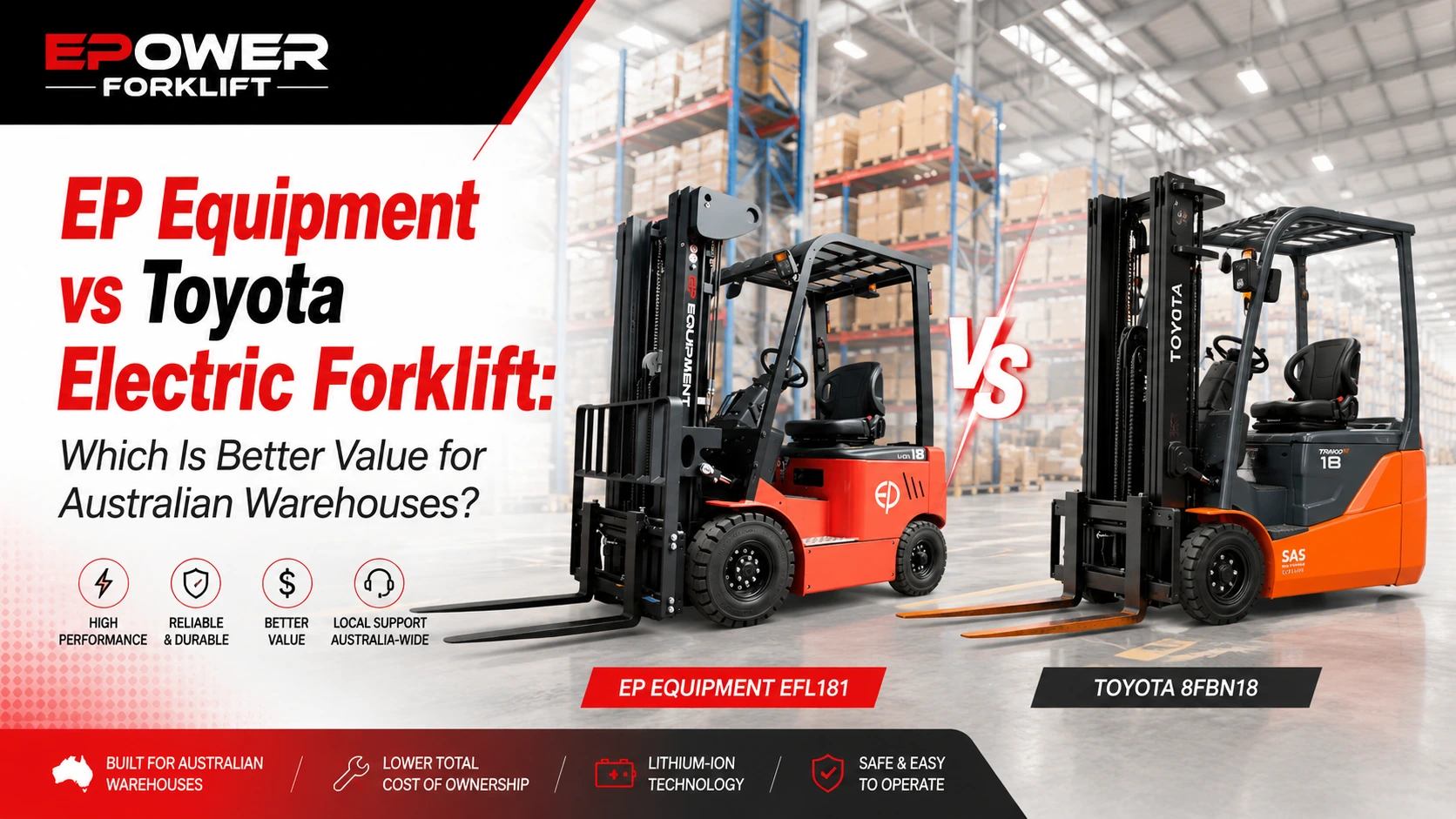
Most buyers arrive at this comparison after receiving a Toyota quote and experiencing sticker shock. They are not necessarily committed to Toyota — they want to know whether EP Equipment is good enough to justify not paying the premium. That is the right question, and this article answers it directly.
The short version: EP Equipment delivers better financial value for most standard warehouse applications in Australian metro areas. Toyota delivers better service network coverage, proven reach truck heritage above 10 metres, and stronger resale value. Neither answer applies universally — it depends on your location, application, and fleet replacement cycle.
EPower Forklift is the authorised EP Equipment distributor in Australia. We will not pretend to be neutral. What we will do is tell you where Toyota genuinely has the advantage, where EP Equipment wins, and where the decision comes down to your specific operation — because a comparison that only tells you one side is not useful to anyone making a real purchasing decision.
How Do EP Equipment and Toyota Compare as Electric Forklift Brands?
EP Equipment and Toyota are not direct equivalents — they operate at different tiers with different histories and different strategic focuses. Understanding that context is necessary before comparing individual models.
Toyota Material Handling is widely recognised as the world's largest forklift manufacturer and global market leader. The brand portfolio includes Toyota, BT, Raymond, and CESAB. Toyota makes electric, LPG, and diesel forklifts. Electric is a significant and growing part of the portfolio, not the entirety of it.
EP Equipment traces its roots back to 1993 and operates today as a leading electric forklift manufacturer headquartered in Hangzhou, China. It manufactures exclusively electric and warehouse equipment — no combustion products. EP Equipment operates large-scale manufacturing facilities in China and exports to more than 100 countries worldwide. EV Magazine's 2024 ranking places EP Equipment in the global top 8 electric forklift OEMs alongside Toyota, Jungheinrich, Crown, and Kion Group.
The relevant framing for Australian buyers: EP Equipment is not a generic Chinese forklift manufacturer. It is a specialist electric manufacturer at scale, competing in the same global market as Toyota's electric division — at a lower price point.
| Criteria | EP Equipment | Toyota |
|---|---|---|
| Founded | 1993 — Hangzhou, China | 1926 — Japan |
| Global position | Top 8 electric forklift OEMs | No. 1 overall forklift market share |
| Manufacturing focus | 100% electric and warehouse | Electric, LPG, Diesel |
| Purchase price — 2.5T electric (AU) | AUD 18,000 to 22,000 | AUD 28,000 to 35,000 |
| Battery standard | Lithium-ion — included | Lead-acid standard, Li-ion costs extra |
| Battery warranty | 8 years — X5 Series | 3 to 5 years - 8FBMT (lithium-ion specified) |
| AU dealer network | Authorised dealers, including EPower | Toyota Material Handling Australia — national |
What Are the Real Differences in Specs and Battery Technology?
The most common mistake buyers make when comparing these two brands is looking at spec sheets, seeing similar numbers, and concluding they are buying the same product at different price points. The second most common mistake is assuming Toyota is better across every spec because it costs more. Neither is accurate.
For standard counterbalance forklifts in the 1.5 to 3.5 tonne range, the performance specification gap between EP Equipment and Toyota is smaller than the price gap. The meaningful differences are battery technology standard, operator safety systems, and after-sales infrastructure — not motor power or lift height.
How Do EP Equipment and Toyota Compare on Electric Counterbalance Specs?
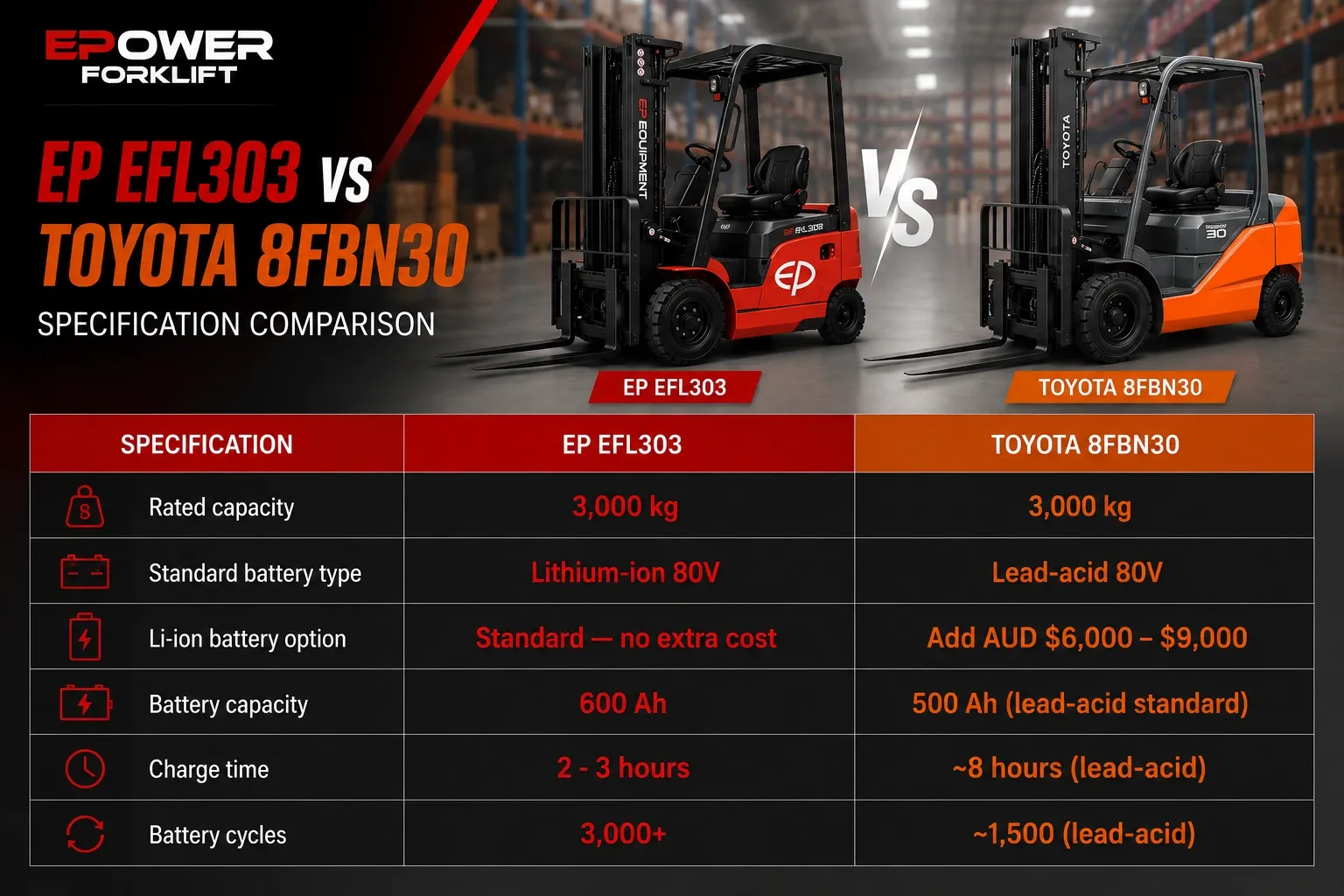
The table below directly compares equivalent models — EP EFL303 and Toyota 8FBN30, both of which are 3-tonne electric counterbalance forklifts.
| Specification | EP EFL303 | Toyota 8FBN30 |
|---|---|---|
| Rated capacity | 3,000 kg | 3,000 kg |
| Standard battery type | Lithium-ion 80V | Lead-acid 80V |
| Li-ion battery option | Standard — no extra cost | Add AUD $6,000 – $9,000 |
| Battery capacity | 600 Ah | 500 Ah (lead-acid standard) |
| Charge time | 2 - 3 hours | ~8 hours (lead-acid) |
| Battery cycles | 3,000+ | ~1,500 (lead-acid) |
| Drive motor | 7.5 kW AC | 7.5 kW AC |
| Pump motor | 11 kW | 10 kW |
| Max lift height | 7,000mm | 7,000mm |
| Turning radius | 2,415mm | 2,350mm |
| Active stability system | Not fitted | Toyota SAS — standard |
Two specifications stand out from this comparison.
First, battery technology. EP Equipment includes lithium-ion as standard. Toyota 8FBN30 ships with lead-acid as standard and charges AUD 6,000 to 9,000 extra for lithium-ion. A like-for-like comparison — both units with lithium-ion — narrows the purchase price gap significantly while EP Equipment retains the TCO advantage through its 8-year battery warranty.
Second, Toyota SAS (System of Active Stability). This is a proprietary active safety system designed to reduce the risk of tip-over and load instability through electronic control of steering, mast, and chassis functions. It is an active engineering control for operator safety, not a passive feature. For fleet managers who prioritise operator safety technology as a primary criterion, this is a meaningful advantage for Toyota.
How Do Their Reach Trucks and Warehouse Product Ranges Compare?
The counterbalance comparison is relatively on specs. The reach truck comparison is less so.
Toyota's BT Reflex reach truck series carries 70 years of reach-truck heritage with the BT brand. BT Reflex models handle lift heights up to 13,000mm with AC technology and integrate with Toyota's I-site fleet management system. The BT Reflex is the standard specification for many large-scale Australian distribution centres — not because buyers have not looked at alternatives, but because it has a proven track record that fleet managers treat as a risk reducer.
EP Equipment's CQD series reach truck handles lift heights up to 12,500mm with lithium-ion standard and competitive specifications in the 6,000 to 10,000mm range. On paper, the specs are comparable. In Australian warehouses, the field history is shorter — EP Equipment's reach truck penetration in Australia began in earnest around 2018 to 2020.
For warehouse racking below 8 metres, EP Equipment reach trucks are a viable, cost-competitive alternative. Toyota's longer operating history in high-rack applications may be a consideration for operators running reach trucks above 10 metres, where downtime carries a high operational cost.
For pallet trucks and pallet stackers, EP Equipment competes most effectively. The specification gap versus Toyota BT Levio equivalents is smallest in this category, and the price gap is largest. This is the segment where EP Equipment's value case is clearest and most straightforward.
What Is the Real Cost Difference Over 5 Years?
Sticker price comparison understates EP Equipment's value case and overstates Toyota's. Total cost of ownership over five years is the correct metric — and it produces a materially different result.
How Do Purchase Price and Battery Warranty Affect the 5-Year Cost?
The table below models illustrative TCO for a single 2.5-tonne electric counterbalance unit running two shifts per day over five years. Numbers are indicative based on Australian market conditions in 2024.
| Cost Component | EP Equipment EFX252 | Toyota 8FBE25 | Notes |
|---|---|---|---|
| Purchase price | AUD 25,xxx | AUD 32,xxx | Approximate AU 2024 pricing |
| Li-ion battery | Included | AUD 7,xxx option | Toyota lead-acid is standard |
| Energy cost — 5 years | AUD 5,xxx | AUD 7,xxx | Li-ion 15 to 20% more efficient than lead-acid |
| Scheduled maintenance — 5 years | AUD 3,xxx | AUD 5,xxx | Toyota dealer labour rate is higher |
| Battery replacement risk | AUD 0 | AUD 0 to 12,xxx | EP Equipment 8-year warranty vs Toyota 3 to 5-year |
| 5-year TCO | AUD 29,xxx | AUD 44,xxx to 56,xxx | Excludes resale value |
Actual pricing, maintenance costs and energy consumption vary by dealer, application and operating environment.
The illustrative 5-year TCO gap ranges, from AUD 15,000 to AUD 27,000 per unit, depending on whether the Toyota battery requires replacement outside warranty. On a fleet of five units, that is AUD 75,000 to AUD 135,000.
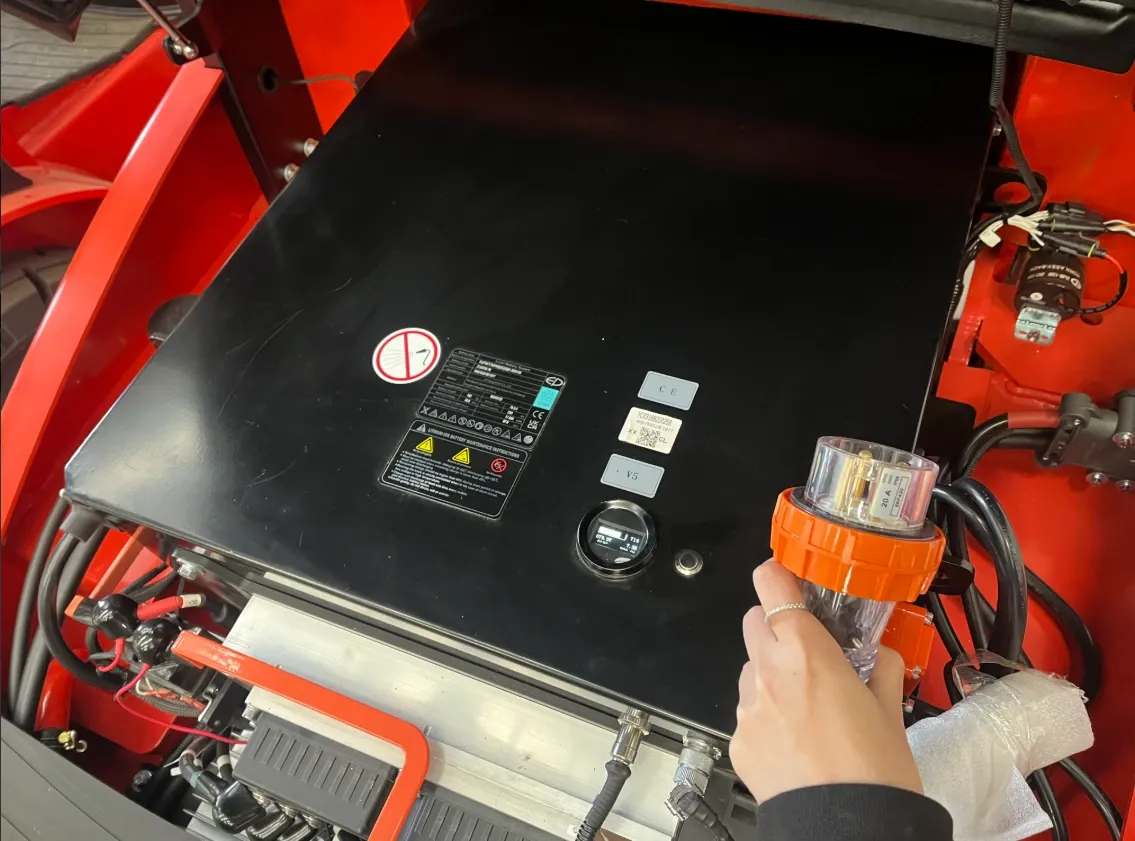
The EP Equipment 8-year battery warranty deserves specific attention. A lithium-ion battery replacement costs AUD 10,000 to 15,000. Toyota's standard warranty covers 3 to 5 years. EP Equipment's warranty covers 8 years. For a two-shift operation, the lithium-ion battery should comfortably exceed 8 years with correct charging practice — but the warranty means the financial risk sits with the manufacturer, not the buyer, for that entire period.
The 8-year battery warranty is not a marketing number. It is a contractual commitment that shifts battery replacement risk from the buyer to EP Equipment for the majority of the forklift's working life. EP Equipment's 8-year battery warranty is among the longest standard lithium-ion battery warranties currently available in the Australian forklift market.
How Do Maintenance Costs and Parts Availability Compare in Australia?
Electric forklift maintenance is fundamentally different from combustion, and this works in favour of both brands equally on the service items themselves. No engine oil, no coolant, no filters, no belts. Primary maintenance items for both EP Equipment and Toyota electric forklifts are tyre replacement every 2,000 to 3,000 hours, brake inspection, hydraulic fluid change, and mast chain lubrication.
Where the brands diverge is in labour rate and parts access.
Toyota scheduled service costs approximately AUD 800 to 1,200 per 500-hour service through Toyota authorised dealers. Parts are on-shelf at Toyota dealer locations across Australia. For unplanned breakdowns, Toyota's network provides 24 to 48-hour response in most metro and regional areas.
EP Equipment scheduled service through Epower costs approximately AUD 600 to 900 per 500-hour service. Parts access through Epower covers the full EP Equipment catalogue. Standard parts are typically available within 3 to 7 days from Epower's Australian inventory. Specialised parts not held in local stock carry a 2 to 4 week lead time from EP Equipment.
For a site in metropolitan Sydney, Melbourne, Brisbane, or Perth, the practical difference in service access between Epower and Toyota is smaller than buyers typically expect. For a site in regional Queensland, regional WA, or remote operations, the gap is real and should be explicitly factored into the purchase decision.
Which Brand Has Better After-Sales Support in Australia?
Toyota's after-sales network is broader. That is the honest answer, and it is not a close comparison at the national level.
Toyota Material Handling Australia operates as a registered subsidiary with a national dealer network, parts distribution infrastructure in Sydney and Melbourne, and regional dealer coverage. When a Toyota forklift breaks down in Toowoomba or Bunbury, there is a local or regional dealer with access to parts and a service booking system.
EP Equipment's network in Australia is growing. Epower operates as EP Equipment's authorised Australian distributor with direct access to EP Equipment's full parts catalogue, technical service manuals, firmware documentation, and warranty processing. The network is concentrated in major metro areas. It does not yet have the regional depth that Toyota has built over decades.
What authorised distributor mean in practice matters here? Epower is not a grey-market reseller. We have direct manufacturer relationships, official warranty processing, and access to technical resources that independent service providers do not. When a warranty claim is needed, it is handled through Epower directly — not through an overseas process.
The practical question for each buyer is not whether Toyota's network is better nationally — it is. The question is whether Toyota's network advantage applies to your specific site, and whether that advantage justifies AUD 12,000 to 15,000 in additional purchase cost per unit.
EPower note: "For a site in Western Sydney, Melbourne's west, or Brisbane's south, the practical service access difference between Epower and Toyota is less significant than the price difference. For a site in Kalgoorlie, Mount Isa, or Darwin, factor the service gap into your decision — it is a genuine consideration and we would rather you know that upfront than discover it after purchase."
Which Electric Forklift Is Better Value for Your Warehouse?
Better value is not a universal answer. It depends on three variables: your location relative to the service network, your application and lift height requirements, and your fleet replacement cycle.
| Scenario | Better Choice | Primary Reason |
|---|---|---|
| Budget-priority, 1 to 5 units, metro location, standard counterbalance | EP Equipment | AUD 10,000 to 15,000 savings per unit, Li-ion standard, 8-year battery warranty |
| Large fleet 10+ units, national coverage, reach truck above 10 metres | Toyota | Service network depth, BT reach truck heritage, and resale value |
| Standard warehouse, metro, 5 to 10 units, cost-conscious | EP Equipment | TCO advantage clear over 5 years, Li-ion efficiency, warranty coverage |
| Regional or remote site, any fleet size | Toyota | Parts on-shelf locally, service SLA critical at breakdown |
| Replacing existing Toyota fleet | Toyota | Parts commonality, operator familiarity, existing dealer relationship |
| Pallet truck or pallet stacker application | EP Equipment | Spec gap smallest, price gap largest — clearest value case |
EP Equipment wins on: lithium-ion as standard at no extra cost, purchase price, 8-year battery warranty, and 5-year TCO for standard counterbalance and warehouse equipment applications.
Toyota wins on: national service network depth, BT reach truck heritage above 10 metres, Toyota SAS operator safety system, resale value, and risk reduction for buyers in regional areas or with large fleets requiring national coverage.
For the majority of Australian metro warehouse operators running standard counterbalance forklifts in the 1.5 to 3.5 tonne range, EP Equipment delivers better financial value. The Toyota premium buys service network convenience and brand risk reduction, not meaningfully better equipment in that specific application.
What Should You Know About Resale Value and Long-Term Investment?
How Does EP Equipment's Resale Value Compare to Toyota in Australia?
Toyota retains its resale value significantly better. A used Toyota electric forklift, three to five years old, typically holds 50 to 60% of its original purchase price in the Australian market. EP Equipment's used market in Australia is smaller and less established — resale pricing is less predictable, generally in the 35 to 45% range of purchase price.
For buyers planning to sell or trade in within five years, Toyota's resale advantage partially offsets the purchase price gap and should be included in the financial calculation. For buyers planning to run equipment to end-of-life at eight to twelve years, the TCO calculation favours EP Equipment regardless of resale position.
Is EP Equipment a Credible Long-Term Investment for an Australian Warehouse Fleet?
Yes — with specific conditions. EP Equipment is a top 8 global electric forklift manufacturer with the manufacturing scale necessary to sustain long-term parts supply. The 8-year battery warranty is a genuine long-term commitment, not a marketing claim. The product quality in the 1.5 to 3.5 tonne counterbalance range is competitive with the global field experience EP Equipment has accumulated across 100+ export markets.
The remaining risk is not product quality — it is whether EP Equipment's Australian service network continues to develop at the rate it has shown since 2018. The trajectory is positive. The outcome over the next decade is not guaranteed. Buyers committing to a fleet of five or more units should assess EPower's local support capacity for their specific location before committing, and factor that assessment into the decision.
EPower Forklift helps you find the right machine, configure it to your operation, and support it for the life of the equipment. Get in touch →