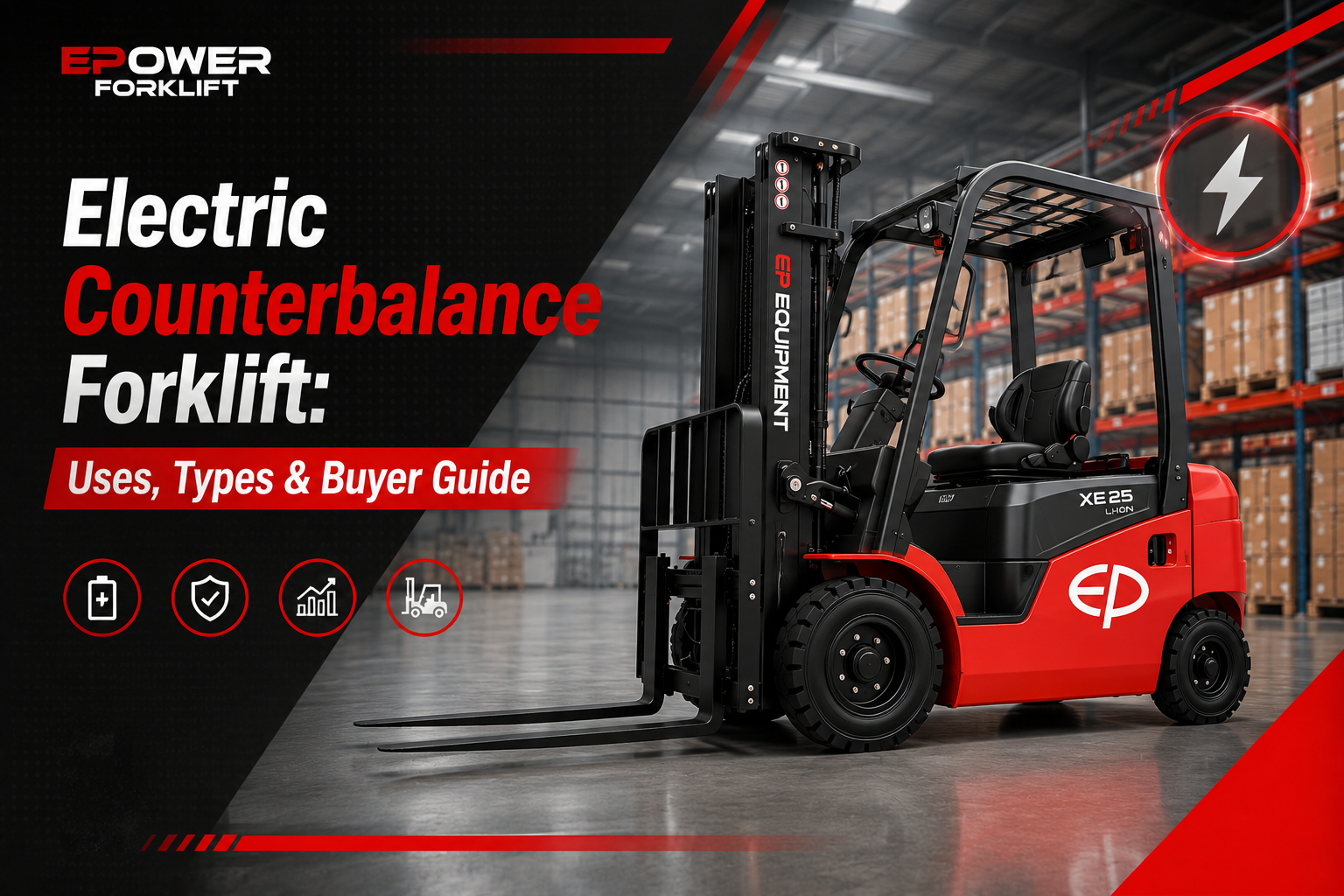
Electric counterbalance forklifts are the most widely deployed material handling machines in Australian warehousing — and the most frequently misspecified. The wrong configuration choice, an undersized battery system, or a capacity rating specified at ground level rather than working height are decisions that compound across every shift for the next five to seven years.
This guide covers the full specification decision for electric counterbalance forklifts — when the category is right and when it is not, how to choose between 3-wheel and 4-wheel configurations, what battery voltage and chemistry mean for your shift pattern and total cost, how to specify load capacity correctly at working height, and which EPower models are best matched to Australian warehouse and industrial applications across the 1.8 to 5.0 tonne range.
If you are reading this after already running the numbers on reach trucks, pallet movers, or stackers and have confirmed that a counterbalance forklift is the right category for your application, this is the guide that takes you through the rest of the decision.
What Is an Electric Counterbalance Forklift?
An electric counterbalance forklift is a sit-down powered industrial truck that uses a rear-mounted counterweight to offset the load carried on the front forks — eliminating the outrigger legs or stabilising arms required by reach trucks and stackers. This open-front design is what makes counterbalance forklifts
operationally versatile: operators can approach a load directly from any direction, pick it up, and transport it without the geometry restrictions that limit narrow-aisle equipment.
An onboard battery — lead-acid or lithium-ion — drives both the traction motor and the hydraulic pump. Zero direct emissions, lower running costs, and a simpler maintenance profile than diesel or LPG equivalents make electric counterbalance forklifts the standard specification for new warehouse fleet purchases across Australia in 2026.
Electric Counterbalance vs Other Warehouse Trucks: What's the Difference?
Before committing to a counterbalance forklift, confirm it is the right equipment category for the primary task. The table below covers the decision boundary between counterbalance forklifts and the most common alternatives.
| Equipment Type | Capacity Range | Max Lift Height | Aisle Width Required | Primary Application |
|---|---|---|---|---|
| Counterbalance (3-wheel) | 1.0t – 2.0t | Up to 7.0m | 2.8m – 3.5m | Narrow indoor warehouse, high-frequency picking |
| Counterbalance (4-wheel) | 1.5t – 10t+ | Up to 7.0m | 3.5m – 4.5m | Loading dock, mixed indoor/outdoor, heavy loads |
| Reach truck | 1.0t – 2.5t | Up to 12.5m | 2.3m – 2.8m | High-rack narrow aisle, indoor only |
| Pallet truck | 1.5t – 3.0t | Floor level | 1.8m – 2.2m | Horizontal transport, dock levelling |
| Electric stacker | 0.5t – 1.5t | Up to 5.0m | 1.8m – 2.5m | Light stacking, compact storage |
| Order picker | 0.5t – 1.0t | Up to 10.0m | 1.5m – 2.0m | Item-level picking, e-commerce fulfilment |
Choose a counterbalance forklift if:
- Your operation involves loading and unloading trucks at dock height
- You need one machine to handle transport, stacking, and loading dock work
- Loads exceed 2.0 tonnes — beyond the practical range of stackers and most reach trucks
- The forklift moves between indoor and outdoor environments
Consider another equipment type if:
- Your primary requirement is high-rack storage above 8 metres — a reach truck delivers better vertical density at lower total cost
- Your operation is exclusively floor-level pallet movement — a pallet truck is faster and more cost-effective for that task alone
- Aisle width is consistently under 2.5 metres — a reach truck or narrow-aisle stacker will outperform a counterbalance in those constraints
Should You Choose a 3-Wheel or 4-Wheel Counterbalance Forklift?
The configuration choice between a 3-wheel and 4-wheel counterbalance forklift comes down to two variables: aisle width and load capacity.
Choose a 3-wheel Counterbalance model when:
- Your narrowest working aisle is under 3.0 metres
- Your maximum load is under 2.0 tonnes
- The operation is exclusively indoor on sealed concrete
Choose a 4-wheel Counterbalance model when:
- Your loads exceed 2.0 tonnes
- The forklift operates in mixed indoor/outdoor conditions or on uneven surfaces
- Aisle width is 3.5 metres or above
The performance and maneuverability differences between configurations go beyond these thresholds —turning radius, stability under load, tyre options, and surface suitability vary in ways that affect daily operation.
For the complete 3-wheel vs 4-wheel analysis, including real-world application scenarios, see EPower's dedicated
How Does the Electric Power System Affect Forklift Performance?
Electric counterbalance forklifts use separate motors for traction and hydraulics, with regenerative braking recovering energy during deceleration and load lowering. The two variables that matter most operationally are battery voltage and battery chemistry.
Battery voltage:
- 48V systems: Standard on lighter-duty models under 2.0 tonnes. Suited to single-shift, light-cycle applications where sustained hydraulic demand is moderate.
- 80V systems: Standard on mid-to-heavy models above 2.0 tonnes. Higher voltage delivers greater power output, faster hydraulic response, and longer operating windows under sustained load — the correct specification for multi-shift or high-cycle operations.
Battery chemistry — lead-acid vs lithium-ion:
| Factor | Lead-Acid | Lithium-Ion |
|---|---|---|
| Charge time | 8–10 hours + cooling | 2–3 hours |
| Opportunity charging | Damages battery | Safe — recommended |
| Performance at 50% charge | Noticeably reduced | Consistent |
| Maintenance | Weekly watering, acid checks | Zero |
| Cycle life | 1,200–1,500 cycles | 3,000–5,000 cycles |
| Battery room required | Yes | No |
For any counterbalance forklift running more than one shift per day, or in an application where charging windows are constrained, lithium-ion is not a premium option — it is the operationally correct specification. The performance degradation of lead-acid at 50% discharge is particularly relevant for counterbalance forklifts, which are typically the highest-utilisation machines in a warehouse fleet.
What to Evaluate Before Buying A Counterbalance Forklift?
Load Capacity: Specify at Working Height, Not Ground Level
Rated capacity is stated at a standard 500mm load centre at ground level. As lift height increases or load centre moves forward — which happens with longer, wider, or unevenly distributed loads — effective capacity drops, sometimes by 20 to 30% at maximum mast extension.
Practical rule: Identify your heaviest regular load, add 20% as a buffer, and confirm the rated capacity of the model you are considering at your actual maximum working height.
Shift Pattern: This Determines Battery Specification
| Shift Pattern | Lead-Acid | Lithium-Ion |
|---|---|---|
| Single shift (up to 8 hours/day) | Viable with overnight charging | Recommended — zero maintenance overhead |
| Double shift (8–16 hours/day) | Requires battery swap infrastructure | Correct specification — opportunity charging eliminates swap |
| Triple shift / 24-hour operation | Not practical | High-capacity battery + opportunity charging strategy |
Surface Conditions and Environment
- Sealed concrete (indoor): Cushion tyres — tighter turning radius, lower rolling resistance
- Smooth outdoor hardstand: Pneumatic tyres — handles minor surface variation and weather exposure
- Rough terrain or unsealed surfaces: High-clearance pneumatic models only — standard warehouse counterbalance forklifts are not rated for rough terrain use.
After-Sales Support and Parts Availability
After-sales support is consistently the most underweighted purchase variable — until a machine breaks down and a critical component is on a four-week international lead time.
Before committing to any brand or model, confirm: local technician availability and average breakdown response time, whether common wear parts are held in local stock, and the warranty terms for both the machine and battery — including the actual claims process.
EPower operates service infrastructure across Melbourne's industrial corridors — Truganina, Epping, and Dandenong South — with local spare parts holdings for EP Equipment models. Response to operational breakdowns is managed by on-the-ground technicians, not a remote national dispatch model.
What Electric Counterbalance Forklifts Does EPower Offer?
EPower Forklift's counterbalance range covers 1.8 to 5.0+ tonnes, all lithium-ion as standard, with local stock across Melbourne facilities and direct after-sales support. Four models cover the primary application requirements of Australian warehouse and industrial operations.
EFL181 — 1.8T Four-Wheel Electric Counterbalance
EOFY Sale: from $26,xxx → $22,xxx | 48V Lithium-Ion
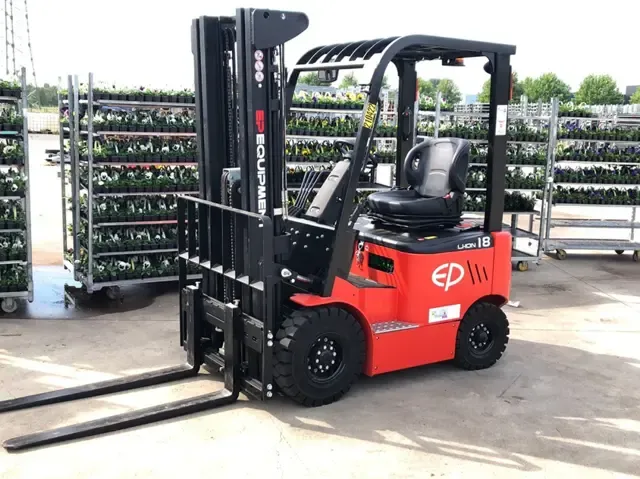
The EFL181 is built for operations that need a reliable electric counterbalance without a dedicated charging infrastructure. The integrated onboard charger allows the machine to charge from any standard power outlet — a practical advantage for small warehouses, construction sites, and multi-location operations where centralised charging is not available.
Specifications:
- Load capacity: 1,800 kg
- Lift height: 4,800–5,500mm
- Turning radius: 1,920mm
- Battery: 48V lithium-ion with integrated charger
- Operating hours: 3–5 hours per charge
Best suited for: Small warehouses, retail operations, construction material handling, and businesses making their first transition from manual or diesel equipment to electric.
Operational boundary: The 3–5 hour operating window suits single-shift, light-cycle use. For continuous or multi-shift operation, the EFL253 or EFX5-351 are the appropriate step up.
EFL253 — 2.5T Four-Wheel Electric Counterbalance
EOFY Sale: from $31,xxx → $26,xxx | 80V Lithium-Ion
The EFL253 is the standard-specification model for full-shift warehouse operation. The 80V system delivers stronger hydraulic performance and traction than 48V equivalents — evident in faster lift speeds, better ramp performance, and consistent output under sustained load. The triplex mast option extends lift height to 6,000mm, covering most standard Australian warehouse racking configurations.
Specifications:
- Load capacity: 2,500 kg
- Lift height: 3,000–6,000mm (duplex or triplex mast)
- Turning radius: 2,305mm
- Battery: 80V lithium-ion
- Operating hours: 5–7 hours per charge
Best suited for: Distribution centres, logistics hubs, manufacturing facilities, and warehouse operations running a full single shift with occasional double-shift requirements.
Operational boundary: The 2,305mm turning radius requires aisle widths of approximately 3.8–4.2 metres for comfortable loaded operation. For tighter aisles, the 3-wheel EFL203 is the more appropriate configuration.
EFX5-351 — 3.5T Four-Wheel Electric Counterbalance
EOFY Sale: from $31,xxx → $29,xxx | 80V Lithium-Ion
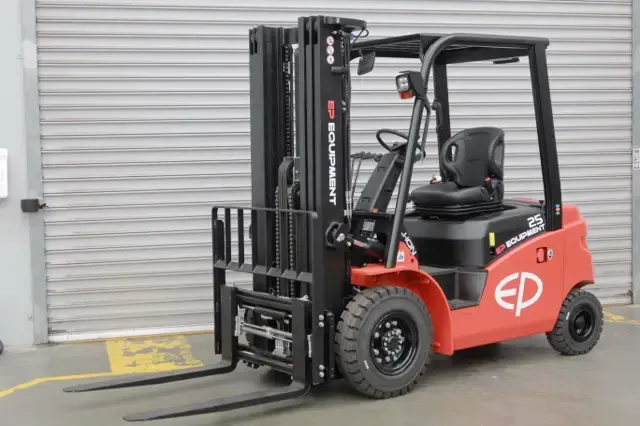
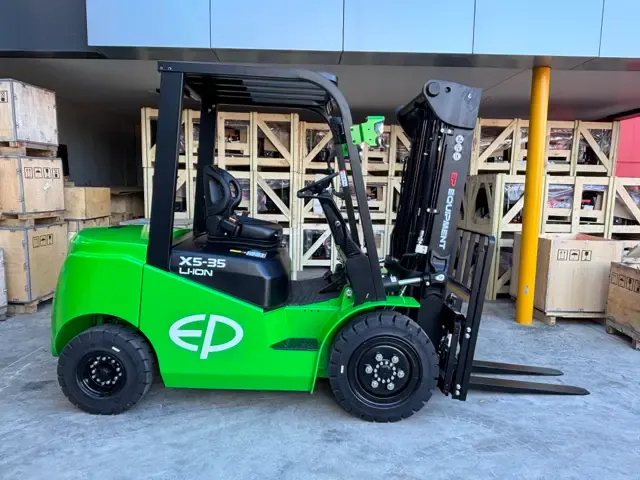
The EFX5-351 is designed for operations that run equipment hard — continuous multi-shift use, heavy pallet weights, and high daily cycle counts. Its modular lithium-ion system supports one or two 280Ah battery packs, allowing the machine to be configured for single-shift use or reconfigured for extended multi-shift operation without replacing the unit. For operations that are scaling, the battery configuration can be upgraded as shift patterns intensify.
Specifications:
- Load capacity: 3,500 kg
- Lift height: 3,000–6,000mm
- Turning radius: 2,498mm
- Battery: 80V lithium-ion, modular 280Ah (single or dual configuration)
- Operating hours: 3–5 hours (single battery); extended with dual configuration
Best suited for: High-throughput distribution centres, manufacturing facilities, and operations transitioning from diesel or LPG forklifts in the 3.0–3.5 tonne class.
CPD50L1 — 5.0T Four-Wheel Electric Counterbalance
EOFY Sale: from $70,xxx → $62,xxx | 80V Lithium-Ion
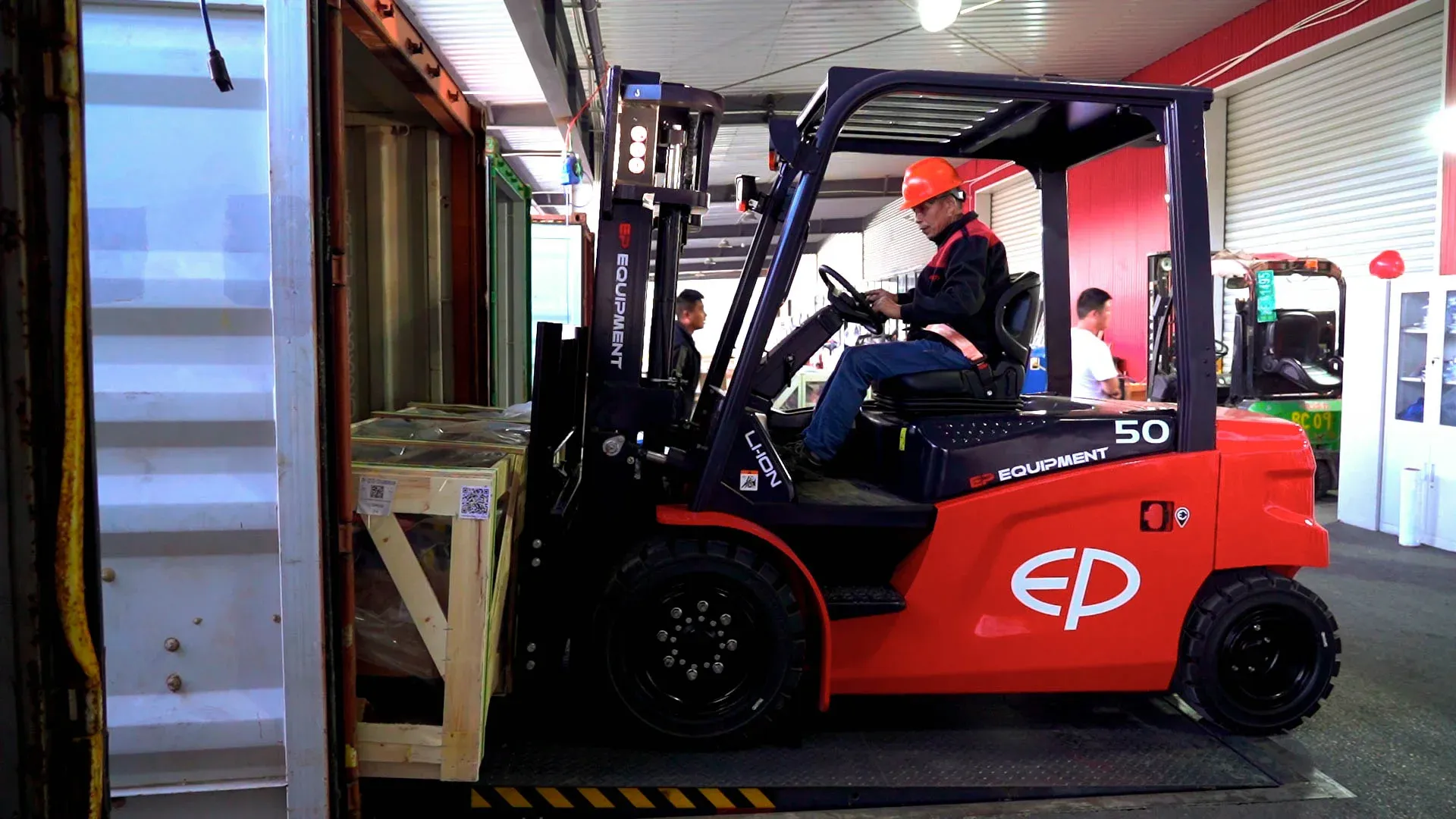
The CPD50L1 covers the capacity range where diesel was previously the default and where most electric suppliers do not have a competitive product. At 5.0 tonnes, it is built for industrial manufacturing, building materials logistics, and large distribution hubs handling oversized or high-mass loads. The high-capacity lithium battery system maintains consistent output across full heavy-cycle shifts — without the performance degradation that lead-acid exhibits under sustained heavy load.
Specifications:
- Load capacity: 5,000 kg
- Lift height: 3,000–6,000mm
- Turning radius: 2,675mm
- Battery: 80V high-capacity lithium-ion
- Attachments: integrated side shift, cascade side shift available
- Operating hours: 3–5 hours per charge
Best suited for: Industrial manufacturing, building and construction materials logistics, large distribution hubs, and operations transitioning from diesel forklifts in the 4.0–5.0 tonne range.
Model Selection Summary
| Model | Capacity | Best Application | EOFY Price |
|---|---|---|---|
| EFL181 | 1.8T | Small warehouse, construction, light single-shift | From $22,xxxGet offer! |
| EFL253 | 2.5T | Distribution, logistics, full single-shift warehouse | From $26,xxxGet offer! |
| EFX5-351 | 3.5T | High-throughput, multi-shift, heavy warehouse | From $29,xxxGet offer! |
| CPD50L1 | 5.0T | Industrial, heavy manufacturing, large distribution | From $62,xxxGet offer! |
Conclusion
Choosing the right electric counterbalance forklift comes down to four variables: load capacity at working height, aisle width, battery specification, and the demands of your operating environment. Getting these factors right has a far greater impact on long-term productivity and operating costs than focusing solely on purchase price.
For most warehouse operations, a counterbalance forklift remains the most versatile solution for loading, transport, and general material handling. The challenge is not choosing a forklift — it is choosing the right specification for the work being performed.
EPower's electric counterbalance range covers applications from 1.8 to 5.0+ tonnes, with lithium-ion models available for everything from small warehouses to high-throughput industrial operations.
If you are unsure which model best matches your load requirements, shift pattern, and site conditions, speak with the EPower team before making a decision. We assess the application first, then recommend the most suitable equipment. Talk to the EPower Forklift team →
View all EOFY models and pricing →
FAQs
How much does an electric counterbalance forklift cost in Australia?
Most electric counterbalance forklifts cost between AUD $22,xxx and $70,xxx+, depending on capacity, battery type, and specifications.
What is the difference between a 3-wheel and 4-wheel electric forklift?
A 3-wheel forklift offers better manoeuvrability in narrow aisles, while a 4-wheel forklift provides greater stability and higher load capacity.
Can an electric counterbalance forklift work outdoors?
Yes. Models with pneumatic tyres can operate on smooth outdoor surfaces, loading yards, and hardstands.
How long does an electric counterbalance forklift battery last?
A lithium-ion battery typically lasts 3,000–5,000 charge cycles and can provide 3–8 hours of operation per charge.
What is the best electric counterbalance forklift for a small warehouse?
A 1.8T–2.5T electric forklift is usually the best choice, offering a balance of compact size, lifting capacity, and manoeuvrability.