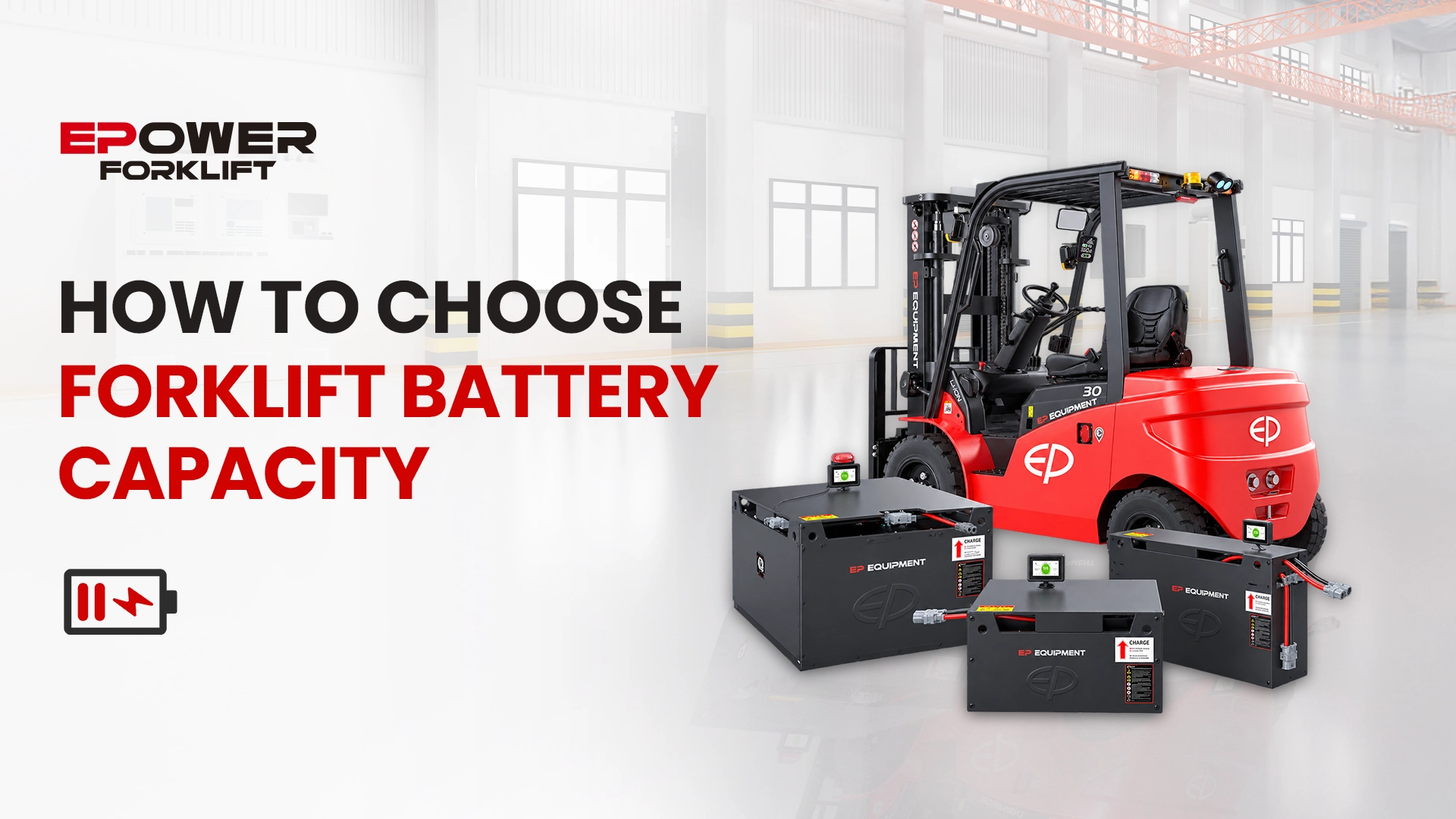
To understand how to choose forklift battery capacity, size the battery for the longest realistic operating period between charging opportunities not simply the total length of the shift.
Start with the battery voltage, chemistry, physical size and weight approved for the forklift. Then match the battery’s energy capacity to actual productive hours, load weight, lift cycles, travel distance, gradients, surface conditions, outdoor exposure and operating temperature. Finally, confirm that the charger can recover enough energy during the breaks available on your site.
A standard battery may be sufficient when a forklift works intermittently for three to five hours per day and can recharge during lunch or other scheduled downtime. A larger battery is more likely to be required when the forklift operates continuously, carries heavy loads, travels long distances, works on gradients or must remain available with little time to charge.
- Forklift load capacity and battery capacity are related operationally, but they are not the same specification.
- Forklift battery amp-hours cannot be compared accurately without voltage. Compare nominal energy in kilowatt-hours when assessing batteries with different voltages.
- Published runtime figures are planning guides, not guarantees. Actual runtime depends on the truck, battery, charger, operator, load profile and site conditions.
What Does Forklift Battery Capacity Mean?
Forklift battery capacity describes how much electrical charge or energy a battery can store. Three figures matter:
| Battery specification | What it tells you | What it does not tell you alone |
|---|---|---|
| Voltage (V) | The electrical system voltage required by the forklift | Runtime or compatibility with the site’s mains supply |
| Amp-hours (Ah) | The quantity of charge the battery can deliver over time | Total energy when batteries have different voltages |
| Kilowatt-hours (kWh) | Approximate nominal energy stored in the battery | Exact usable runtime under real working conditions |
Buyers often focus on forklift battery amp hours because Ah is prominent on the data plate. However, 460Ah at 80V stores much more energy than 460Ah at 48V. The voltage and amp-hour rating must therefore be assessed together.
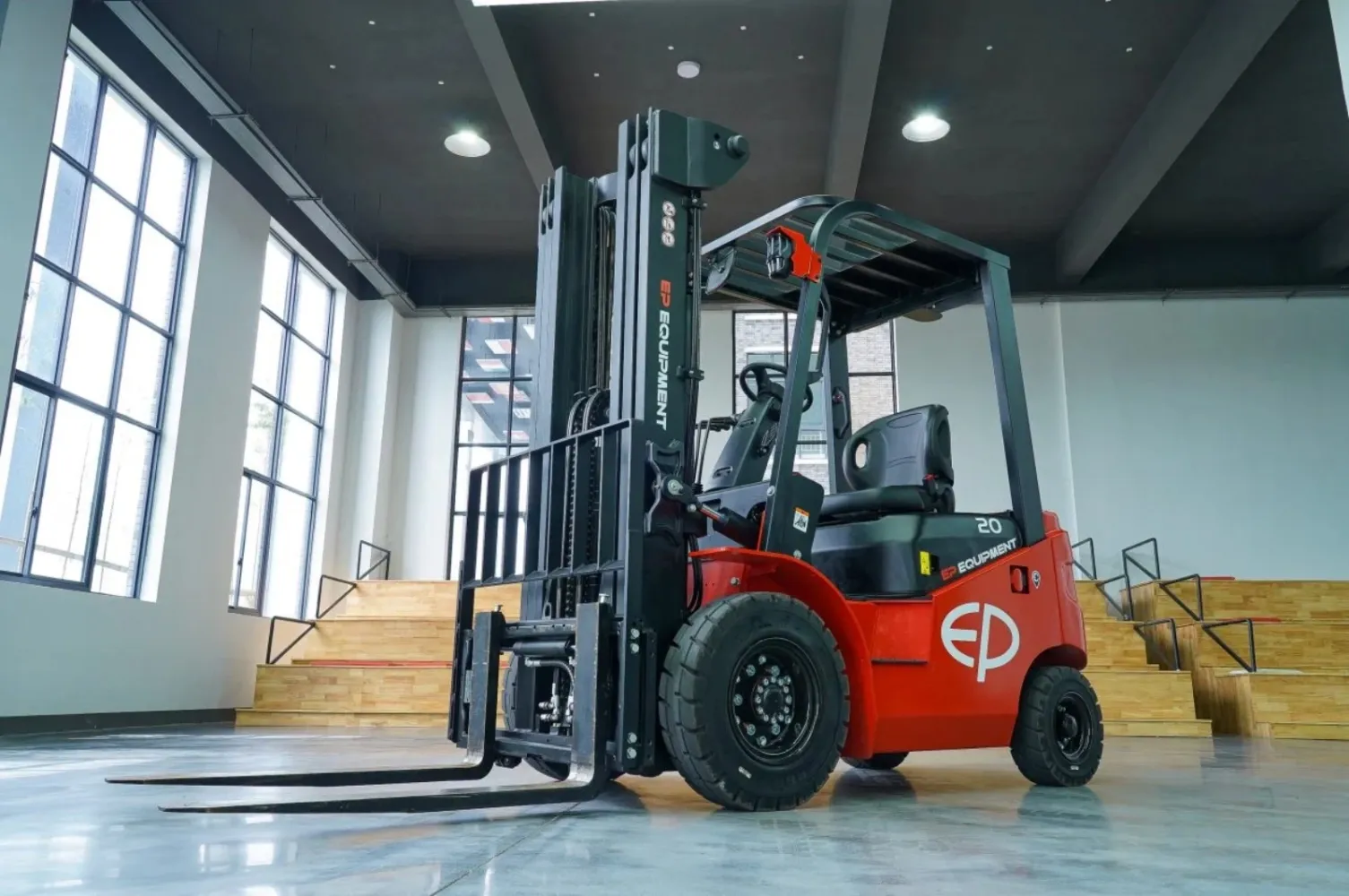
Electric forklift battery capacity also needs to be considered within an approved truck–battery–charger system. A higher-Ah battery is not automatically compatible because it fits inside the battery compartment. Battery voltage, dimensions, weight, connector, Battery Management System (BMS), CAN communication and charger profile all need to match the forklift manufacturer’s specification.
How Do You Calculate Battery Energy From Volts and Amp-Hours?
Use this formula to compare nominal battery energy:
Nominal battery energy (kWh) = voltage × amp-hours ÷ 1,000
| Battery specification | Approximate nominal energy | Operational meaning |
|---|---|---|
| 48V/150Ah | 18.4kWh | Compact forklift configuration; runtime remains duty-dependent |
| 80V/230Ah | 18.4kWh | Common standard option for selected 2.0–2.5t forklifts |
| 80V/280Ah | 22.4kWh | Higher-energy option used across selected medium-capacity models |
| 80V/410Ah | 32.8kWh | Extended-runtime option for selected intensive applications |
| 80V/460Ah | 36.8kWh | Approximately twice the nominal energy of 80V/230Ah |
| 80V/560Ah | 44.8kWh | Common option in selected 3.0–5.0t applications |
| 80V/690Ah | 55.2kWh | Larger option for selected 5t applications |
| 309V/150Ah | 46.4kWh | High-voltage example that stores more energy than 80V/460Ah |
These are nominal calculations. They do not deduct BMS protection limits, conversion losses, cold-temperature effects or the reserve needed for operational peaks. They also do not show how efficiently a specific forklift converts battery energy into travel, lifting and hydraulic work.
The comparison does reveal an important point: Ah alone can be misleading. A 309V/150Ah battery stores approximately 46.4kWh, while an 80V/460Ah battery stores approximately 36.8kWh. The lower-Ah battery stores more energy because its voltage is much higher.
How to Choose Forklift Battery Capacity in Seven Steps
1. Confirm the Approved Battery System
Before calculating runtime, confirm the forklift manufacturer’s approved:
- Battery voltage and chemistry
- Minimum and maximum battery weight
- Battery dimensions and mounting method
- Connector and cable specification
- BMS and truck communication requirements
- Compatible charger model and charge profile
- Cold-storage or environmental options, where required
Do not retrofit a different voltage, chemistry or battery weight without written technical approval. On a counterbalance forklift, battery weight may form part of the truck’s stability design.
2. Separate Shift Length From Productive Operating Time
An eight-hour shift does not necessarily require eight hours of continuous battery runtime. A forklift may spend significant time waiting at a dock, idling between picks, parked during breaks or unused while operators complete other tasks.
Record the following over at least one representative working week:
- Key-on hours and actual travel hours
- Lifting and hydraulic activity
- Start-of-shift and end-of-shift state of charge
- Energy added by the charger
- Loads moved and average load weight
- Travel distance and ramp usage
- Breaks, shift handovers and other idle periods
- Peak days, seasonal surges and unexpected delays
For an existing battery electric forklift, BMS, telematics and charger records provide a stronger basis than operator estimates alone.
3. Find the Longest Window Without Charging
The critical number is the longest period the forklift must work before it can recharge.
A forklift operating from 7:00 am to 3:00 pm may have a 15-minute morning break, a 30-minute lunch break and loading delays that create useful charging windows. Another forklift may work the same shift continuously in a yard where the charger is too far away. These two sites need different battery and charger strategies even if the forklifts have the same rated load capacity.
4. Classify the Duty Intensity
Duty intensity is affected by more than operating hours. A forklift consumes more energy when it:
- Carries heavier loads more frequently
- Performs repeated high lifts
- Accelerates and brakes continuously
- Travels long distances
- Climbs ramps or works on gradients
- Uses energy-intensive attachments
- Operates on rough or high-resistance surfaces
- Works outdoors in heat, rain or cold
A short but demanding shift can require more battery energy than a longer, low-intensity warehouse shift.
5. Convert Measured Energy Demand Into the Approved Capacity Range
Where reliable energy data is available, identify the highest realistic energy use between charging windows. Then select an approved battery that can supply that requirement while retaining the manufacturer-recommended operating reserve.
If the chosen truck uses a fixed 80V system, the relationship can be expressed as:
Required nominal Ah = required nominal kWh × 1,000 ÷ 80V
This conversion is only a screening calculation. EPower should still validate usable battery energy, peak current demand, BMS limits, battery weight and the approved configuration for the exact model.
6. Match Charger Output to Available Breaks
A larger battery does not solve a shift-coverage problem if the charger cannot replace enough energy during the available downtime.
Confirm:
- Charger input: single-phase or three-phase
- Charger output voltage and current
- Time available for each charging session
- Whether several forklifts will charge simultaneously
- Distance between the work zone and charger
- Whether the site electrical supply can support the total demand
- The battery manufacturer’s approved charging temperature and charge rate
Lithium-ion batteries can support opportunity charging, but the charging schedule still needs to be followed. EPower’s guide to electric forklift battery charging mistakes explains why deep discharge, incompatible chargers and unsuitable charging temperatures reduce battery performance and life.
7. Validate the Result Under Real Conditions
After commissioning, review battery performance over normal and peak weeks. Track:
- Lowest state of charge reached during each shift
- Energy added during each charge
- Missed charging opportunities
- Temperature and fault events
- Runtime by task or operator
- Unplanned downtime
- Changes in travel route, load profile or attachments
If the battery finishes every shift with a very high state of charge, the site may have paid for capacity it does not use. If the forklift repeatedly approaches its lower BMS limit, the problem may be insufficient capacity, insufficient charging time, excessive duty intensity or poor charging discipline.
How Does Shift Pattern Affect Forklift Battery Capacity?
Shift pattern affects how long the forklift must operate between charging opportunities. A light single-shift warehouse, a double-shift 3PL site and a continuous operation can require different battery and charger strategies even when the forklift load capacity is similar.
For a detailed comparison by single-shift, double-shift and 24/7 operation, read EPower’s forklift battery sizing by shift pattern guide.
Which Working Conditions Increase Battery Demand?
| Working condition | Why energy use increases | Battery-selection response |
|---|---|---|
| Heavier average loads | More energy is required for acceleration, travel and lifting | Size from actual load profile, not maximum rated capacity alone |
| Frequent high lifts | Hydraulic demand and cycle time increase | Include lift height and lifts per hour in the duty survey |
| Long travel routes | Traction motors run for longer periods | Measure route distance and laden/unladen travel ratio |
| Gradients and ramps | Climbing requires higher sustained power | Record gradient, ramp length and travel frequency |
| Rough or soft surfaces | Rolling resistance and traction demand rise | Use a suitable truck and tyre configuration before adding battery capacity |
| Attachments | Add weight and may increase hydraulic demand | Confirm attachment rating, residual load capacity and energy impact |
| Outdoor work | Temperature, wind, water exposure and surface conditions vary | Specify environmental protection and assess seasonal peaks |
| Continuous operation | Fewer idle periods are available for charging | Consider a larger battery and higher-output charging |
| Cold storage | Low temperature reduces usable performance and affects charging | Use a cold-storage package, thermal protection and additional capacity where required |
Battery capacity should not be used to compensate for selecting the wrong forklift type. A larger battery will not turn a standard warehouse forklift into a rough-terrain machine or make an unsuitable truck safe on a steep gradient.
Is Battery Capacity the Same as Forklift Load Capacity?
No. Battery capacity measures stored electrical energy, usually in Ah or kWh. Forklift load capacity measures how much weight the truck can safely lift at a stated load centre and lift height.
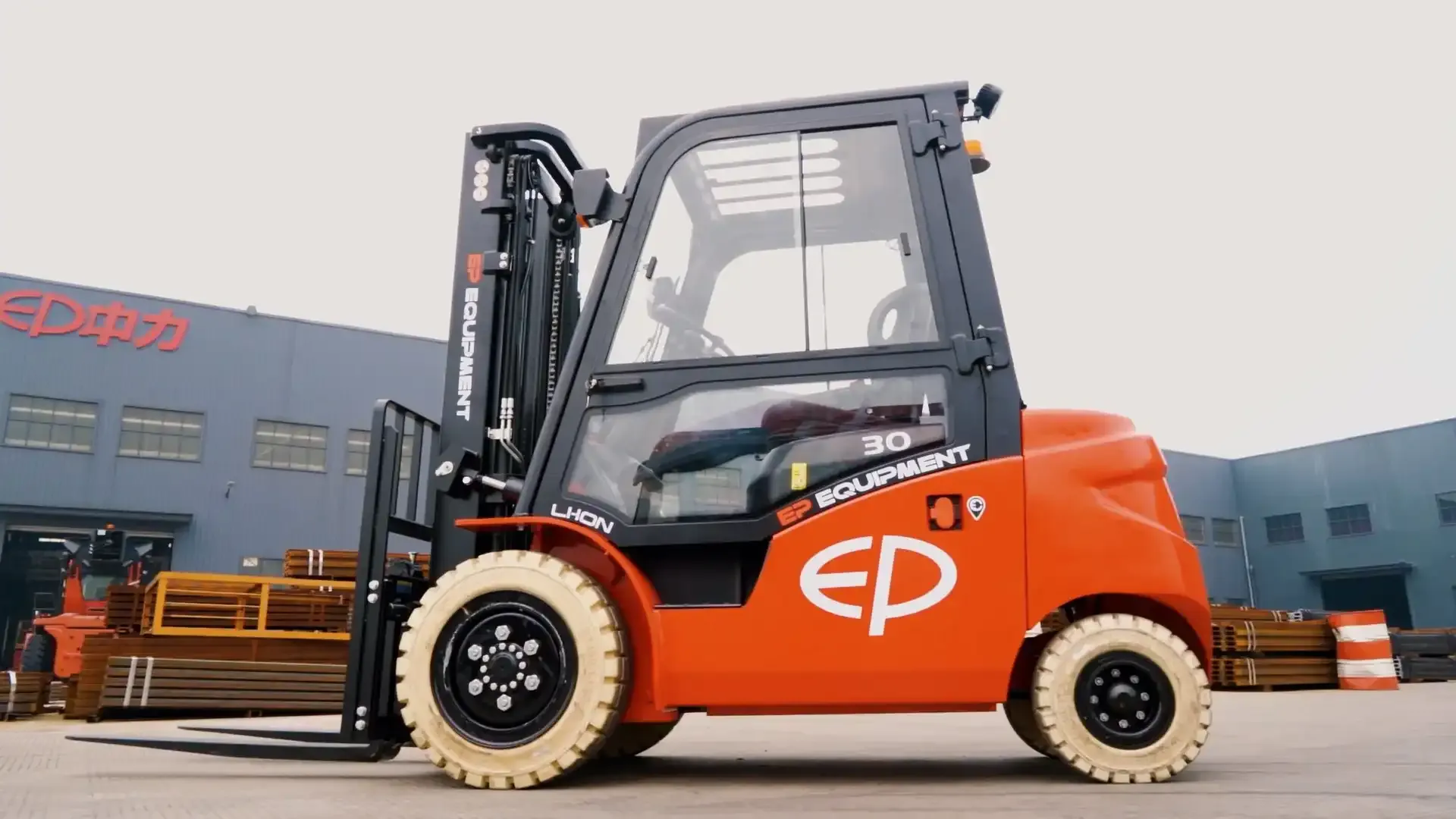
The two specifications are related in operation, but they solve different questions. Load capacity tells you whether the forklift can safely handle the load. Battery capacity tells you whether the forklift can store enough energy to complete the required duty cycle.
A larger battery does not increase the forklift’s rated lifting capacity. The approved load capacity plate remains the authority for how much the forklift can lift.
Forklift Battery Selection Checklist
Before approving a battery electric forklift quotation, confirm:
- Approved battery voltage, chemistry, weight, dimensions, BMS communication and charger profile
- Actual productive working hours and the longest window between charging opportunities
- Maximum and average load weights, lift height, load centre and attachment use
- Travel distance, gradients, surface conditions, outdoor exposure and seasonal peaks
- Available charging windows, charger output and site electrical supply
- Cold storage, moisture, heat or harsh-environment requirements
- Warranty terms, operating-hour limits, commissioning and local service support
The final battery choice should be the smallest approved capacity that reliably supports the required duty cycle, charging windows and operating reserve.
When Is a Larger Battery Not the Best Choice?
A larger battery is not automatically the most economical or operationally effective option.
It may be unnecessary when:
- The forklift works only a few intermittent hours per day
- Predictable breaks already provide enough opportunity charging
- The standard battery finishes the peak shift with adequate reserve
- The charger, rather than the battery, is causing poor availability
- Operators are missing scheduled charging windows
- The travel route or forklift type is inefficient for the task
- Seasonal peaks can be covered more economically through short-term hire
A larger battery can increase purchase cost, weight and charging time. In some models, it may also require a different charger or electrical supply. The best solution is the smallest approved capacity that reliably supports the required duty cycle, peak workload and operating reserve.
Conclusion
The correct answer to how to choose forklift battery capacity begins with the shift pattern. Confirm the forklift’s approved battery system, measure energy use between real charging opportunities and adjust the specification for load weight, travel, lifting, gradients, surface and temperature.
For intermittent three- to five-hour applications with regular breaks, a standard battery may be sufficient. For continuous warehouse, 3PL, supermarket or outdoor operations, a larger battery and higher-output charger may be required. Cold storage, rough terrain and high-capacity work need purpose-built configurations rather than capacity upgrades alone.
EPower supplies EP Equipment electric forklifts with model-specific battery and charger options for Australian operations. Talk to EPower Forklift to review your loads, shift pattern, charging windows, electrical supply and operating environment before selecting the final battery capacity. Contact EPower team →
Frequently Asked Questions
How do I calculate the battery capacity needed for a forklift?
Measure the maximum energy used between charging periods, keep the manufacturer’s recommended safety reserve, then choose an approved battery. Compare batteries in kWh (voltage × Ah ÷ 1,000), and also confirm usable energy, weight, BMS, and charger compatibility with the supplier.
Is a higher Ah forklift battery always better?
No. Higher Ah can extend runtime when voltage is the same, but it may add cost, weight and charging time. The battery must be manufacturer approved, and the extra capacity should solve a measured shift-coverage requirement.
How many hours does an electric forklift battery last?
Depending on forklift class and duty cycle, indicative operating time can range from approximately three hours to ten hours or more. Loads, lift frequency, travel distance, gradients, temperature and opportunity charging can change the result substantially.