Mast specification is one of the most common places forklift procurement mistakes happen — not in choosing the wrong brand or the wrong capacity, but in specifying the wrong mast for the site. A forklift that cannot fit through the loading dock door, or one that hits the ceiling when picking a load at floor level, is a mast specification problem. Both are avoidable with three measurements confirmed before the order is placed.
What Is a Forklift Mast and How Does It Work?
The mast, also called the upright, is the vertical assembly at the front of the forklift that raises and lowers the forks. It consists of interlocking rail sections, hydraulic cylinders and chains. As the hydraulic system extends the mast sections, the carriage and forks rise.
Three measurements matter for every mast specification:
Collapsed height is the mast height when fully lowered. This determines whether the forklift can pass through low-clearance points on site, including dock doors, container entries, mezzanine entries and fire door frames. Check this first, because a forklift that cannot pass through the lowest clearance point is unsuitable even if it can reach the required shelf height.
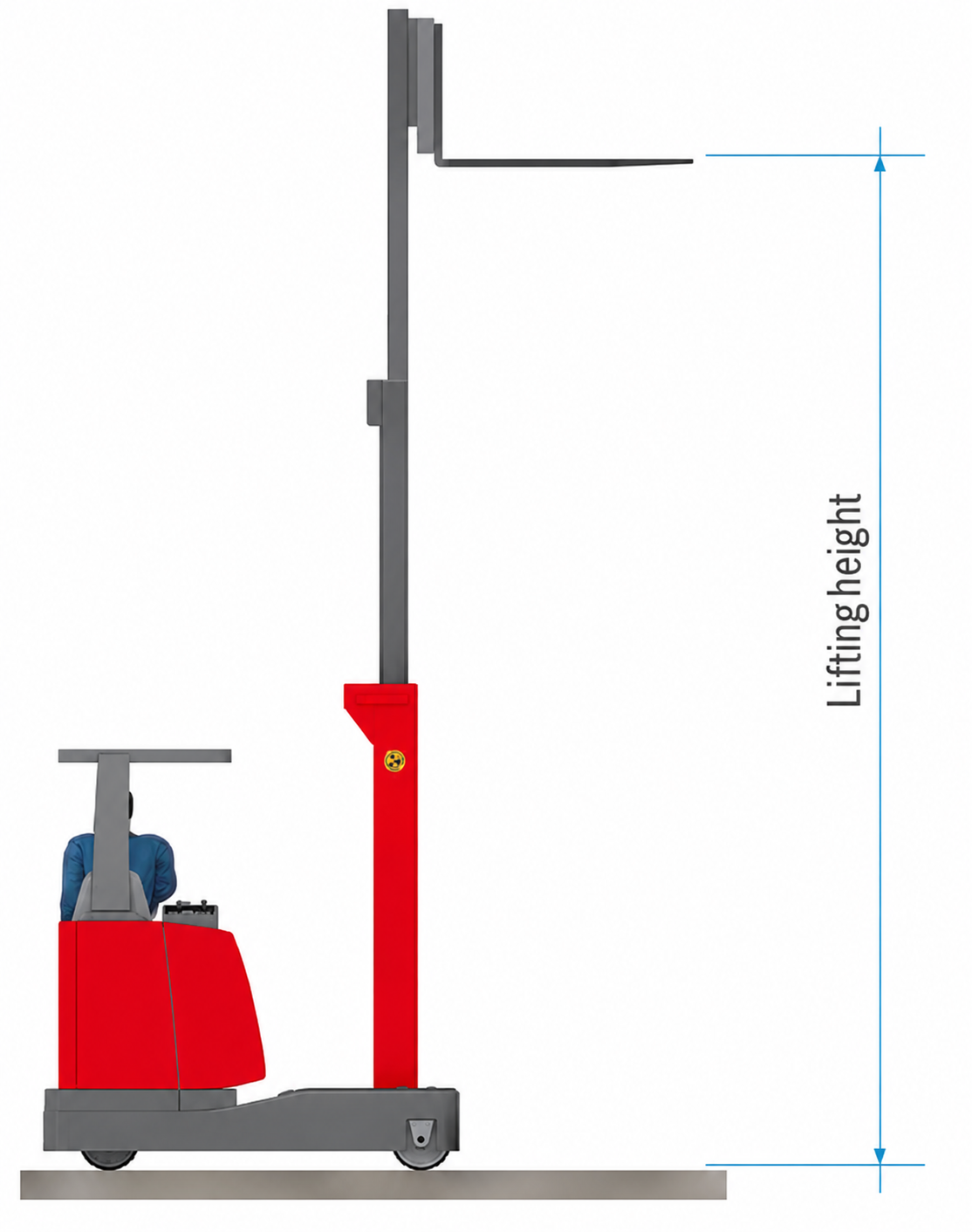
Maximum fork height is the height the forks reach when the mast is fully extended. This must exceed the top shelf of the racking system, with approximately 150 to 200mm working clearance for practical pallet placement and retrieval.
Free lift is the vertical distance the forks can rise before the outer mast sections begin to extend upward. This matters inside containers, under ductwork or below mezzanines, where the mast must not grow taller while the load is being lifted.
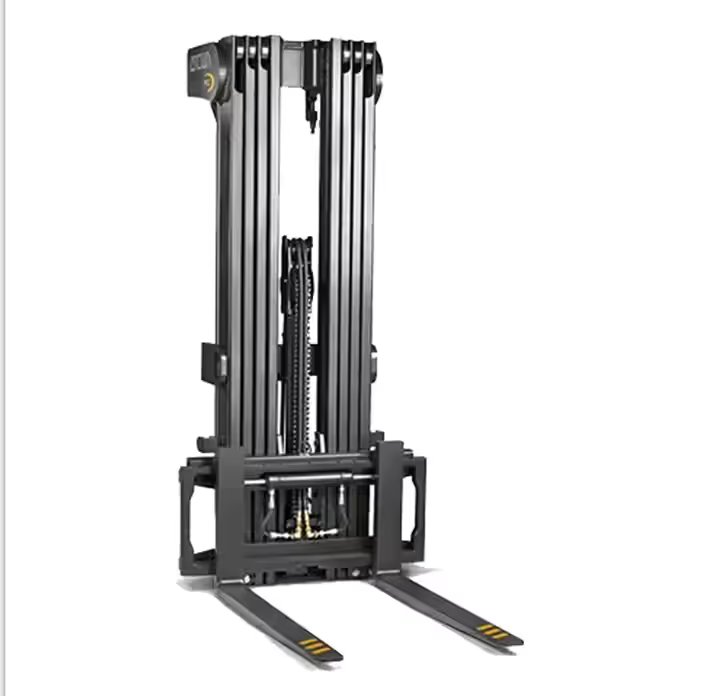
Maximum fork height and extended mast height are not the same measurement. Maximum fork height tells you how high the forks can lift. Extended mast height tells you how tall the mast becomes when fully raised.
What Are the Main Types of Forklift Masts?
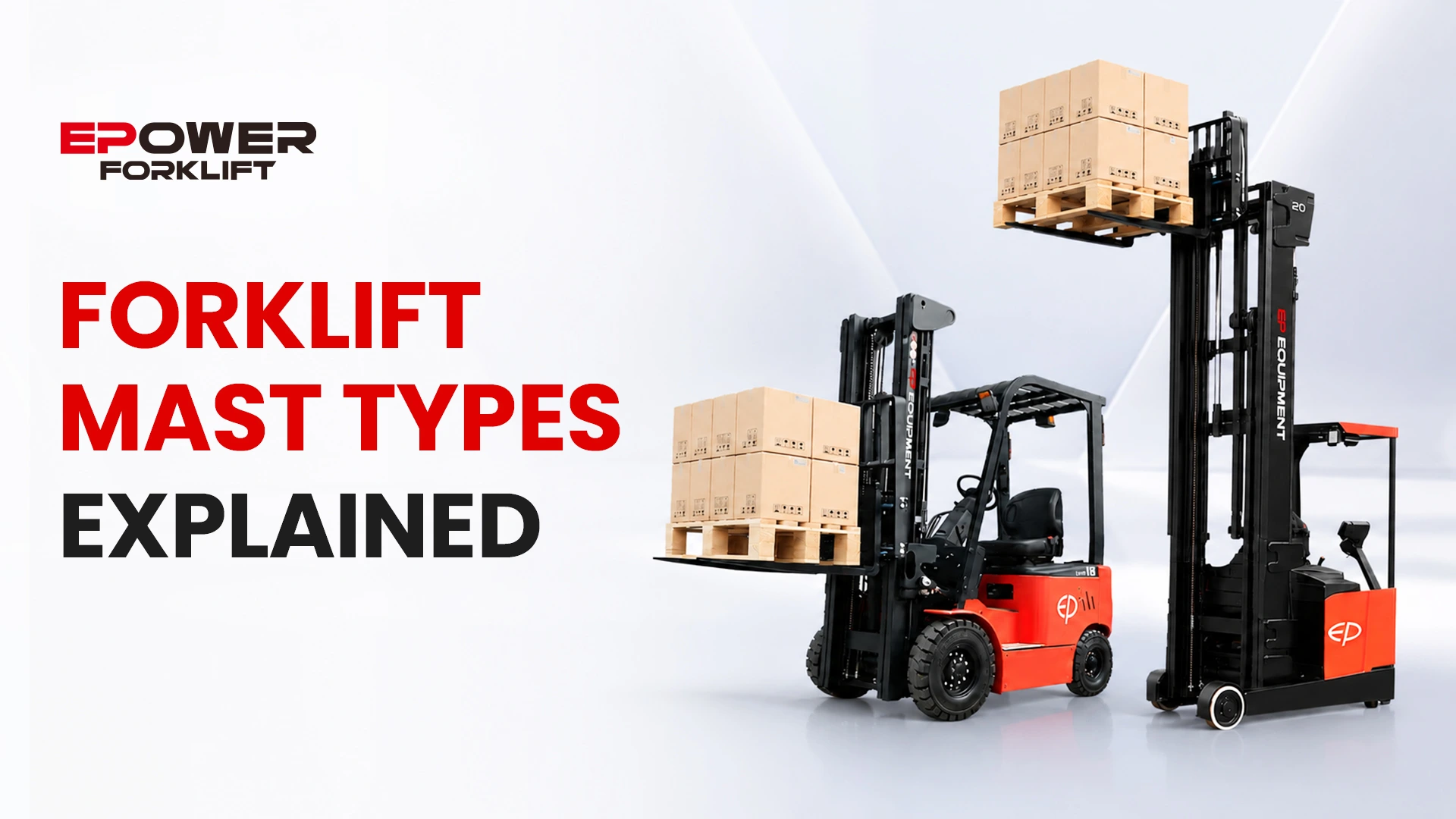
Forklift masts are commonly described in the industry as simplex, duplex, triplex and quad. EP Equipment, however, uses three orderable mast configurations: 2-Standard, 2-Free and 3-Free. The sections below explain how the generic mast names map to EP’s actual specification terms.
Simplex Mast (Single-Stage)
A simplex mast is a single-stage mast with limited or no free lift. It is mainly used as an industry reference for low-lift applications with no overhead constraint. EP Equipment does not offer a single-stage mast in its mast specification table; two-stage is the entry configuration.
Duplex Mast (Two-Stage)
A duplex mast has two stages. In EP Equipment terminology, the relevant two-stage configurations are 2-Standard and 2-Free. 2-Standard provides standard free lift for conventional warehouse use, while 2-Free provides full free lift for low-overhead applications.
Triplex Mast (Three-Stage)
A triplex mast has three stages. In EP Equipment terminology, the relevant configuration is 3-Free, a three-stage full-free-lift mast. It is used where the site needs higher lift height while still managing collapsed height and free lift, such as higher racking, doorway constraints or container loading.
Quad Mast (Four-Stage)
A quad mast is a four-stage mast used in some high-bay applications. EP Equipment does not offer a four-stage mast in its mast specification table. For applications above the practical counterbalance mast range, the better EP pathway is usually a reach truck rather than a quad mast.
What Is Free Lift and Why Does It Matter?
Free lift is the vertical distance the forks can rise before the outer mast sections begin to extend upward. It matters wherever the forklift must lift or carry loads under an overhead constraint, such as inside a container, under ducting, below sprinkler lines or beneath a mezzanine.
Maximum fork height tells you which shelf the forklift can reach. Free lift tells you whether the forklift can raise the load before the mast grows taller. In open warehouse space, standard free lift may be sufficient. In low-overhead areas, full free lift may determine whether the forklift can complete the task at all.
For container loading, a standard dry container has an internal height of approximately 2,393mm and a door opening height of about 2,280mm. The mast must clear the door opening and provide enough free lift to pick a pallet without extending into the container roof.
For EP forklifts, this is usually handled by specifying 3-Free, EP’s three-stage full-free-lift configuration, rather than asking for a separate “container mast”. The exact collapsed height, free lift and backrest option should be confirmed against the container type and load being handled.
What Mast Types Does EP Equipment Offer?
EP Equipment uses three practical mast configuration terms: 2-Standard, 2-Free and 3-Free. These are the terms buyers should use when comparing EP specifications or requesting a quote from EPower.
| EP mast types | Common name | Practical meaning |
|---|---|---|
| 2-Standard | Duplex standard mast | Two-stage mast with standard free lift |
| 2-Free | Duplex full-free-lift mast | Two-stage mast with full free lift |
| 3-Free | Triplex full-free-lift mast | Three-stage mast with full free lift |
2-Standard: Two-Stage Standard Free Lift
2-Standard is EP’s entry two-stage mast configuration. It is suitable for standard indoor warehouse work where the forklift does not need to lift loads under a low ceiling, inside a container or below a mezzanine.
Across many EP 2.0T to 3.5T counterbalance models, 2-Standard free lift is typically around 120 to 135mm, depending on the model. EP’s 2-Standard counterbalance mast options typically top out at 4,500mm maximum fork height.
Choose 2-Standard when the site has enough overhead clearance, the racking height is moderate and full free lift is not required.
2-Free: Two-Stage Full Free Lift
2-Free is also a two-stage mast, but it provides full free lift. This allows the forks to rise much further before the outer mast section begins to extend upward.
This matters in low-overhead areas such as doorways, mezzanines, ducting, sprinkler lines or low internal structures. It is also useful when the site needs full free lift but does not require the extra lift height of a three-stage mast.
A key point from EP mast data is that full free lift does not always increase collapsed height. For example, on the ICE251 at 3,000mm lift height, the 2-Standard mast has a collapsed height of 2,075mm with 140mm free lift. The 2-Free mast has a collapsed height of 2,035mm with 1,470mm free lift. In this case, the 2-Free mast is 40mm lower when collapsed and provides much more free lift.
3-Free: Three-Stage Full Free Lift
3-Free is EP’s three-stage full-free-lift configuration. It is used when the forklift needs higher lift height while still keeping collapsed height and free lift suitable for constrained areas.
On EP counterbalance models, 3-Free mast options start from around 4,300mm maximum fork height and commonly extend up to 6,000mm, with selected high-capacity counterbalance models reaching 7,000mm (EFL703-HV and EFL1003).
Choose 3-Free when the application combines higher racking with doorway clearance, ceiling constraints, container loading or other low-overhead requirements.
For container work, the EP configuration to specify is usually 3-Free, not a separate “container mast”. On the CPD18TVL with a 3-Free mast at 4,500mm lift height, collapsed height is 2,140mm and free lift is 1,430mm without a load backrest. With a load backrest fitted, free lift reduces to 1,115mm. Confirm the backrest option before ordering because it materially changes usable free lift.
What If the Site Needs More Than 7,000mm Lift Height?
If the site needs lift heights beyond the practical EP counterbalance mast range, the answer is usually not a four-stage counterbalance mast. For high-bay applications, you can review EP reach truck options instead. Examples include the CQD16L at 8m, CQD20LB at 9.5m and CQD20L at 12m, subject to load profile, aisle width, battery requirement and model availability.
How Do You Choose the Right Mast for Your Warehouse?
Three steps, confirmed in order before placing the order.
Step 1: Identify the Lowest Clearance on Site
Measure the lowest point the forklift must pass through during normal operation, including dock doors, container entries, mezzanine entries, fire door frames and overhead conveyor clearances.
The collapsed mast height must be lower than this measurement, with a practical safety margin for travel.
Step 2: Confirm the Required Maximum Fork Height
Measure the top shelf height and add approximately 150 to 200mm working clearance for practical pallet placement and retrieval.
Also check the forklift’s load capacity chart at the actual working height, because rated capacity can reduce as lift height increases.
Step 3 — Assess the free lift requirement
Check whether the forklift needs to pick or carry loads under overhead constraints, such as containers, ducting, sprinkler lines, low mezzanine areas or low internal doorways.
If overhead constraints exist, specify an EP full-free-lift configuration: 2-Free or 3-Free, depending on the required lift height. If the site has moderate racking height and no low overhead constraints, 2-Standard may be sufficient.
| Application | Recommended mast type | Key requirement |
|---|---|---|
| Standard indoor warehouse with moderate racking height | 2-Standard | Check maximum fork height and collapsed height. |
| Indoor warehouse with low overhead constraints | 2-Free | Full free lift must allow lifting before the outer mast extends. |
| Higher racking with doorway or ceiling constraints | 3-Free | Check maximum fork height, collapsed height and free lift together. |
| Container loading and unloading | 3-Free | Collapsed height must clear the container door, with enough free lift for lifting inside the container. |
| Mezzanine, ducting or other overhead obstruction areas | 2-Free or 3-Free | Choose based on required lift height, collapsed height and free lift. |
Before finalising the mast, confirm collapsed height, maximum fork height, free lift and residual capacity. Mast changes after delivery can be expensive and may not be possible on every model.
Does Mast Type Affect Load Capacity?
Yes. Lifting capacity reduces as lift height increases. This is residual capacity, and it applies to every mast type.
The practical implication is simple: a forklift rated at 2,500kg may not safely lift 2,500kg at the full height of the mast. Always confirm the load capacity chart at the actual working height, not just the headline rated capacity.
Conclusion
Choosing the right forklift mast starts with the site, not the catalogue. Before ordering, confirm the lowest clearance the forklift must pass through, the maximum fork height required at the racking, and whether full free lift is needed for containers, mezzanines or low-overhead areas.
The correct mast must also be checked against the forklift’s residual capacity at the actual working height. A mast that reaches the shelf is not enough if the forklift cannot safely lift the required load at that height.
For EP forklifts, EPower can help match the correct EP mast configuration, including 2-Standard, 2-Free or 3-Free, against collapsed height, free lift, maximum fork height and load capacity chart data before the order is finalised. Contact EPower to confirm the right mast specification for your application.
Frequently Asked Questions
What is the difference between a duplex and triplex forklift mast?
A duplex mast has two stages, while a triplex mast has three stages. In EP Equipment terminology, 2-Standard and 2-Free are two-stage configurations, while 3-Free is a three-stage full-free-lift configuration.
What forklift mast is best for container loading?
For EP Equipment forklifts, container loading usually requires 3-Free, not a separate “container mast”. The mast must have low collapsed height, enough free lift and confirmed residual capacity for the load and container type.
Does a taller mast reduce forklift capacity?
Yes. Usable lifting capacity usually reduces as lift height increases. Always check the forklift’s load capacity chart at the actual working height, not only the headline rated capacity.
What measurements do I need before choosing a forklift mast?
Confirm the lowest clearance on site, maximum fork height, free lift requirement, load weight at height, load centre, backrest or attachment requirements and any container, mezzanine or low-overhead constraints.