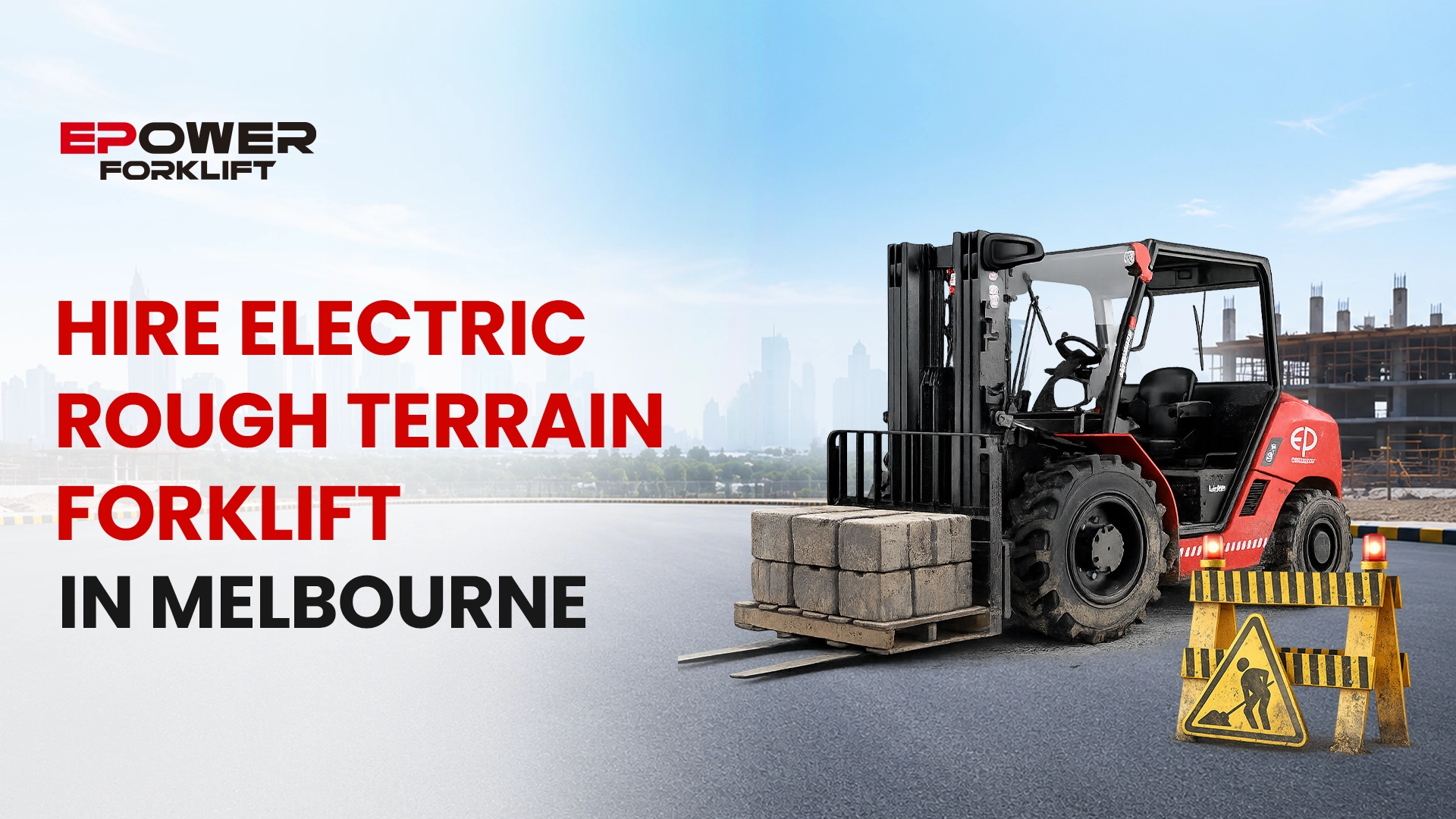
Electric rough terrain forklift hire is not the right choice for every outdoor site. For short-cycle construction projects, diesel, LPG, petrol, or a lower-cost used outdoor machine may still make better commercial sense.
Where electric rough terrain hire becomes more compelling is in fixed-site operations with mains power, long-term rough-ground handling needs, and real noise, emissions, or fuel-logistics constraints.
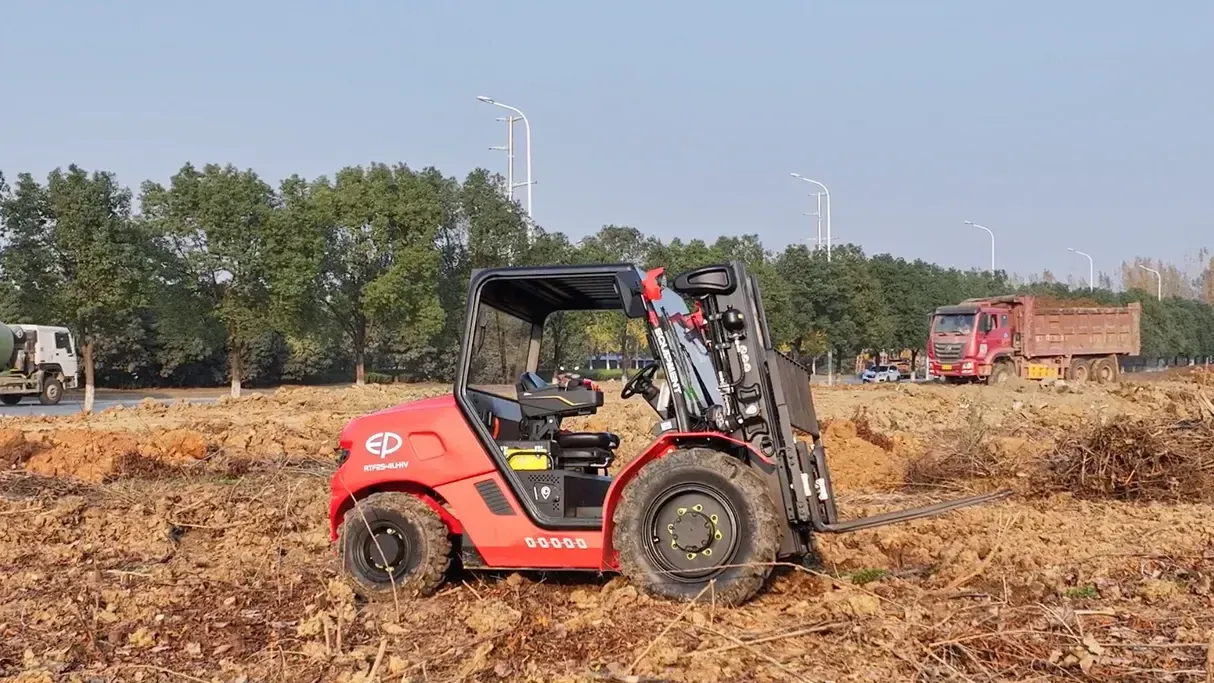
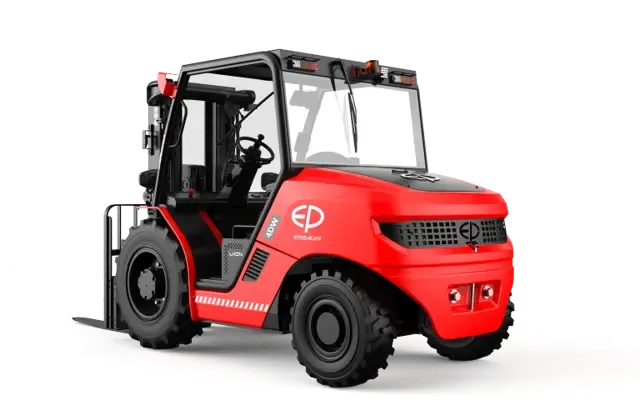
EPower currently hires the EP RTF25-4L1-HV, a 2.5-tonne electric rough terrain forklift with a 309V/150Ah lithium-ion battery, switchable 2WD/4WD, and 50% laden gradeability. For the right site, it gives operators a practical electric alternative to diesel rough terrain hire.
What Is a Rough Terrain Forklift and When Do You Need One?
A rough terrain forklift is purpose-built for outdoor and unprepared surfaces, including gravel, compacted earth, mud, construction rubble, grass, sawdust, and wood chip ground cover.
Large pneumatic tyres, higher ground clearance, wider wheelbase, and a reinforced chassis are what separate it from a standard warehouse counterbalance forklift.
A standard warehouse electric forklift is not designed for rough outdoor surfaces. Small cushion tyres, lower ground clearance, and a warehouse-focused chassis can become problems on gravel, compacted earth, mud, rubble, loose material, or uneven access paths.
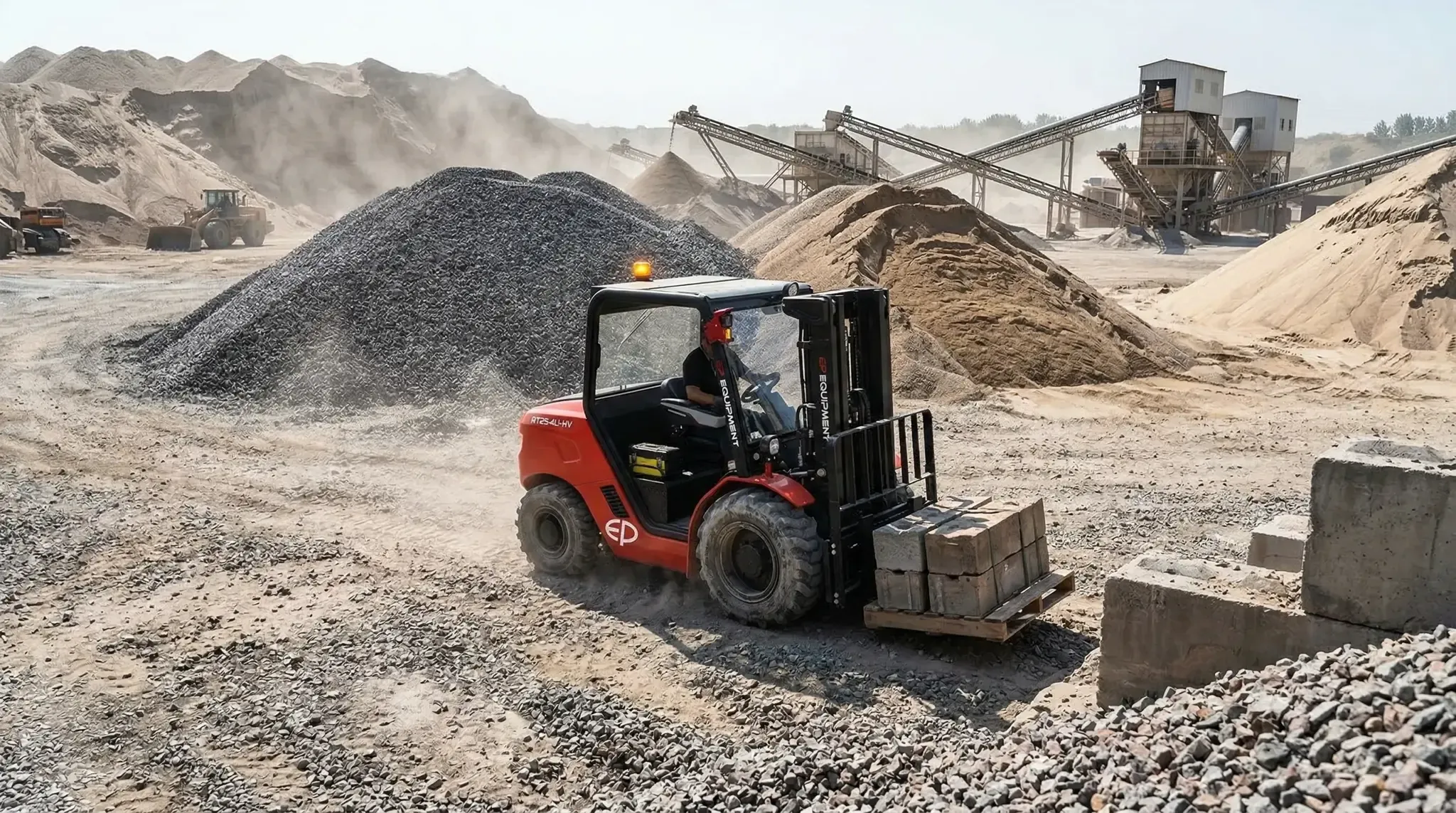
Rough terrain electric hire is best suited to fixed or long-duration sites such as:
- Timber yards and sawmills
- Recycling, waste transfer, and materials yards
- Landscape supply and nursery yards
- Wineries and rural fringe operations
- Council depots, parks, and zoos
- Long-duration civil projects of 24 months or longer with confirmed mains power
A sealed concrete outdoor yard where no surface variation exists is often fine for a standard counterbalance forklift. Short-term construction work, remote sites without reliable power, or outdoor-only applications with no noise or emissions constraint may be better served by diesel, LPG, petrol, or a different hire setup.
Where Does Electric Rough Terrain Have a Real Advantage?
Electric rough terrain forklifts are not automatically better than diesel in every application. Their advantage is strongest where the site is fixed, the machine is used over a longer period, charging access is available, and diesel creates practical issues around exhaust, noise, fuel storage, or indoor-outdoor movement.
Zero Exhaust at the Point of Use
Electric rough terrain forklifts produce no diesel exhaust at the point of use. This matters most in semi-enclosed or partially covered work areas such as sheds, covered loading zones, basement access, warehouse shells, transfer stations, and enclosed yard areas.
Diesel equipment may still be suitable for open outdoor sites, but it creates more management requirements when work moves into enclosed or poorly ventilated areas. Electric operation can reduce diesel exhaust exposure and simplify OHS risk controls around ventilation.
Diesel vs LPG vs Electric Forklifts: Key Differences, Costs, and Best Uses
Lower Drivetrain Noise
Electric rough-terrain forklifts generally produce less drivetrain noise than diesel-powered models because they do not have a continuously operating combustion engine. For example, the RTF25-4L1-HV is rated at 70 dB(A) at the operator’s ear, indicating relatively low operator-position noise during operation.
However, this rating should not be interpreted as the noise level experienced at a nearby property boundary. Actual site noise will also depend on distance, ground and building surfaces, reversing alarms, attachments, loading activity, the number of machines operating, and overall site traffic. For timber yards near residential areas, a site-specific noise assessment may still be required.
Indoor and Outdoor Use in the Same Operation
Electric rough terrain forklifts can be useful where material handling moves between outdoor rough-ground areas and semi-enclosed zones on the same site. Examples include outdoor unloading followed by movement into a shed, covered storage area, workshop, warehouse shell, or processing zone.
This can reduce the need to use one machine outdoors and another machine indoors, provided the forklift’s size, mast height, turning space, floor loading, surface condition, and charging access are suitable.
No Fuel Storage or Fuel Delivery
Diesel rough terrain forklifts require fuel supply, refuelling procedures, and site fuel storage controls. LPG units require cylinder handling, storage, and replacement. Electric units remove those fuel logistics, but they introduce a different requirement: suitable charging access.
For fixed-site operations with mains power, this trade-off can be worthwhile. For remote or temporary sites without reliable power, fuel-based equipment may still be more practical.
Lower Operating Cost Potential
Electric charging can be cheaper than diesel fuel over longer hire periods, but the saving depends on site power cost, duty cycle, terrain, load profile and daily runtime. For fixed sites with regular use and reliable charging, the operating-cost case is stronger.
For sites with regular daily use and reliable charging access, electric rough terrain hire can reduce running costs and simplify site logistics compared with diesel. For short, irregular, outdoor-only, or remote use, the financial advantage may be smaller.
Where Diesel, LPG, or Petrol Still Makes More Sense
Electric rough terrain hire is not the default answer for every site. Diesel, LPG, petrol, or a second-hand outdoor machine may be more suitable when:
- the project is short term
- the site has no reliable mains power
- the machine is needed for outdoor-only work
- there are no meaningful noise or emissions constraints
- the expected use period is well below 24 months
- charging downtime cannot be built into the operation
- the site needs a lower-cost machine for occasional rough-ground handling
This is why electric rough terrain hire should be assessed as a commercial fit, not just a technical specification.
What Do You Need to Know Before Hiring a Rough Terrain Forklift?
Operator Licence Requirements
In Victoria, rough terrain forklifts are generally operated under the same Class LF High Risk Work Licence used for standard counterbalance forklifts, provided the operator’s position does not rise with the load. There is no separate rough terrain forklift licence class.
However, an LF licence alone is not enough. The hirer should make sure operators are familiar with the specific machine, site surface, gradients, visibility limits, load types, and any attachments fitted before the forklift enters service.
2 Types of Forklift Licences in Australia: LF and LO Explained
Site OHS Requirements
Any site using a rough terrain forklift should manage surface condition, gradients, pedestrian separation, load handling, operator licence checks, pre-start inspections, charging or refuelling arrangements, and emergency procedures.
For construction work in Victoria, additional duties may apply under the Occupational Health and Safety Act 2004 (Vic) and Occupational Health and Safety Regulations 2017. Where the work involves high-risk construction work, including the movement of powered mobile plant, a site-specific SWMS must be prepared and followed.
EPower supplies a pre-start checklist with every hire unit, but the site-specific OHS controls, traffic management plan, and operator supervision remain the hirer’s responsibility.
Before booking, confirm the maximum site grade, load weight, load centre, ground conditions, access width, required lift height, and whether the forklift’s rated capacity is suitable for the actual work.
Charging or Refuelling Requirements
Charging is one of the most important practical considerations for this electric rough terrain forklift. The machine may be technically suitable for the ground conditions, but if the site cannot provide the correct power supply in the required location, a diesel forklift or another charging arrangement may be more practical.[]{.PDq2pG_selectionAnchor}
EPower supplies a compatible charger with the hire unit. The hirer is responsible for ensuring that suitable power access is available at the charging location.
The available charging configurations for EP RTF25-4L1-HV are:
| Charging option | Power supply required | Approximate full-charge time |
|---|---|---|
| 3.3 kW onboard charger — optional | Single-phase, 85–265 V | ~14 hours |
| 10 kW onboard charger — standard | 304–456 V | ~4.5 hours |
| 20 kW external charger — standard | Three-phase, 380–480 V | ~2.5 hours |
| 40 kW external charger — optional | Three-phase, 380–480 V | ~1.5 hours |
Charging times are approximate and may vary according to the battery’s starting state of charge, battery temperature, ambient conditions and charger configuration.
For standard charging, the site should confirm the required supply type, outlet rating, amperage, charging location and available charging window before booking. For fast charging, the site must also confirm that its electrical infrastructure can support the higher power demand.
Charging cable reach also matters. The charger must be positioned safely within the approved cable reach of both the machine and the power outlet. Extension leads, temporary cabling or improvised charging arrangements should not be assumed to be suitable. Confirm the charger location and maximum cable reach with EPower before hire.
Before booking, the site should confirm:
- whether suitable mains power is available;
- whether the required supply is single-phase or three-phase;
- the required outlet voltage and amperage;
- where the charger will be located;
- whether the forklift can park safely within charging-cable reach;
- whether the charging window matches the expected daily runtime; and
- whether charging access will remain available throughout the hire period.
For fixed-site operations with reliable mains power, electric charging may be simpler than managing diesel or LPG supply. For temporary or remote sites, however, power availability may become the limiting factor.
EP RTF25-4L1-HV Model: Specifications
| Specification | Detail |
|---|---|
| Model | EP RTF25-4L1-HV |
| Capacity | 2.5T |
| Battery | 309V / 150Ah Li-ion |
| Runtime | 8–10 hours per shift, depending on duty cycle |
| Fast charge | 1-hour partial top-up (20 kW pile);~1.5 hours to full charge on optional 40 kW pile |
| Mast | 3.7m triplex container mast standard; 4.0m, 4.3m and 4.8m triplex options available |
| Tyres | Pneumatic, front 280/80 R20, rear 27x10-12NHS |
| Ground clearance | 266mm mast, 258mm wheelbase centre |
| Gradeability | 50% laden, 48% unladen |
| Drivetrain | 2WD/4WD switchable, automatic limited-slip differential |
| Travel speed | 16 km/h laden, 26 km/h unladen |
| Overall width | 1,450mm |
| Safety | Surround-view system, rear view camera, blue spot light |
| Attachments | Optional side-shift and fork positioner. Rated capacity reduces by 200 kg when a sideshifter is fitted. |
| Hire rate | From AUD 51/day, minimum 3 years, maintenance excluded |
The 50% laden gradeability is one of the model’s strongest site-performance advantages. For yards, depots, sawmills, nurseries, recycling facilities, and long-duration civil sites where ramps, uneven access, and loaded movement are routine, this performance level can help prevent the machine from becoming a bottleneck when site conditions change.
The standard surround-view camera system is relevant for busy fixed-site operations where pedestrian traffic, blind spots, and tight access are constant factors. It supports plant-pedestrian risk management, but it does not replace a site traffic management plan.
Is the EP RTF25-4L1-HV Right for Your Site?
Use this checklist before enquiring about the RTF25-4L1-HV :
| Question | Why it matters |
|---|---|
| Does the site have confirmed mains power at the required supply type? | Charging is the main practical requirement for electric rough terrain hire. |
| Is the expected use period 24 months or longer? | The hire offer is better suited to long-term or fixed-site operations than short-cycle projects. |
| Is the site within EPower’s Melbourne metropolitan service area? | Service access, delivery, maintenance, and response times affect the suitability of the hire. |
| Is the maximum load within 2.5T at the required load centre? | The forklift must match the actual load, not only the headline capacity. |
| Are there noise, emissions, fuel storage, or enclosed-area constraints that diesel would complicate? | These are the conditions where electric rough terrain has a stronger commercial case. |
If the answer to any of the first three questions is no, diesel, LPG, petrol, or a different hire setup is likely to be the better option. EPower can still advise on the most suitable machine for the site.
If the answer to all five questions is yes, the EP RTF25-4L1-HV may be a strong fit for your operation.
How Much Does Electric Rough Terrain Forklift Hire Cost at EPower?
The current hire offer on the EP RTF25-4L1-HV starts from AUD 51 per day, based on a minimum 3-year term, with maintenance excluded. Contact EPower for current availability, short-term hire options, and delivery arrangements to your Melbourne site address. Delivery covers Melbourne metropolitan areas. Australia-wide freight can be arranged at additional cost.
Because this is a long-term hire offer, it is usually better suited to fixed-site operations or long-duration projects than short-term construction use. For shorter projects, EPower can help compare whether short-term hire, diesel, LPG, petrol, or a second-hand outdoor machine is more cost-effective.
For ongoing operations with regular rough-ground handling requirements beyond 24 months, long-term rental may produce better economics if the site also benefits from lower point-of-use emissions, reduced noise, and no fuel storage or fuel delivery. The team can model both options based on your project duration, utilisation pattern, site power, and operating constraints.
Hire Forklift in Melbourne: A Complete Guide to Hire Options & Costs
Conclusion
The EP RTF25-4L1-HV is not a general replacement for every diesel rough terrain forklift. It is a practical electric hire option for fixed-site Melbourne operations that need rough-ground capability, confirmed mains power, long-term use, and a real reason to avoid diesel exhaust, noise, or fuel logistics.
Before booking, confirm the site’s power supply, charging location, expected hire duration, maximum load, load centre, surface condition, grade, and service area. Contact EPower to check availability, charging requirements, delivery options, and hire terms for your Melbourne site.