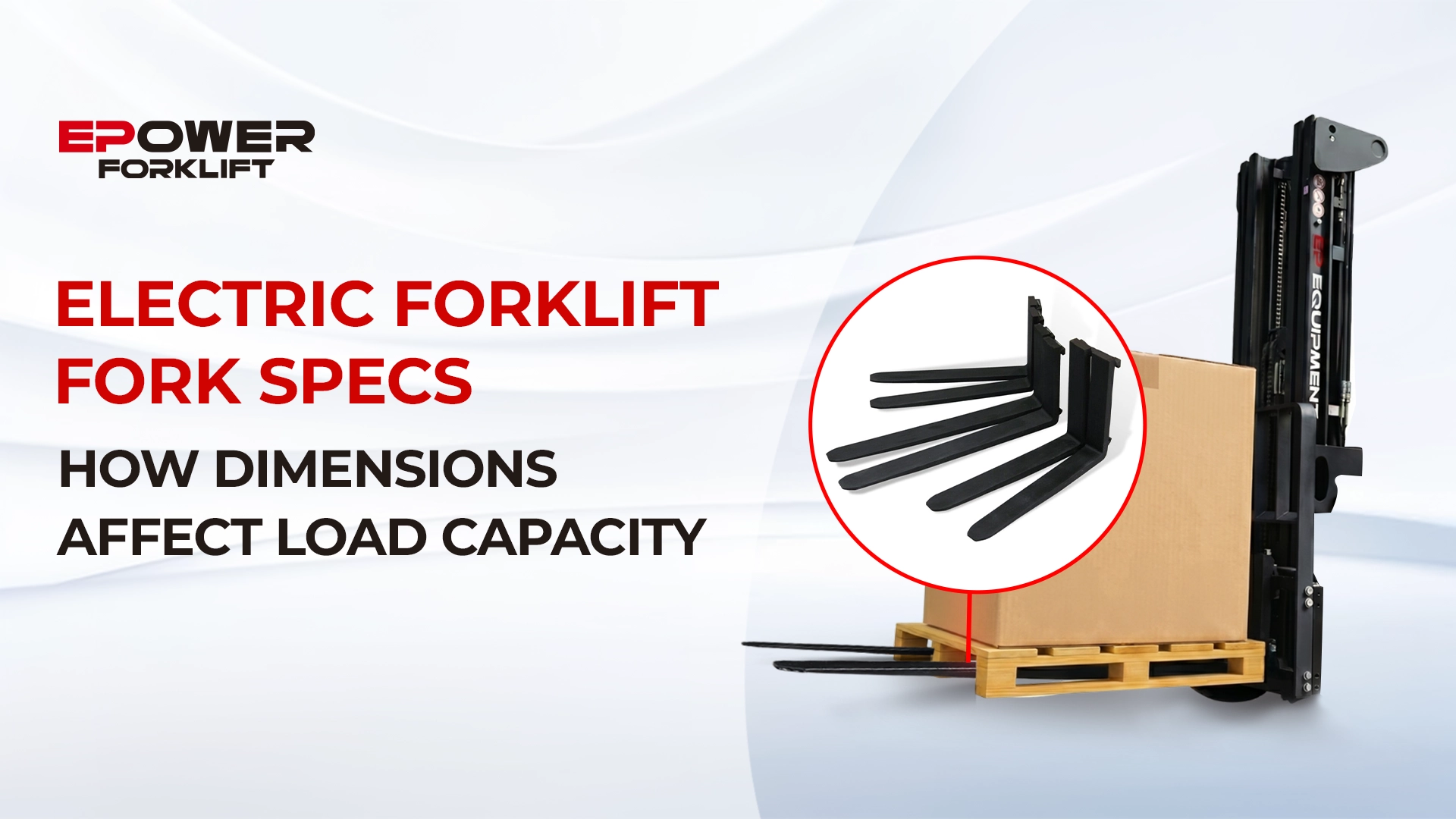
Fork specifications are where most pre-start checklists stop at visual inspection and call it done. That is not sufficient. A fork may look serviceable while already exceeding accepted wear limits. It may fit the carriage but still be the wrong length for the load. And a fork pair that has been together for years may carry mismatched rated capacities if one fork was replaced without checking.
In practice, the issue usually appears when a warehouse changes load type — for example, moving from standard pallets to longer timber packs, steel bundles, machinery crates, or imported pallets — but continues using the same fork setup.
When EPower delivers an electric forklift, fleet managers frequently ask whether the standard forks are right for their load profile. The answer requires checking the fork’s key specifications, not assumptions. This guide covers what those specifications are, what they mean for safe working load, and when fork inspection criteria indicate that a fork should be removed from service.
What Are the Key Specifications on a Forklift Fork?
Six specifications define a forklift fork's performance and compliance status: length, blade width, heel thickness, taper, carriage class, and rated fork capacity. A fork can meet five of the six and still be unfit for the application.
| Specification | What It Measures | Why It Matters |
|---|---|---|
| Length | Heel to tip distance | Minimum 2/3 of load length required for stability |
| Blade width | Width of load-bearing surface | Affects load distribution across pallet base |
| Heel thickness | Thickness at shank bend | Common fork inspection criteria treat 10% wear as the service limit |
| Taper | Thickness reduction heel to tip | Loss of taper geometry is a structural defect |
| Carriage class | ISO 2328 mounting dimension | Must match the forklift carriage exactly |
| Rated fork capacity | Maximum load per fork pair | Independent specification from the forklift's rated capacity |
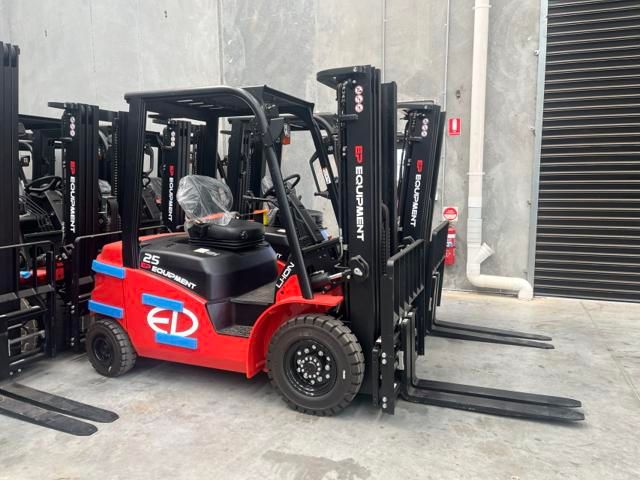
These specifications are set by the fork manufacturer, not the forklift manufacturer. EP Equipment forklifts ship with ISO 2328-compliant forks carrying manufacturer identification and rated capacity markings. Those markings are the reference point for every measurement check that follows.
How Does Fork Length Affect Load Stability?
A widely used rule of thumb is that fork length should support at least two-thirds of the load's longest dimension. Below that ratio, the load's centre of gravity extends past the supported area, creating instability under lift and travel.
Standard fork lengths for EPower models vary by model and configuration — common options include 920mm, 1,070mm, 1,220mm, 1,500mm, and 1,800mm, among others. The correct length for any given operation depends on the load profile, not on what the model ships with as standard.
For the Australian standard pallet (1,165mm x 1,165mm), the 2/3 rule requires a minimum fork length of approximately 777mm. A 900mm or 920mm fork meets that requirement. A 1,200mm fork provides a wider support base and better load distribution — which matters more when loads are unevenly distributed or when pallet quality varies. Neither length is wrong for a standard AU pallet; the correct choice depends on the actual loads being handled, not just the pallet dimensions.
For non-standard loads — steel sections, long timber packs, wide industrial pallets — the fork length must be recalculated against the actual load dimension. Fleet managers who handle mixed load profiles should confirm fork length requirements against their heaviest and longest loads, not their most common ones.
Fork length can also be excessive. A fork that protrudes significantly past the load creates a pedestrian and structural hazard during travel and in tight racking aisles. The correct length supports 2/3 of the load without unnecessary overhang.
Fork length selection is part of the pre-delivery configuration conversation for EP Equipment orders through EPower. It is one of the most common questions we discuss with fleet managers, because a forklift may be correctly rated for the load weight but still unsuitable if the forks do not support enough of the load. In that case, the issue becomes stability rather than lifting power.
3-Tonne Electric Forklift: Specifications, Price & Melbourne Buying Guide
How Does Fork Thickness Wear Affect Rated Capacity?
Fork rated capacity is calculated at the original heel thickness. As the fork wears at the heel — the thickest point at the shank bend where bending stress concentrates on every lift — the structural capacity decreases. The forklift's data plate does not reflect that decrease. The operator does not indicate unless the fork is measured.
Wear percentage = (Original thickness - Measured thickness) / Original thickness × 100
Fork inspection standards and manufacturer guidance commonly treat 10% wear from original heel thickness as the service limit. A fork manufactured at 40mm heel thickness reaches its service limit at 36mm. At that point, the fork must be removed from service — not monitored, not flagged for next inspection, removed.
The structural relationship between thickness and capacity is not linear. Fork load capacity is proportional to the cube of the thickness. A 10% reduction in thickness produces a significantly larger reduction in structural strength than 10%. This is why recognised fork inspection criteria treat 10% wear as a removal-from-service limit rather than a graduated warning threshold.
Taper loss follows similar logic. The fork thickens from tip to heel in a controlled taper; this geometry distributes load along the blade rather than concentrating it at one point. A fork that has been straightened through impact, deliberate correction, or cumulative load deformation has lost that geometry. Loss of taper is a structural defect that requires fork replacement regardless of whether the heel thickness measurement is within the limit.
How Do You Measure Fork Wear Correctly?
Visual inspection alone is not enough for a formal fork measurement inspection. A vernier calliper or dedicated fork wear gauge is required. Fork wear gauges are available from Australian safety equipment suppliers for under AUD 100.
Locate the original thickness. The manufacturer's marking on the fork should state the original dimensions and rated capacity. If the marking is not legible, the original specification should be verified through manufacturer records, documentation, or by contacting the authorised dealer before the fork returns to service. A fork with unverifiable specifications should be removed from service until identification is confirmed — not necessarily permanently, but until the specification can be established from records.
Measure heel thickness. Measure at the shank bend on both forks independently. Forks in a pair wear at different rates and may reach the service limit at different times.
Calculate wear. Subtract the measured thickness from the original, divide by the original, and multiply by 100. At 10% or above: remove from service.
Straight edge test. Place a straight edge along the upper surface of the blade. A gap exceeding 0.5% of the fork length indicates the fork has bent beyond tolerance.
Check the pair. If one fork in a pair has been replaced with a different-rated fork, the lower-capacity fork governs the load limit for the entire pair. Mismatched pairs must not be operated until matched forks are fitted.
In service inspections, wear at the heel is easy to underestimate because the fork can still look straight and usable. That is why EPower encourages fleet managers to include measurement checks in scheduled maintenance rather than relying on visual inspection alone.
EP Equipment forks carry manufacturer markings that identify the fork specification and rated capacity. If those markings become illegible on an EP Equipment fork, EPower Forklift can help verify the original specification for the model from available documentation.
What Is Carriage Class and Why Does It Determine Fork Compatibility?
Carriage class refers to the ISO 2328 mounting dimensions that determine whether a fork will correctly fit the forklift carriage. It is not the same as fork capacity. A replacement fork may have the right rated capacity but still be incompatible if the hook dimensions do not match the carriage.
This matters because a fork that does not seat or lock correctly on the carriage is not mechanically secure, even if it appears close enough to fit. Replacement forks should be specified by carriage class, rated fork capacity, fork length, and the forklift model — not by load rating alone.
For EP Equipment forklifts, the carriage class for the specific unit should be confirmed from the operator manual, data plate, or EPower before replacement forks are ordered.
This matters when customers source replacement forks outside the original supply chain. The replacement fork may appear close enough to fit, but if the hooks do not seat and lock correctly, the combination should not be treated as serviceable.
When Should a Fork Be Removed from Service in Australia?
For fleet managers, the practical question is not whether a fork has “some wear”. The question is whether the fork can still be identified, measured, and confirmed as safe for the load it is carrying. If the answer is no, the fork should not stay in service while the business waits for the next scheduled inspection.
Fork inspection standards and manufacturer guidance commonly treat the following as removal-from-service conditions, subject to confirmation by a competent person and the fork manufacturer’s documentation:
- Fork blade or shank thickness worn by 10% or more from the original manufacturer specification.
- Any visible crack on the blade, heel, shank, hook, or mounting area.
- Blade or shank straightness deviation beyond the permitted tolerance, commonly 0.5% of blade length or shank height.
- Blade-to-shank angle deviation greater than 3° from the original manufactured angle.
- Fork tip height difference between a pair exceeding the permitted limit, commonly 3% of blade length.
- Manufacturer markings are no longer legible and the original fork specification cannot be verified from records.
- Forks are mismatched, incorrectly rated, or not properly seated/locked on the carriage.
Forks should not be welded, heated, or straightened in the field. Any repair must follow the fork manufacturer’s approved procedure and the applicable inspection and testing standard. In normal warehouse practice, cracked, excessively worn, or permanently deformed forks should be replaced rather than repaired.
A serious fork defect can result in the forklift being removed from service until the issue is corrected. Replacement fork procurement takes time; the measurement process that prevents that scenario takes only minutes.
How Do You Match Fork Specifications to Your Application?
Three steps in order: define the load profile, confirm carriage class, and verify against the data plate.
Define the load profile by identifying the longest and heaviest loads in the operation. Calculate minimum fork length from the 2/3 rule using the actual load dimension, not the pallet dimension if the load extends past the pallet. Confirm that the fork's rated capacity covers the actual load at the actual load centre — which may differ from the data plate's standard 500mm load centre if loads are wider or longer than standard.
Confirm carriage class from the operator manual before any fork procurement. Do not assume from the capacity rating.
Verify that the fork's rated capacity is not lower than the forklift's operating capacity at the relevant load centre. If attachments are in use, the attachment's de-rating applies before assessing fork adequacy.
The table below reflects common configuration discussions EPower has with Australian warehouse operators. It is not a substitute for model-specific confirmation, but it shows the type of load-profile thinking that should happen before forks are ordered.
| Load Profile | Fork Length | Carriage Class |
|---|---|---|
| Standard AU pallet, loads to 2.5T | 1,070mm to 1,220mm | Class II |
| Oversized pallet or timber pack, loads to 2.5T | 1,500mm | Class II |
| Long loads above 2,400mm, loads to 2.5T | 1,800mm | Class II — confirm with EPower |
| 3.5T to 5.5T loads | 1,220mm to 1,500mm | Class III |
| Above 5.5T | Confirm with EPower | Class IV |
What Else Should Fleet Managers Know?
How Often Must Forks Be Formally Inspected?
Operators should visually check forks during every pre-start inspection. Formal fork inspections should be carried out by a competent person, recorded, and repeated after any significant impact, suspected overload, or visible damage.
Can a Fork Be Repaired Instead of Replaced?
In normal warehouse practice, cracked, excessively worn, or permanently deformed forks should be replaced, not repaired. Forks should not be welded, heated, or straightened unless the repair is authorised by the fork manufacturer and followed by the required inspection and testing.
Conclusion
Fork specifications govern the structural foundation of every lift. Length determines load stability. Heel thickness sets the structural capacity behind every cycle. Carriage class determines whether the fork is actually secured to the machine. None of these is a secondary consideration.
In Australia, fork condition should be assessed against the relevant standards, manufacturer documentation, and a competent inspection procedure — not visual judgement alone. A fork at 10% wear is at its service limit — not approaching it. A fork with an illegible marking needs its specification verified before it returns to work. A mismatched pair has a single rated capacity: the lower one.
Forklifts distributed by EPower ship with ISO 2328-compliant forks appropriate for standard warehouse applications. For operations handling non-standard loads, specialist applications, or fleet managers reviewing fork compliance on existing equipment, EPower can advise on fork specification and replacement options. Connect with EPower Forklift team today!