The rated capacity figure on a forklift data plate is not a fixed limit for every lift. It is a reference point that applies under a specific set of conditions: a defined load centre, mast vertical, and a specified lift height. Change any of those conditions and the governing limit changes — even though the headline rated capacity figure remains the same.
This is where load capacity charts matter. The chart shows what the forklift can actually lift across the range of load centres and lift heights encountered in real operations. Most operators know the chart exists. Fewer know how to apply it when the load in front of them is not a standard pallet at a standard height.
As EP Equipment's authorised Australian distributor, EPower covers load capacity chart application during operator familiarisation for every new fleet delivery — because misreading the chart, or not reading it at all, is the most direct path to an overload incident.
What Is a Forklift Load Capacity Chart?
A load capacity chart shows the maximum load the forklift is rated to lift at defined load centres and lift heights. It may appear as a discrete table of figures, a curve-format graph, or a combination of both. The format varies by manufacturer and model — the information it contains is the same regardless of format.
Not all data plates include a full chart. Some show only a single rated capacity figure at a specified load centre and lift height. If the data plate on your unit shows only one number, the full capacity data is available from the manufacturer or authorised dealer. Operating with only the headline figure means operating without the information needed to assess non-standard lifts.
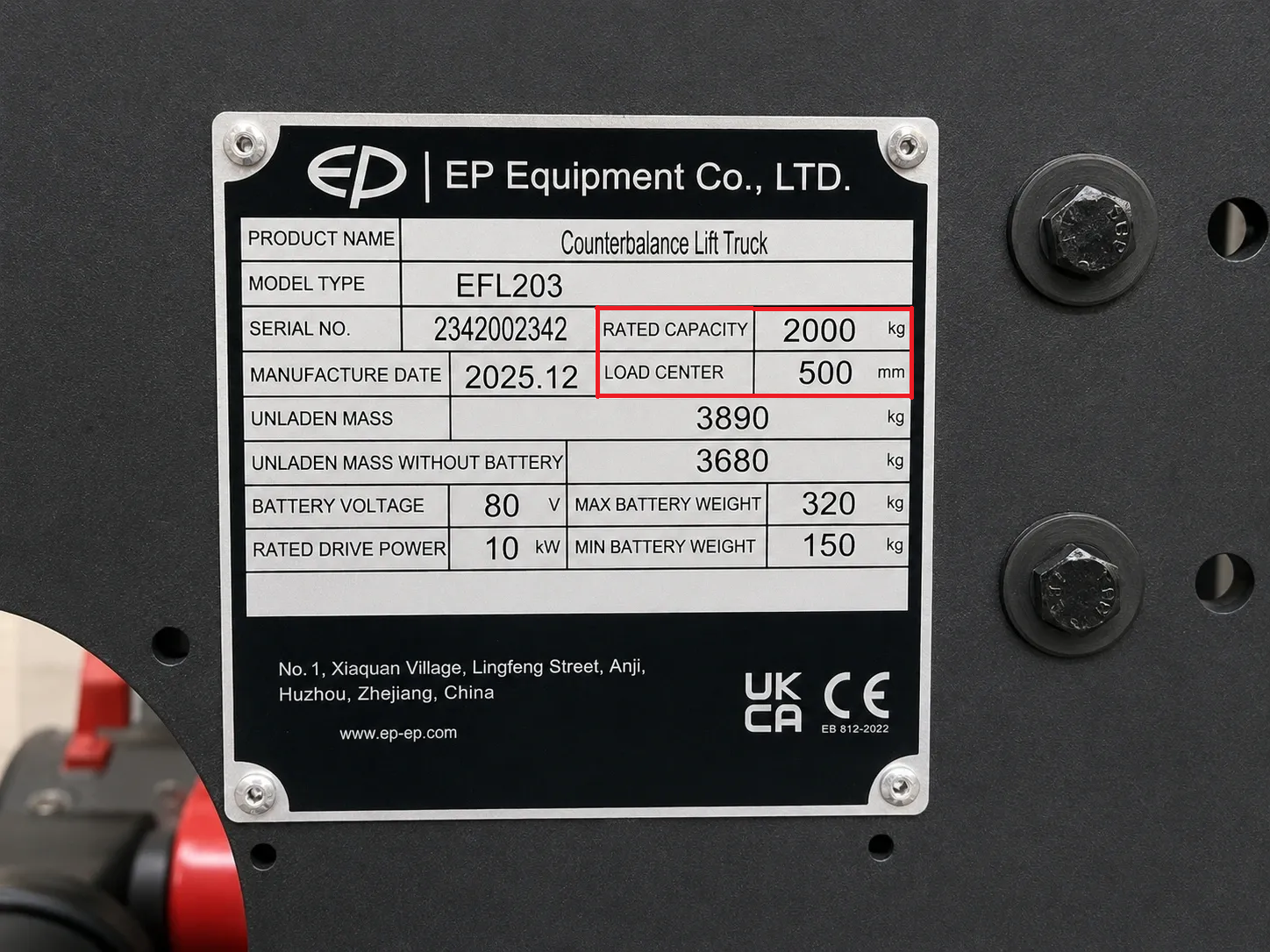
On EP Equipment electric forklift models distributed through EPower, the load capacity chart is included on the data plate. The load centre reference shown on any specific EP Equipment unit will be stated on that unit's data plate. Always use the data plate on the specific machine, not a general specification sheet, as the authoritative reference. A sales brochure may help with model selection, but it should not be used as the final operating reference for a lift.
What Is Load Centre and Why Does It Change Rated Capacity?
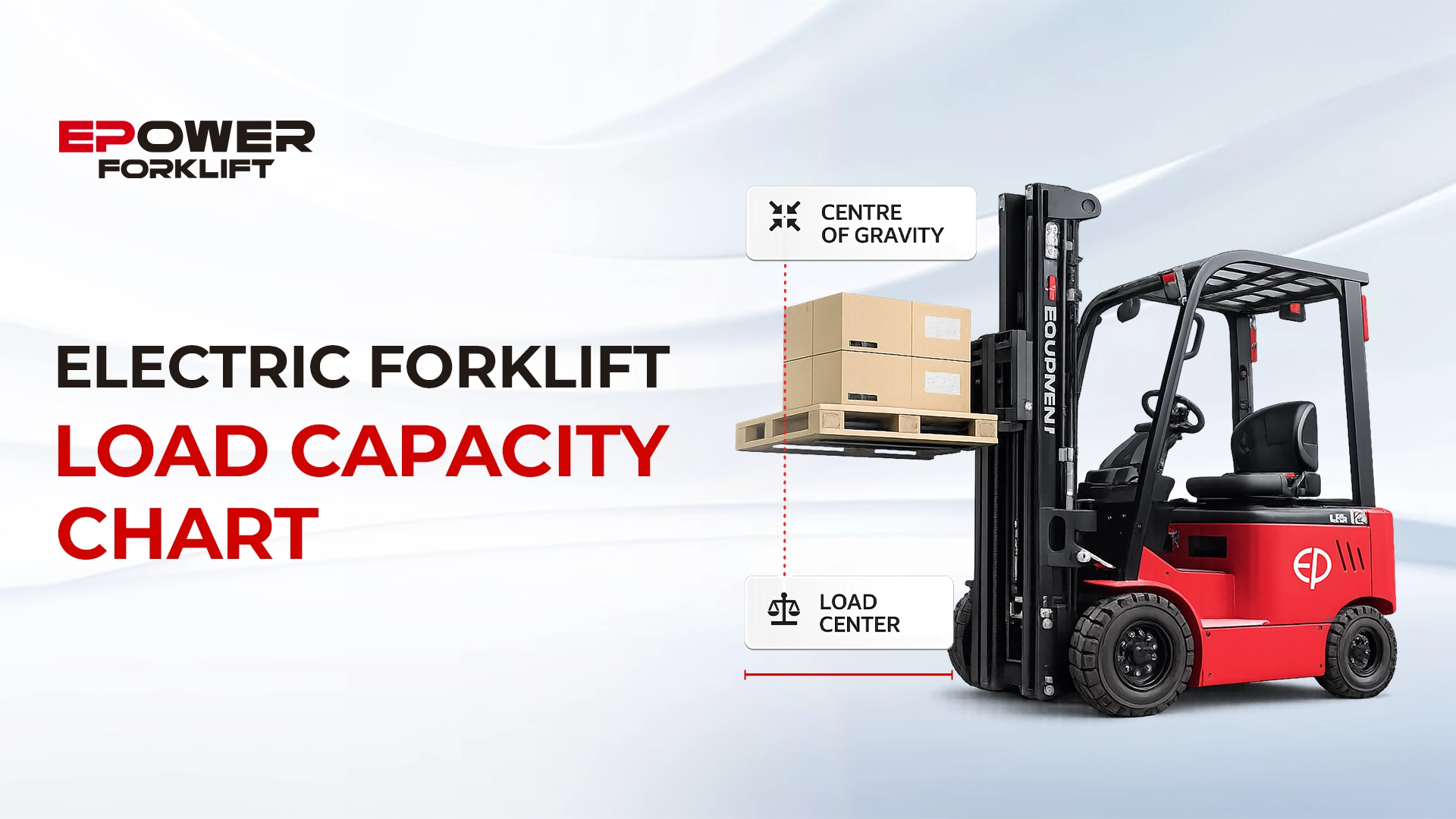
Load centre is the horizontal distance from the vertical face of the forks to the centre of gravity of the load.
The rated capacity on a data plate is calculated at a specific load centre distance. Internationally, many specification sheets and imported forklifts use 500mm as the reference point. In Australian practice, 600mm is the commonly referenced load centre for forklifts above one tonne, reflecting common pallet and load dimensions used in warehouse operations. WorkSafe Victoria explicitly notes that some imported forklifts are rated at 500mm load centre, a figure common in international specification sheets, and that buyers should be aware of the difference when comparing models.
When evaluating any forklift's capacity, the correct reference point is the load centre stated on that specific machine's data plate — not a general assumption of 500mm or 600mm. When comparing specifications between brands, confirm which load centre each manufacturer uses before treating headline figures as equivalent.
The physics behind why capacity changes with load centre is straightforward. A counterbalance forklift operates as a lever system with the front axle as the fulcrum. The load creates a forward tipping moment equal to load weight multiplied by load centre distance. The forklift's own weight — including the battery — creates an opposing moment. When load centre increases, the forward tipping moment increases for the same weight. To maintain stable operating limits, the safe working load must decrease. This mechanical constraint is calculated by the manufacturer and embedded in the chart.
How Do You Calculate the Actual Load Centre of Your Load?
For a uniform rectangular load sitting centred on the forks, load centre equals half the load depth. A 1,200mm deep load gives a load centre of 600mm. A 1,165mm Australian pallet gives approximately 582mm.
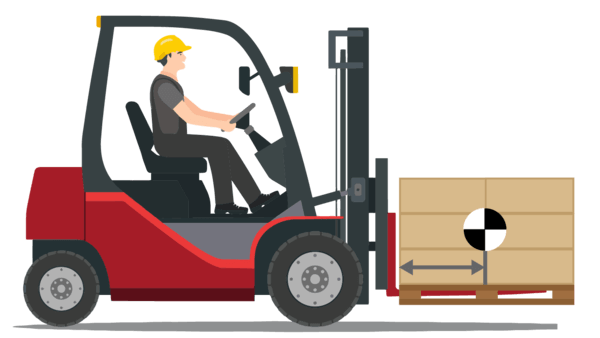
For non-uniform loads where weight is distributed unevenly, the geometric centre is not the load centre. The load centre shifts toward the heavier end. Without the ability to measure actual weight distribution, the conservative approach is to assume the load centre is at the geometric centre plus a margin, or to measure by weighing both ends separately.
For loads that extend beyond the fork tips, the load centre may sit beyond the tip itself. This is a combined fork length and capacity problem — confirm fork length adequacy first, then apply the chart at the actual calculated load centre.
Electric Forklift Fork Specs: How Dimensions Affect Load Capacity
How Does Lift Height Affect the Chart?
With taller masts, high stacking applications, reach trucks, and non-standard mast configurations, capacity may reduce as lift height increases. The mechanism: raising the load shifts the combined centre of gravity upward and changes the tipping moment geometry. The chart captures this where applicable as progressively lower capacity figures at higher lift heights for a given load centre.
For standard counterbalance masts with limited height range, some data plates may show capacity only at maximum lift height, or show minimal variation across heights. For reach trucks and high-mast counterbalance configurations, the reduction across lift heights is more pronounced and the chart will reflect it clearly.
In many configurations, capacity reduction becomes more relevant once the mast extends beyond the free-lift range. However, operators should follow the figures shown on the specific load chart for their unit — mast design, truck configuration, and chart format all affect how this is expressed.
The graph below is an example of EP Equipment rated capacities and load centre curves for RTF25-4L1 rough terrain forklift configurations. It shows how rated capacity reduces as load centre increases and as higher mast heights are used. If a sideshifter is fitted, the chart note requires 200kg to be subtracted from the applicable chart figure.
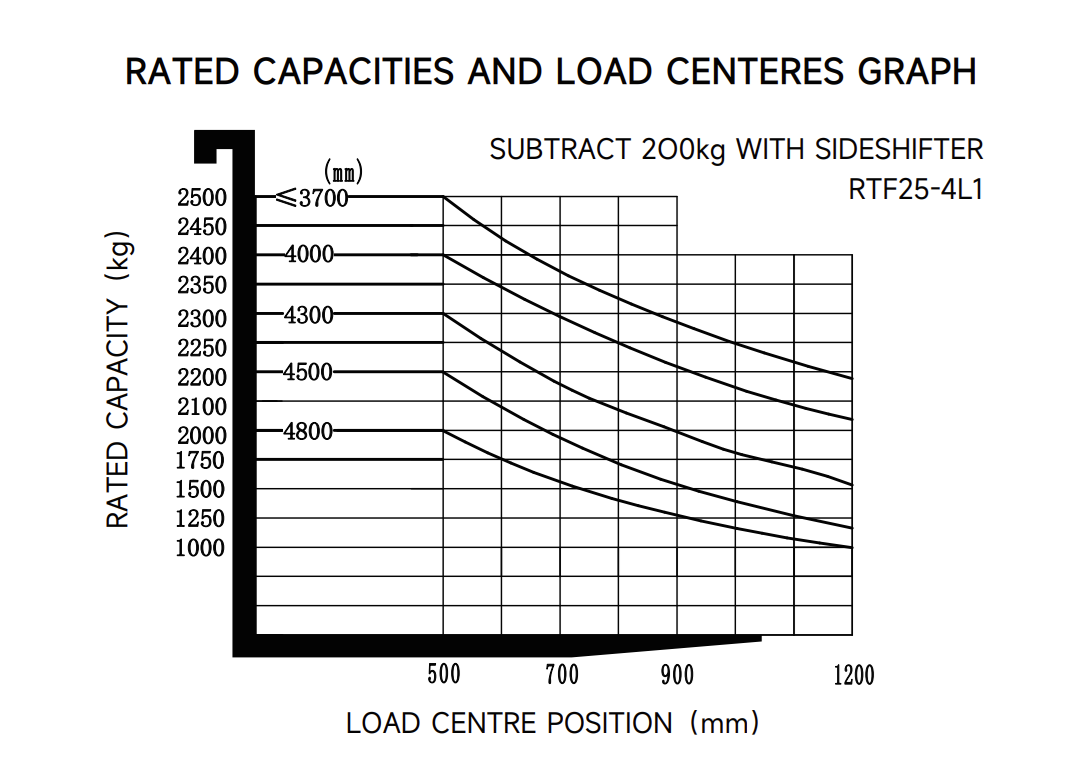
The combined effect of a non-standard load centre and elevated lift height appears as a single figure at the chart intersection. Do not calculate separate reductions for each variable and add them — read the intersection directly.
How Do You Read the Load Capacity Chart?
You read a forklift load capacity chart by confirming the actual load centre, checking the required lift height, finding the chart intersection, and comparing that figure with the actual load weight.
Step 1: Confirm the Actual Load Centre
Start by calculating the actual load centre of the load. If the load is unevenly distributed, the load centre shifts toward the heavier side. In that case, do not rely only on the geometric centre.
Step 2: Confirm the Required Lift Height
Next, identify the lift height required to place or retrieve the load. This is the working height for the task, not simply the forklift’s maximum mast height.
A forklift may be able to carry a load at a lower height but have a lower rated capacity at a higher lift height. This is especially important for high-rack storage, reach trucks, and high-mast counterbalance forklifts.
Step 3: Find the Chart Intersection
Find where the actual load centre and required lift height meet on the load capacity chart. That intersection is the rated capacity for that lift configuration.
If the load centre or lift height falls between values on the chart, use the more conservative lower capacity figure unless the manufacturer’s documentation clearly allows another method.
Step 4: Compare the Chart Figure with the Actual Load Weight
Compare the actual load weight with the chart figure. If the load is heavier than the chart figure for that load centre and lift height, the lift should not proceed with that configuration.
Use a higher-capacity forklift, reduce the lift height where practical, reconfigure the load, remove or change the attachment where appropriate, or seek manufacturer or dealer guidance.
If the load weight cannot be confirmed, stop and verify it before using the chart.
The Complete Pre-Start Checklist for Forklift Operators: What to Check Before Every Shift
How Does Changing Load Centre Affect Capacity in Practice?
Changing load centre reduces forklift capacity because the load creates more forward tipping force as it moves further away from the fork face. On the EP RTF25-4L1 graph, capacity reduces as the load centre moves outward from the reference position.
Scenario 1: Oversized Pallet or Long Load
A 1,400mm deep load has a geometric centre of 700mm. The operator must read the capacity at 700mm, not rely on the headline capacity at the reference load centre.
This matters for building materials, bundled pipe, long packs and wide industrial components. If the load extends well beyond the forks, the load centre is likely further out than a standard pallet, and rated capacity will be lower.
Scenario 2: Unevenly Distributed Load
An uneven load may have the same dimensions as a standard pallet but a different actual load centre. If the heavier part of the load sits further forward, the centre of gravity also moves forward.
In that case, the operator should not use the pallet’s geometric centre as the load centre. The actual load centre should be estimated conservatively or confirmed before checking the capacity graph.
Scenario 3: Sideshifter or Attachment Moving the Load Forward
A sideshifter or attachment can increase the effective load centre by moving the load further away from the fork face. On the EP RTF25-4L1 graph, the note also states: “Subtract 200kg with sideshifter.”
The operator should first read the applicable capacity at the actual load centre, then subtract 200kg if a sideshifter is fitted. The final figure is the capacity to compare with the actual load weight.
What Are the Most Common Load Centre Mistakes Australian Operators Make?
Four patterns appear consistently in EPower's experience with electric forklift operators across Australian warehouses.
Treating rated capacity as a fixed operating limit
Rated capacity applies at the reference conditions stated on the data plate. Every deviation — load centre beyond the reference, lift height above base, attachment fitted — produces a lower limit. The chart quantifies those deviations. Not using it means not knowing the actual limit.
Not rechecking capacity when load type changes mid-shift
A capacity assessment for standard pallets does not cover a different load profile later in the same shift. If load dimensions, weight distribution, or lift height change, the chart check must be repeated for the new load.
Fitting an attachment and continuing to reference the forklift's original data plate capacity
Once an attachment is fitted, the forklift-and-attachment combination rating governs. The original data plate figure no longer applies. If the combined rating documentation is not present, do not operate with the attachment fitted.
Using a capacity chart from a similar model
Load capacity charts are model-specific. Charts from two EP Equipment counterbalance models of similar configuration are not interchangeable. The chart on the specific unit's data plate governs that unit only.
What If the Load Weight Is Unknown?
If the load weight cannot be confirmed, the lift should not proceed. Check supplier documentation, weigh the load, use a forklift scale attachment, or obtain an approved site assessment before comparing the load against the chart.
Frequently Asked Questions
Does Lithium-Ion Battery Weight Affect the Forklift's Load Capacity Rating?
Yes. The battery is part of the counterbalance system. EP Equipment electric models are rated with the specified lithium-ion battery configuration in place — that battery weight contributes to the counterbalance calculation behind the rated capacity. Substituting a different battery — different chemistry, different weight — changes the counterbalance without updating the data plate. Any battery substitution on an EP Equipment unit should be confirmed with EPower before the unit returns to service.
What Load Centre Is Commonly Used for Forklifts in Australia?
In Australian practice, 600mm is commonly used as the reference load centre for forklifts above one tonne. However, operators and buyers should always confirm the load centre stated on the specific forklift data plate, because the data plate is the authoritative reference for that machine.
WorkSafe Victoria notes that some imported forklifts are rated at 500mm load centre, so buyers should check this carefully when comparing imported specifications with Australian-use requirements.
Why Is a 500mm Load Centre Different from a 600mm Load Centre?
A forklift rated at 500mm load centre is not directly comparable with a forklift rated at 600mm load centre. As load centre increases, rated capacity usually decreases, so a 3,500 kg rating at 500mm and a 3,200 kg rating at 600mm should not be compared from the headline figures alone.
Conclusion
A forklift’s headline rated capacity is only the starting point. The load capacity chart on the specific machine shows the governing limit for the actual load centre, lift height and attachment configuration.
Before lifting non-standard loads, oversized pallets, high-rack loads or loads with attachments fitted, read the chart and confirm the actual load weight. If you are assessing whether an EP Equipment electric forklift suits your load profile, EPower can walk through the data plate and capacity chart with you before purchase or rental. Contact EPower team today!