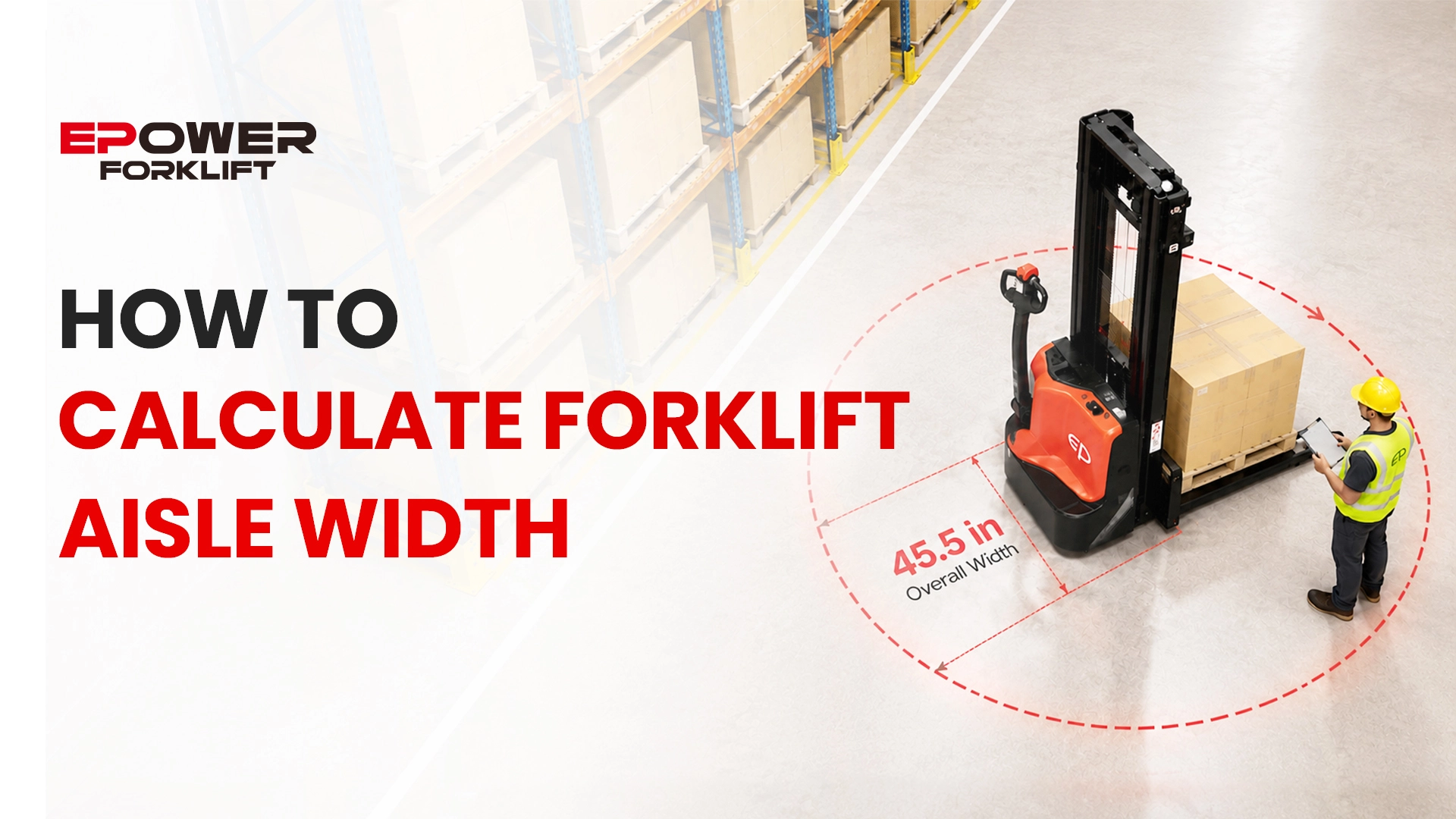
The belief that 3.5 metres is a universal forklift aisle width is one of the most persistent misconceptions in Australian warehouse planning. It leads to racking installed at the wrong centres, forklifts that cannot complete a right-angle stack without a multi-point turn, and productivity losses that compound across hundreds of cycles per day.
AS4084-2023 should be checked when designing pallet racking clearances. In practice, aisle width must be confirmed against the specific forklift’s right-angle stacking requirement, pallet dimensions, racking layout, and required safety clearances. The right aisle width depends on the specific forklift model — not the category, not the capacity, and not what the previous warehouse used.
Why Is There No Single Standard Forklift Aisle Width in Australia?
The correct aisle width is not a category figure. Two forklifts in the same capacity range from different manufacturers can have right-angle stacking aisle requirements that differ by 300 to 500mm. A 3.5-metre aisle may be adequate for one 2.5T counterbalance and completely inadequate for another.
Actual aisle width numbers must come from the forklift’s specifications and design calculation — not from category estimates.
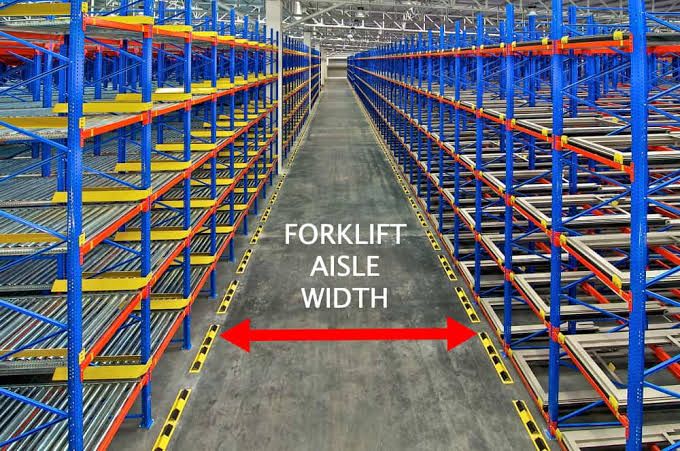
There is also a distinction between two aisle types that buyers often conflate. A travel aisle is where the forklift moves with a load but does not turn into racking — narrower clearance is sufficient. A stacking aisle is where the forklift turns 90 degrees to place or retrieve a load from racking — this is where the right-angle stacking aisle width (Ast) applies. A warehouse may have different aisle widths in different sections depending on which operation occurs where.
EPower expert note: “The most expensive aisle planning mistake we see is a warehouse that committed to racking installation before confirming the Ast of the forklift. The racking went in at 3.2-metre centres because that is what the previous warehouse used. The new forklift had an Ast of 3.5 metres. Every single stacking cycle required a three-point turn. The racking could not be moved without significant cost.”
What Is Ast and How Do You Use It?
Ast, or right-angle stacking aisle width, is the minimum aisle space a forklift needs to turn 90 degrees and complete a stack in a single movement. It is published by the manufacturer for each specific model and configuration.
The manufacturer’s published Ast remains the primary design reference. However, understanding the dimensions behind Ast helps buyers see why aisle width cannot be estimated from forklift capacity or load size alone.
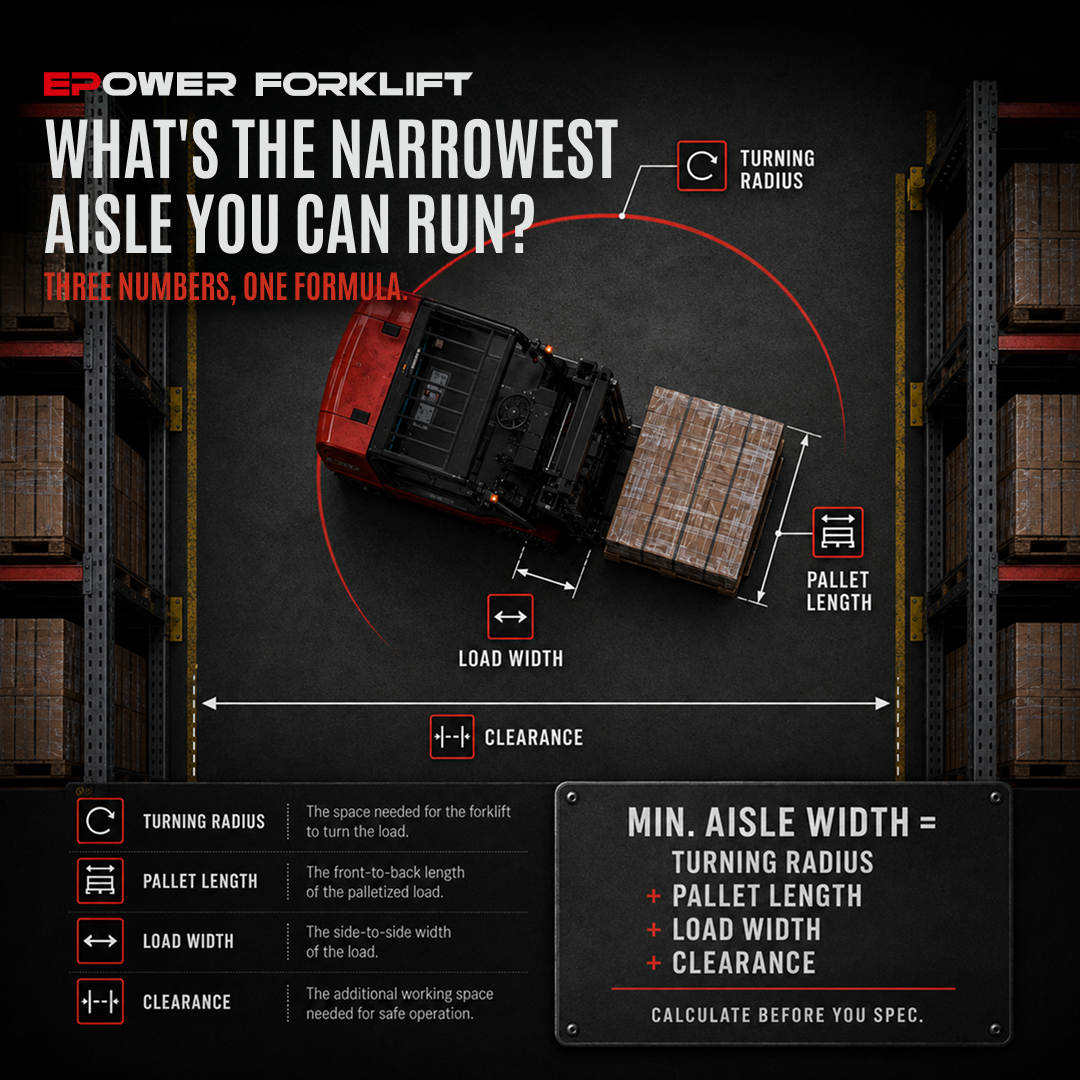
A practical Ast calculation can be expressed as:
Ast = Wa + l6 + x + a
Where:
- Wa: the rear turning dimension of the forklift. When the forklift turns, the counterweight swings out to one side. Wa is the distance from the turning centre to the outermost rear point of the forklift.
- l6: the load length. For a standard Australian CHEP or Loscam pallet measuring 1,165mm × 1,165mm, if the 1,165mm side faces the aisle, l6 = 1,165mm. If a different pallet or load presents a 1,200mm depth to the aisle, l6 = 1,200mm.
- x: the distance from the turning centre to the fork face, where the load begins. This dimension is important because the load does not start at the turning centre.
- a: the required safety clearance or margin. The required amount depends on the racking design, forklift operation and site risk assessment.
Worked example, 2.5T counterbalance forklift, indicative only:
- Wa, rear turning dimension: 2,305mm
- l6, standard CHEP pallet depth: 1,165mm
- x, load distance from the turning centre to the fork face: 495mm
- a, safety clearance: 200mm
=> Ast = 2,305 + 1,165 + 495 + 200 = 4,165mm
This example shows why aisle width should not be calculated from turning radius and pallet depth alone. The distance from the turning centre to the fork face also affects the space required to complete a right-angle stack.
Additionally, pallets sitting on racking may overhang into the aisle. A standard 1,165mm CHEP pallet on 1,100mm-deep racking frames overhangs by approximately 65mm in total, or about 32.5mm each side if centred. The actual aisle should allow for pallet overhang when confirming usable stacking clearance.
This is a worked example only. Confirm the published Ast from the model data sheet before using any figure in racking design.
Top 5 Very Narrow Aisle Forklift Trucks With Turning Radius Under 2000mm
EPower expert note: “The Ast on the spec sheet is the number to design racking around. Not the turning radius, not a category estimate — the published Ast for the specific model in the specific configuration. If a side-shifter is fitted, the Ast changes because the attachment affects the effective load centre and turning envelope.”
What Aisle Width Do EP Equipment Forklift Models Need?
The table below uses published Ast figures for selected EP Equipment models. These figures should still be checked against the actual pallet size, load orientation, attachments, racking layout and required safety clearance before finalising a forklift or warehouse layout.
| Model name | Forklift type | Capacity | Min. Aisle Width |
|---|---|---|---|
| EP EFL181 | 4-wheel counterbalance | 1.8 ton | 3,725mm |
| EP EFL253 | 4-wheel counterbalance | 2.5 ton | 4,200mm |
| EP CPD15TVL | 3-wheel counterbalance | 1.5 ton | 3,300mm |
| EP CPD20TVL | 3-wheel counterbalance | 2.0 ton | 3,435mm |
| EP CQD20L | Reach truck | 2.0 ton | 2,885mm |
| EP CQE15S | Pallet stacker | 1.5 ton | 2,800mm |
Note: Min. Aisle Width in this table are calculated with l6 = 1,200mm load length.
The 3-wheel vs 4-wheel decision on EP counterbalance models can materially change Ast, often by several hundred millimetres depending on model and configuration. But for existing 3.2-metre aisles, EP counterbalance models are not suitable for right-angle stacking. The better fit is a reach truck, such as the CQD20L at 2,885mm or the CQE15S at 2,700mm. The three-wheel versus four-wheel counterbalance decision becomes more relevant around 3.5m and above.
3-Wheel Electric Forklift: Application, Key Benefits & Buying Guide
Should You Choose the Forklift or the Racking Layout First?
The sequence of the decision determines the outcome.
New warehouse or new racking installation: specify the forklift first. The published Ast of the chosen model determines the minimum aisle centres for racking. Racking is then installed to suit the forklift. Racking is inexpensive to adjust at design stage and expensive to adjust after installation.
Existing racking, buying a new forklift: measure the narrowest right-angle stacking aisle first, including any pallet overhang from existing racking into the aisle. This measurement is the binding constraint. The forklift’s Ast must fit within that measurement plus safety clearances. Do not select a forklift before measuring existing aisles.
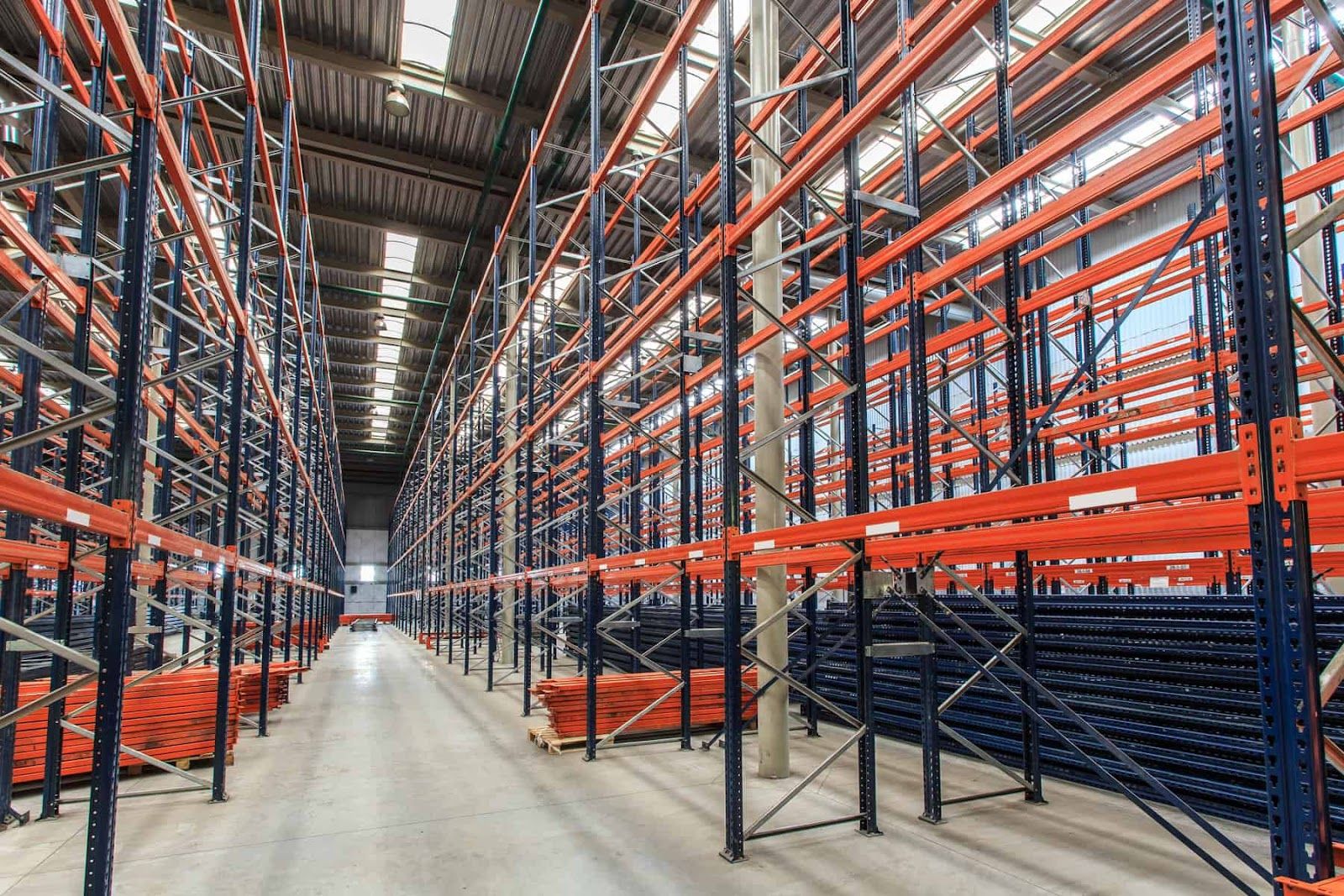
A very tight layout may look good in a drawing, but if every pallet movement becomes slow and stressful, the warehouse loses time instead of saving space. In many warehouses, a slightly wider aisle can be more productive than a layout that pushes equipment to its limit.
The common mistake on both sides: reusing an old layout without checking against current forklifts and pallets, or selecting a forklift category without checking the specific model’s Ast. Within the same category, Ast can vary by several hundred millimetres between models.
EPower recommends confirming aisle width against the model’s Ast before delivery for existing warehouses. Confirming it before the order is placed is significantly cheaper than discovering the problem after the forklift arrives.
How Wide Should Travel Aisles Be When Pedestrians and Forklifts Share the Site?
Stacking aisles and travel aisles are different. As a practical planning allowance, a one-way travel aisle may need approximately 600mm more than the loaded forklift width before pedestrian separation, barriers, intersections and site traffic controls are considered. For a 2.5T counterbalance carrying a standard pallet, a loaded width of approximately 1,400 to 1,600mm may point to a travel aisle allowance of around 2,000 to 2,200mm before additional traffic-management requirements are assessed.
Safe Work Australia’s warehouse traffic management guidance makes a key point: where forklifts are used, the best way to reduce forklift-related injury risk is to separate pedestrians and forklifts. If separation is not possible, layout changes, barriers, and traffic controls are required. Where pedestrians and forklifts share any route, aisle width must accommodate both safely — not just the forklift. This is a risk management obligation under the Occupational Health and Safety Act 2004 (Vic) and equivalent state legislation.
Three checks before ordering an ep equipment forklift where aisle width is a constraint:
Check 1: Measure the narrowest right-angle stacking aisle at floor level, including any pallet overhang from existing racking into the aisle.
Check 2: Request the published Ast from EPower for the specific EP Equipment model and configuration — including any attachments such as side-shifters or fork positioners.
Check 3: Confirm that Ast plus required safety clearance fits within the measured aisle width. If it does not, either a different model is required or the aisle must be widened.
Provide warehouse aisle measurements at the time of enquiry with EPower. Confirming Ast compatibility before the order is placed takes one conversation.
Electric Forklift Fork Specs: How Dimensions Affect Load Capacity
Conclusion
Forklift aisle width should be confirmed from the specific forklift model, load size, pallet orientation, racking layout and safety clearance.
For stacking aisles, the key number is the forklift’s published Ast in the actual configuration being ordered. For existing racking, measure the narrowest usable aisle first. For new racking, confirm the forklift model and Ast before setting racking centres.
If you’re still unsure which forklift is suitable for your warehouse, contact EPower. We also offer a free on-site measurement and assessment service. Contact EPower team today!
Frequently Asked Questions
What does Ast mean on a forklift specification sheet?
Ast means right-angle stacking aisle width. It indicates the minimum aisle space a forklift needs to turn 90 degrees and place or retrieve a load from racking in a single movement.
Is a travel aisle the same as a stacking aisle?
No. A travel aisle is used for moving through the warehouse with a load. A stacking aisle must allow the forklift to turn into racking and complete a pallet placement or retrieval. Stacking aisles usually require more width.
Can a 2.5T forklift work in a 3.2m aisle?
It depends on the exact forklift model, pallet size, load orientation, attachments, and required clearance. Some compact or 3-wheel models may fit, while other 2.5T counterbalance forklifts may not. Always confirm the published Ast before ordering.
Does a side-shifter affect forklift aisle width?
Yes, it can. Attachments such as side-shifters or fork positioners can affect the effective load centre, truck configuration, and stacking envelope. Confirm the Ast for the forklift with the actual attachment fitted.
Should I choose the forklift or racking layout first?
For a new warehouse, choose the forklift model and confirm its Ast before finalising racking centres. For an existing warehouse, measure the narrowest stacking aisle first and choose a forklift that fits that constraint.