Getting a forklift licence in Victoria is a legal requirement for anyone operating a forklift in a workplace. The process is relatively straightforward, and most candidates can complete their training, assessment, and licence application within a few weeks.
The biggest mistakes are usually administrative rather than operational — missing the 60-day licence application deadline after assessment or enrolling with a training provider that is not approved by WorkSafe Victoria.
As a distributor of electric forklifts to Australian warehouses, EPower Forklift works regularly with new operators and fleet managers who need to understand licensing requirements before putting a forklift into service. This guide explains the requirements, costs, timeline, licence classes, and step-by-step process for obtaining a forklift licence in Victoria in 2026.
Why Do You Need a Forklift Licence in Victoria?
A forklift licence is legally required in Victoria for three reasons that compound each other: it is an offence to operate without one, it voids insurance coverage if an unlicensed operator causes an incident, and it exposes the employer to prosecution under the Occupational Health and Safety Act 2004 (Vic) regardless of whether they knew the operator was unlicensed.
Forklift operation is classified as High Risk Work under the Occupational Health and Safety Regulations 2017 (Vic). In Victoria, WorkSafe Victoria administers the licensing framework. An operator without a current, valid HRW licence for the correct forklift class cannot legally operate any powered industrial truck — regardless of experience, employer size, or whether the forklift is electric or combustion.
The employer's exposure matters as much as the operator's. Under the Occupational Health and Safety Act 2004 (Vic), employers have a duty to provide and maintain a working environment that is safe and without risks to health. This includes ensuring only licensed operators use forklifts on their site. Allowing an unlicensed operator — even unknowingly — constitutes a breach of that duty. Significant penalties may apply to employers and individuals who fail to meet their duties under the Occupational Health and Safety Act 2004 (Vic). Penalty amounts vary depending on the nature and severity of the offence.
What Are the Requirements to Get a Forklift Licence in Victoria?
There are six requirements to enter a forklift licence course in Victoria. All must be met before Day 1 of training.
You must be at least 18 years of age. You must be fluent in English, both verbally and in written form — the assessment includes a written knowledge test and the ability to follow verbal safety instructions; there are no exceptions to this requirement. You must complete a pre-work assignment issued by the RTO before attending Day 1; candidates who arrive without the completed assignment cannot participate and may forfeit their enrolment fee. You must bring a valid photo ID. You must wear appropriate PPE on both training days: a hi-vis vest and closed-toe shoes at a minimum. You do not need a driver's licence as a prerequisite — it is a completely separate licence.
What Is the Difference Between LF and LO Forklift Licence in Victoria?
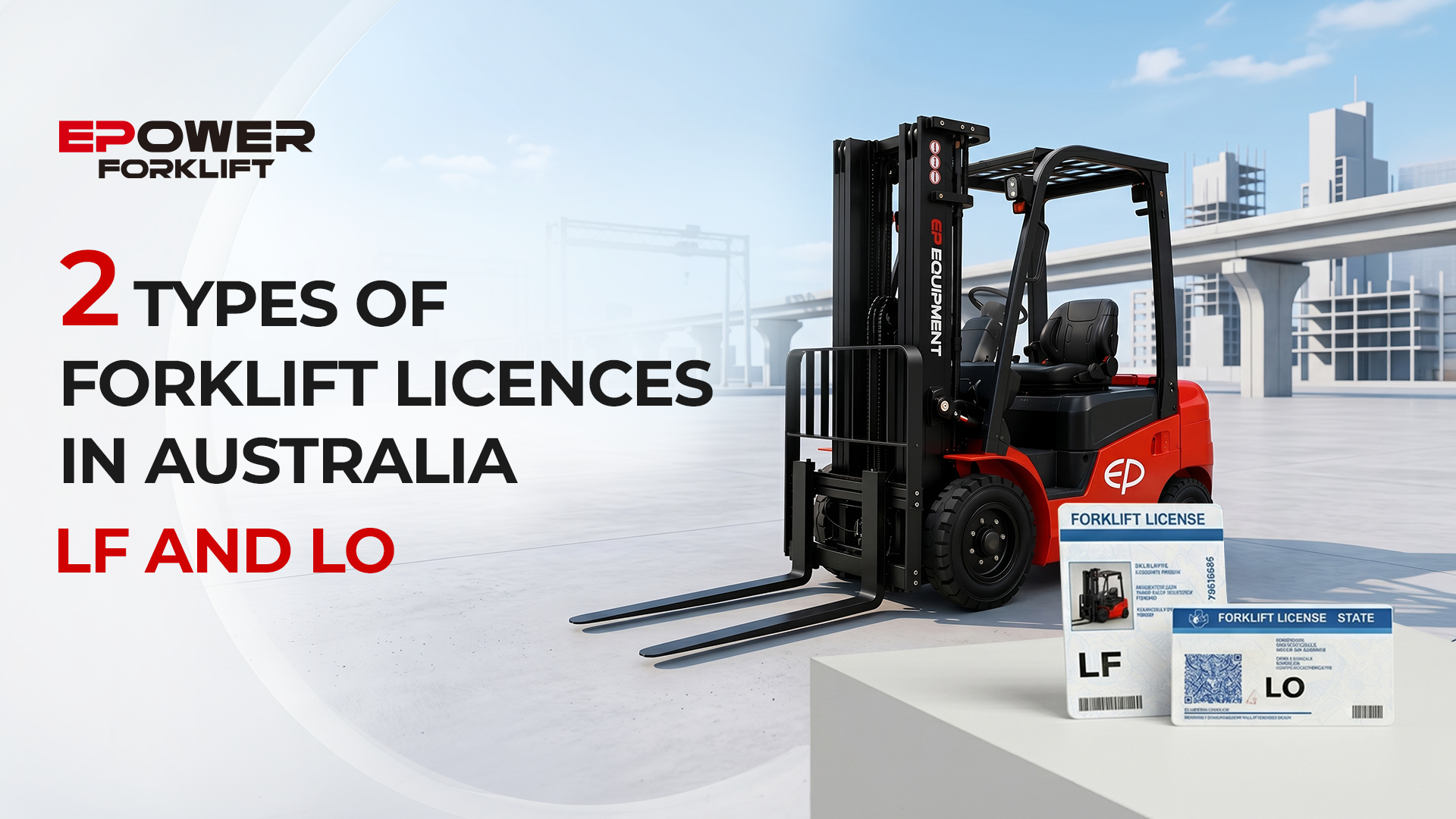
There are two forklift licence classes relevant to forklift operation in Victoria: LF and LO.
LF (Forklift Truck) Licence covers most forklift trucks, including counterbalance forklifts and reach trucks. This is the licence class required for the majority of warehouse forklift operations.
LO (Order Picking Forklift) Licence covers order-picking forklifts where the operator rises with the load platform during operation.
A common misconception is that all pallet trucks and stackers require an LF licence. In reality, many pedestrian-operated machines — such as walkie pallet trucks, pedestrian pallet trucks, and walk-behind stackers — do not require an LF licence because the operator walks behind the equipment rather than riding on the machine as a forklift operator.
For most EPower counterbalance and reach truck models, an LF licence is the relevant licence class. EPower order picker models require an LO licence.
An LF licence does not cover LO forklifts, and an LO licence does not automatically cover all LF forklift classes. Operators should always ensure their licence class matches the equipment being used.
How Do You Get a Forklift Licence in Victoria — Step by Step?
The process runs across five steps: choose an approved RTO, complete Day 1 training, pass the Day 2 assessment, submit your application at Australia Post within 60 days, and receive your HRW licence from WorkSafe Victoria.
Step 1 — Choose a WorkSafe Victoria-approved RTO
Only Registered Training Organisations (RTOs) approved by WorkSafe Victoria can legally issue forklift training certificates that lead to an HRW licence. Training completed through an unapproved provider has no legal standing regardless of what the provider claims.
The unit of competency is TLILIC0003 Licence to Operate a Forklift Truck. Verify any RTO you consider is listed on WorkSafe Victoria's approved provider register or on training.gov.au before enrolling. The cheapest option from an unapproved provider costs more in the end.
Course duration is typically two days for candidates with some prior forklift experience and three days for those with none. The RTO will advise based on your background at enrolment. Upon enrolment, the RTO issues a pre-work assignment that must be completed at home before Day 1. This takes approximately two to four hours. Arriving without it means you cannot enter the course.
When Epower customers ask us about finding training providers, we direct them to verify the RTO's WorkSafe approval status first — not to take the provider's word for it.
Step 2 — Complete Day 1 Training
Day 1 covers the theoretical and supervised practical foundations required by the TLILIC0003 unit. The content is standardised across all approved RTOs in Victoria.
Theory content includes hazard identification in warehouse and site environments, pre-operational checks and pre-start inspection procedures, load calculation and stability principles, load centre and the load capacity chart, safe manoeuvring including turns, ramps, and pedestrian zone protocols, and occupational health and safety regulations applying to forklift operation in Victoria.
Practical content involves supervised exercises — navigating obstacles, lifting and moving loads under trainer observation. This is not an assessment day; it is preparation for Day 2. Candidates who do not demonstrate sufficient progress on Day 1 may be required to repeat the day before proceeding, with additional fees applying.
The load centre and load capacity chart content covered on Day 1 directly applies to reading EP Equipment data plates and operating within rated capacity. Epower's guides on data plate reading andpre-start inspection procedures cover the same principles operators encounter in their licensing course.
Step 3 — Pass the Three-Part Assessment on Day 2
Day 2 is the formal assessment conducted under the National Assessment Instrument (NAI). All three categories must be passed. A fail in any single category fails the assessment for that category only — the other two categories remain valid and do not need to be repeated.
Category 1 — Knowledge Assessment. Written or verbal test covering theory, safety regulations, and hazard identification. Candidates who need verbal delivery rather than written should confirm this with the RTO before the assessment day.
Category 2 — Calculations Assessment. Load capacity calculations using load centre and lift height variables. This is the category most candidates find hardest. If you are unclear on how load centre affects rated capacity — and why a 3,000 kg rated forklift cannot always carry 3,000 kg — review this before Day 2.
Category 3 — Practical Assessment. Demonstrate safe forklift operation in a simulated workplace scenario. The assessor scores performance against NAI criteria. Speed is not assessed — accuracy, safety protocol, and correct technique are.
If you fail a single category, a re-assessment can be booked for that category at approximately AUD 150. You do not repeat the full course.
Step 4 — Submit Your NOA at Australia Post Within 60 Days
This is the step that most often derails candidates who have otherwise completed everything correctly.
After passing all three assessment categories, the RTO issues two documents: a Statement of Attainment for TLILIC0003 and a Notice of Assessment (NOA) with an L2 Application Form. The NOA is not your licence — it is your authority to apply for the licence.
The NOA, L2 Application Form, valid photo ID, and the AUD 71.55 WorkSafe Victoria application fee must all be submitted in person at an Australia Post outlet within 60 days of passing the assessment. If the 60-day window lapses, the application becomes void. The training must be repeated from the beginning.
The identity check at Australia Post requires 100 points: a primary document such as a passport or birth certificate, plus secondary ID such as a driver's licence or utility bill. Do not sign the application form before attending — the signature must be witnessed by the Australia Post officer.
Set a calendar reminder for the submission deadline the moment you receive your NOA. Do not leave it until week eight.
Step 5 — Receive Your High Risk Work Licence
WorkSafe Victoria processes the application after receiving it from Australia Post. Processing typically takes two to four weeks. The physical HRW licence card is mailed to your registered address and is valid for five years.
You do not need to wait for the physical card to begin operating legally. The NOA serves as a temporary licence from the moment it is submitted to Australia Post. An operator carrying their NOA can legally operate a forklift in Victoria while the permanent card is in transit.
The Victorian HRW licence is recognised in all other Australian states and territories under national mutual recognition. There is no requirement to re-license when working interstate.
Once your licence is issued, if you are stepping into an electric forklift for the first time — whether purchasing or renting through Epower — the operational characteristics are different enough from combustion models that a brief model familiarisation is worth completing before your first operational shift.
How Much Does It Cost to Get a Forklift Licence in Victoria?
The total cost combines the RTO course fee and the WorkSafe Victoria application fee. The WorkSafe fee is fixed. The course fee varies by provider.
| Cost Item | Amount | Notes |
|---|---|---|
| RTO course — 2 days | AUD 350 to 600 | Varies by provider and location in Victoria |
| RTO course — 3 days | AUD 450 to 750 | Candidates with no prior experience |
| WorkSafe Victoria application fee | AUD 71.55 | Paid at Australia Post — fixed fee |
| Re-assessment (if needed) | AUD 150 | Per category, not all candidates require this |
| Total typical cost | AUD 420 to 675 | Without re-assessment |
Course fees at budget RTOs in Victoria start around AUD 350 for a 2-day course. Premium providers in metro Melbourne charge up to AUD 600. The WorkSafe fee does not change. When comparing providers on price, verify approved status first — an AUD 50 saving on a course from an unapproved RTO means starting the process over entirely.
For employers who are licensing multiple operators as part of a new fleet setup, the per-operator licensing cost is worth including in the total fleet deployment budget alongside equipment purchase or rental costs.
How Long Does It Take to Get a Forklift Licence in Victoria?
From the day of enrolment to the day the physical HRW licence card arrives, the typical timeline is three to six weeks.
Pre-work assignment completion before Day 1 takes two to four hours. Training runs across two to three days on-site. The NOA is issued by the RTO on Day 2 if all three assessment categories are passed. Australia Post submission should be completed within the first week after assessment — not in week eight. WorkSafe Victoria processing takes two to four weeks after Australia Post receives the application.
The critical timeline point for employers: the NOA provides legal authority to operate from the moment of submission at Australia Post. An operator who passes their assessment on a Thursday and submits at Australia Post on Friday can legally operate a forklift the following Monday — the physical card does not need to arrive first.
For urgent licensing needs, the practical turnaround from enrolment to legal operation can be as short as one week, two to three days of training, plus one day for Australia Post submission.
What Happens After You Get Your Forklift Licence in Victoria?
Does a Forklift Licence Cover All Types of Electric Forklifts?
No. The LF licence covers all standard electric forklifts where the operator's position does not rise with the forks — counterbalance, reach truck, pallet truck, pallet stacker, heavy tonnage, and rough terrain. The LO licence is required for order picking forklifts where the operator rises with the load. These are separate licences, and neither covers the other's machine class.
For operators running a mixed fleet that includes EP Equipment Order Pickers alongside standard counterbalance models, each machine class requires the corresponding licence class. Assigning an LF-only licensed operator to an order picker is a WorkSafe Victoria compliance breach regardless of the operator's experience level.
What Should an Employer Do Before a Licensed Operator Starts Using a New Forklift?
A valid HRW licence confirms legal authority to operate. It does not confirm competency on a specific model. Before an operator uses a new forklift — particularly when transitioning from a combustion model to an electric unit — the employer should conduct a site-specific Verification of Competency (VOC).
VOC confirms the operator can safely operate that specific machine on that specific site. It is particularly important for electric forklift transitions because the operational characteristics differ materially from LPG and diesel: instant torque delivery, regenerative braking behaviour, and near-silent operation in pedestrian zones all require specific awareness that a combustion-trained operator may not have from their licence course alone.
Keep a current copy of every operator's HRW licence in your fleet records and audit annually for upcoming renewal dates. An operator with an expired licence is an unlicensed operator — the employer remains responsible under the OHS Act. When taking delivery of EP Equipment electric forklifts through EPower, ask about model familiarisation as part of your fleet onboarding. A licence covers the legal right to operate. Familiarisation covers the safe operation of the specific machine in your specific environment.
Conclusion
Getting a forklift licence in Victoria is a straightforward process: complete approved training, pass the assessment, and submit your application within the required timeframe. The most common mistake is missing the 60-day application deadline after receiving your Notice of Assessment.
Once licensed, operators should ensure they are trained on the specific forklift model and workplace environment they will be working in. For employers, maintaining licence records and verifying operator competency remains an important part of ongoing compliance.
If you are licensing operators as part of a new fleet deployment, EPower Forklift can assist with equipment selection, operator familiarisation, and fleet onboarding across Australia.
Talk to the EPower Forklift team →
With EOFY closing 30 June 2026, selected lithium-ion models are currently available at up to 15% off, with in-stock units available for delivery within pre-30 June timeframes. If you are building out a licensed team and need equipment to match, the window to act with certainty is now.
Frequently Asked Questions
Can I Get a Forklift Licence Without Experience?
Yes. Previous forklift experience is not required. Beginners can obtain a forklift licence by completing approved training and successfully passing the required assessments.
What Happens If My Forklift Licence Expires?
An expired licence is no longer valid. You must renew it before continuing to perform work that requires a HRW licence.
Do I Need an LF or LO Licence?
It depends on the machine being operated. LF Licence – Most forklift trucks, including counterbalance and reach forklifts. LO Licence – Order-picking forklifts where the operator rises with the load.
Always ensure your licence class matches the forklift being operated!