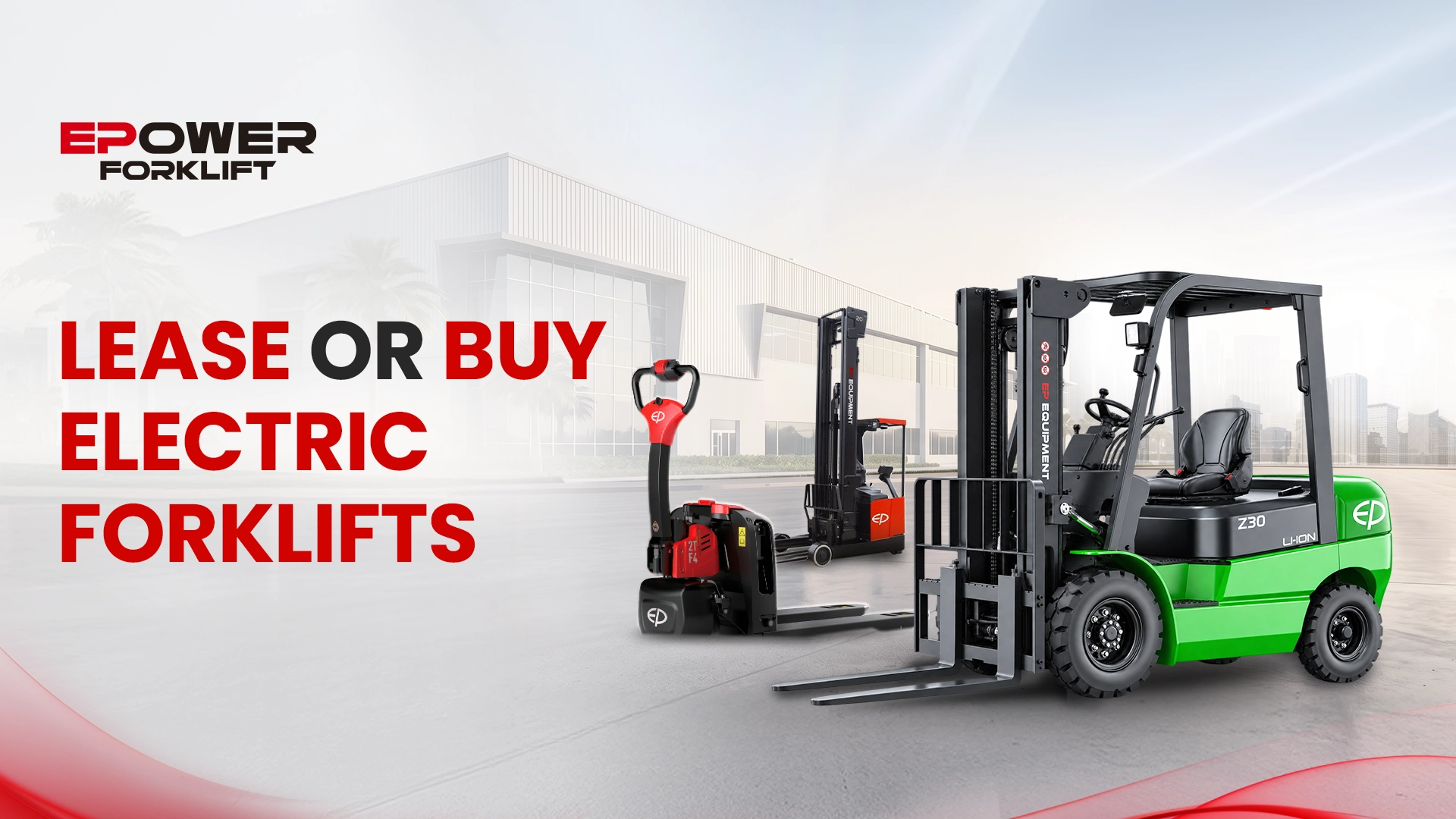
Most forklift acquisition conversations start with "how much does it cost to buy one?" They should start with "how long do I need it, how often will I use it, and how much capital do I want to commit?"
The answers to those three questions determine which acquisition method produces the lowest total cost and the best operational fit. EPower offers both outright purchase and rental on EP electric forklifts. This guide presents each option honestly — the right choice depends on the business situation.
This guide is for operational comparison only. Finance, tax, and accounting treatment depend on the contract structure and business circumstances. Confirm all tax, GST, and accounting implications with your accountant or finance broker before committing.
What Are Your Options for Acquiring a Forklift in Australia?
Buyers often think in terms of “buy or rent”, but finance is a separate path. It allows a business to use a forklift long term without paying the full purchase price upfront. The three finance-related options below are listed separately because ownership, maintenance responsibility and end-of-term outcomes can differ significantly.
| Category | Option | Ownership | Typical Term |
|---|---|---|---|
| Buy | Buy outright | Immediate | Permanent |
| Finance | Finance lease | Optional at end, subject to residual/payment terms | 3 to 5 years |
| Finance | Long-term lease | No | 2 to 5 years |
| Finance | Hire-purchase / rent-to-own | At end of term (subject to contract terms) | 2 to 5 years |
| Rent | Short-term rental | No | Days to months |
The terminology used by suppliers and finance providers is not always consistent. The signed agreement, not the product label, determines ownership, maintenance responsibility, usage limits and end-of-term costs.
The distinction between rent-to-own and finance lease is one many buyers miss. Hire-purchase or rent-to-own usually transfers ownership at the end of the term, subject to the contract terms and final payment. A finance lease may require a residual or balloon payment at the end of the term if the business wants to acquire ownership, depending on the contract. The monthly payment may look similar; the outcome at end of term is different.
Hire Forklift in Melbourne: A Complete Guide to Hire Options & Costs
When Does Buying a Forklift Outright Make Sense?
Outright purchase often has the lowest total cost over a long service life when the forklift is used consistently and capital is available. There is no interest, no lease fee, and no ongoing payment obligation. The TCO advantage compounds the longer the asset is in service.
Best fit for: permanent daily-use operations where the forklift is expected to stay in service for the better part of a decade, capital is available, and the business wants no ongoing financial obligations attached to the equipment.
Australian tax consideration: the instant asset write-off applies per asset below a legislated threshold — A$20,000 for the 2025–26 income year, for businesses with aggregated turnover under A$10 million. Most electric counterbalance forklifts exceed that threshold, so the write-off is unlikely to apply to the forklift itself; assets at or above the threshold go into the small business depreciation pool instead. The threshold has changed repeatedly and is subject to legislation, so confirm the current position with your accountant before making a purchase decision on this basis.
Residual value: owned forklifts have a resale value that partially offsets the original cost. This residual value is captured by the owner, not a finance company.
When buying outright is less suitable: capital-constrained businesses; operations with variable or uncertain forklift requirements; businesses that prefer to upgrade equipment on a regular cycle.
When Does Finance or Leasing a Forklift Make Sense?
Finance options suit businesses that need the forklift long-term but want to preserve working capital, spread the cost, or manage tax treatment of payments.
EPower supplies forklifts on an outright purchase or rental basis. Finance and lease structures are arranged separately through equipment finance brokers or lenders — the section below is included so the comparison is complete, not because EPower originates finance.
Finance lease: the business has use of the asset during the term. End-of-term ownership may require a residual or balloon payment, depending on the contract. The tax treatment of payments, interest, and depreciation depends on the finance structure and business circumstances — confirm with your accountant before comparing options on an after-tax basis.
Long-term lease: no ownership transfer; asset returns to lessor at end of term; maintenance may be included depending on the contract. Accounting and balance-sheet treatment depend on the lease terms, business reporting requirements, and applicable accounting standards — confirm with your accountant. Best for businesses that want to upgrade equipment every 3 to 5 years without residual value risk.
Hire-purchase / rent-to-own: the business spreads the forklift cost over a fixed term, with ownership usually transferring after the final payment and contract conditions are met. This can suit businesses that want ownership without paying the full purchase price upfront. Confirm the total amount payable, final payment, maintenance responsibility and early exit terms before signing.
Questions to ask any finance provider before signing: What is the residual value at end of term? Who is responsible for maintenance and servicing? What are the early exit terms and costs? What are the GST and accounting implications?
Electric Rough Terrain Forklift Hire in Melbourne: When It Makes Commercial Sense
When Does Renting or Hiring a Forklift Make Sense?
For long-term daily use, rental usually has the highest annualised cost of the main acquisition options. Its advantage is flexibility: the business can cover a temporary need, test a forklift, or bridge a breakdown without committing capital.
Seasonal demand peaks. Retail, wholesale, and agricultural operations with predictable busy periods that need additional capacity for 4 to 8 weeks per year. Renting additional units for peak periods avoids permanent fleet oversizing and the full-year cost of an asset that sits idle for most of it.
Project-based needs. Construction sites, warehouse fit-outs, or temporary operations with a defined end date. Buying for a six-month project is rarely cost-effective. Rental converts the cost to a project expense with no residual asset management.
Fleet evaluation before committing to electric. For operations considering transitioning from LPG or diesel to electric for the first time, renting a forklift for 3 to 6 months provides a genuine operational assessment before capital is committed. Battery behaviour across shifts, charging infrastructure requirements, and operator familiarity with electric characteristics can all be validated during the rental period.
Breakdown cover. Primary unit in service for repair; short-term rental covers operations during downtime without a capital outlay.
What rental includes that purchase does not: Under most rental agreements, scheduled maintenance is handled by the provider, subject to the rental terms. Tyres, accidental damage, excess hours, transport costs and battery misuse are not automatically covered, so these exclusions should be checked before signing.
EPower offers rental on selected EP Equipment electric forklifts. Contact EPower to confirm current model availability and rental terms for your specific application.
What Should You Confirm Before Comparing Forklift Acquisition Quotes?
Before comparing purchase, lease, or rental pricing, confirm both the forklift requirement and the contract structure.
Operational requirements:
- Required forklift capacity, load dimensions and load centre
- Required lift height, mast height and attachment needs
- Aisle width, doorway clearance and turning space
- Indoor, outdoor, cold-store, wet or uneven operating conditions
- Daily operating hours, shift pattern and seasonal peaks
- Battery, charger, site power and charging-window requirements
Commercial and contract requirements:
- Expected use period: days, months, years or permanent
- Maintenance responsibility and call-out coverage
- End-of-term ownership, residual or return conditions
- Early exit costs, upgrade options and usage limits
- Tax, GST and accounting treatment with your accountant
These inputs change the comparison materially. A quote without these details confirmed is a starting point, not a decision basis.
How Should You Compare Forklift Purchase, Lease and Rental Costs?
The lowest-cost option depends on how long the forklift will be used, whether capital is available, who carries maintenance risk and what happens at the end of the term.
| Factor | Buy outright | Finance / Rent-to-own | Long-term lease | Short-term rental |
|---|---|---|---|---|
| Upfront capital | Highest | Low to moderate | Low | Minimal |
| Monthly payment | None | Yes | Yes | Yes |
| Long-term total cost | Usually lowest for permanent daily use | Higher than outright purchase | Higher, but may include service and upgrade flexibility | Highest if used continuously long-term |
| Maintenance responsibility | Buyer | Usually buyer | Often included, depending on contract | Usually provider, subject to rental terms |
| End-of-term outcome | Owner keeps or resells asset | Ownership may transfer, depending on structure | Asset returned | Asset returned |
| Best use case | Permanent daily operation | Long-term use with capital preservation | Planned upgrade cycle | Seasonal, project, trial or breakdown cover |
To compare options properly, calculate each structure over the same operating period and the same forklift specification.
A practical rental-cost calculation is:
Weekly or monthly payments + delivery and collection + excluded maintenance + insurance + attachments + excess usage or damage charges + end-of-term costs
A practical purchase-cost calculation is:
Purchase and finance costs + charger and electrical work + maintenance + tyres and parts + insurance - expected resale value
For electric forklifts, battery capacity, charger output, charging windows and site power should also be compared consistently because these affect whether the forklift can complete the required shifts.
As a practical decision guide:
| Business situation | Recommended option | Reason |
|---|---|---|
| Permanent daily use with capital available | Buy outright | Usually lowest long-term cost when the forklift will stay in service for several years |
| Permanent daily use with limited upfront capital | Finance / Rent-to-own | Spreads the cost while keeping ownership as the likely end goal |
| Regular upgrade cycle or residual-value risk concern | Long-term lease | Reduces ownership risk and may include service or upgrade flexibility |
| Seasonal, project-based or uncertain need | Short-term rental | Avoids long-term commitment when the requirement may change |
| Evaluating electric forklifts before committing | Short-term rental | Allows the site to test runtime, charging behaviour and operator acceptance |
The key is to compare the same forklift specification over the same operating period. Purchase usually wins on long-term cost for permanent daily use. Rental usually wins on flexibility when the need is seasonal, temporary, uncertain or used for electric forklift evaluation.
What Changes When Comparing Electric Forklift Options?
Yes, mainly because of battery risk.
The battery is one of the highest-value components of an electric forklift. Under outright purchase, finance or rent-to-own, the buyer usually carries battery condition and replacement risk, subject to the manufacturer warranty. Under long-term lease or rental, battery responsibility may sit with the provider, depending on the contract.
This matters most for businesses moving from diesel or LPG to electric for the first time. Rental or long-term lease can reduce early uncertainty while the site tests battery runtime, charging discipline and operator behaviour.
Switching to Lithium Forklifts? What Your Site Needs to Run Them
Conclusion
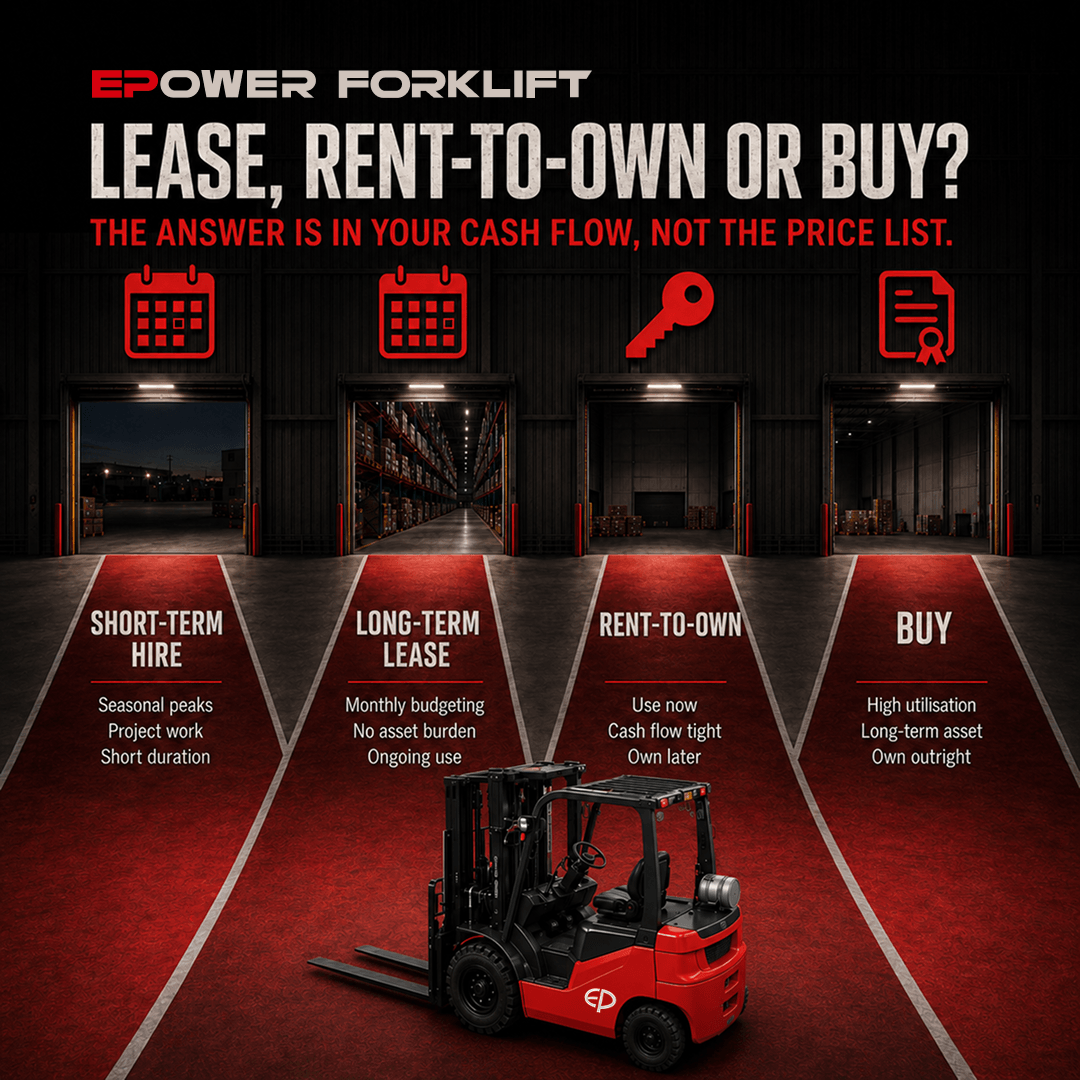
The right forklift purchase, lease or rental option depends on how certain the requirement is, how often the forklift will be used, how much capital the business wants to commit and who should carry maintenance, battery and residual-value risk.
Buy outright when the forklift is a proven long-term asset and capital is available. Consider finance or rent-to-own when ownership is the goal but upfront capital should be preserved. Use rental when the requirement is seasonal, temporary, uncertain or when the business wants to evaluate electric forklifts before committing.
Before comparing quotes, confirm the forklift specification, expected operating period, battery and charger requirements, maintenance responsibility and end-of-term conditions. EPower can help compare these options against your load profile, shift pattern, charging setup and site requirements before you commit. Contact EPower team today!
Frequently Asked Questions
Is buying a forklift always cheaper than renting?
For daily permanent use over a 5-year or longer service life, outright purchase is typically the lowest total cost option when capital is available. Rental makes financial sense for seasonal, project-based, uncertain or evaluation needs.
Can I rent a forklift without a forklift licence?
A business may be able to enter a rental agreement without the person signing the agreement being the licensed operator. However, the person who operates the forklift must meet the applicable high-risk work licence requirements for that forklift type.
Is rent-to-own the same as leasing a forklift?
No. Rent-to-own usually aims toward ownership at the end of the term, subject to the contract terms and final payment. Leasing may not transfer ownership unless the agreement includes a residual or purchase option.