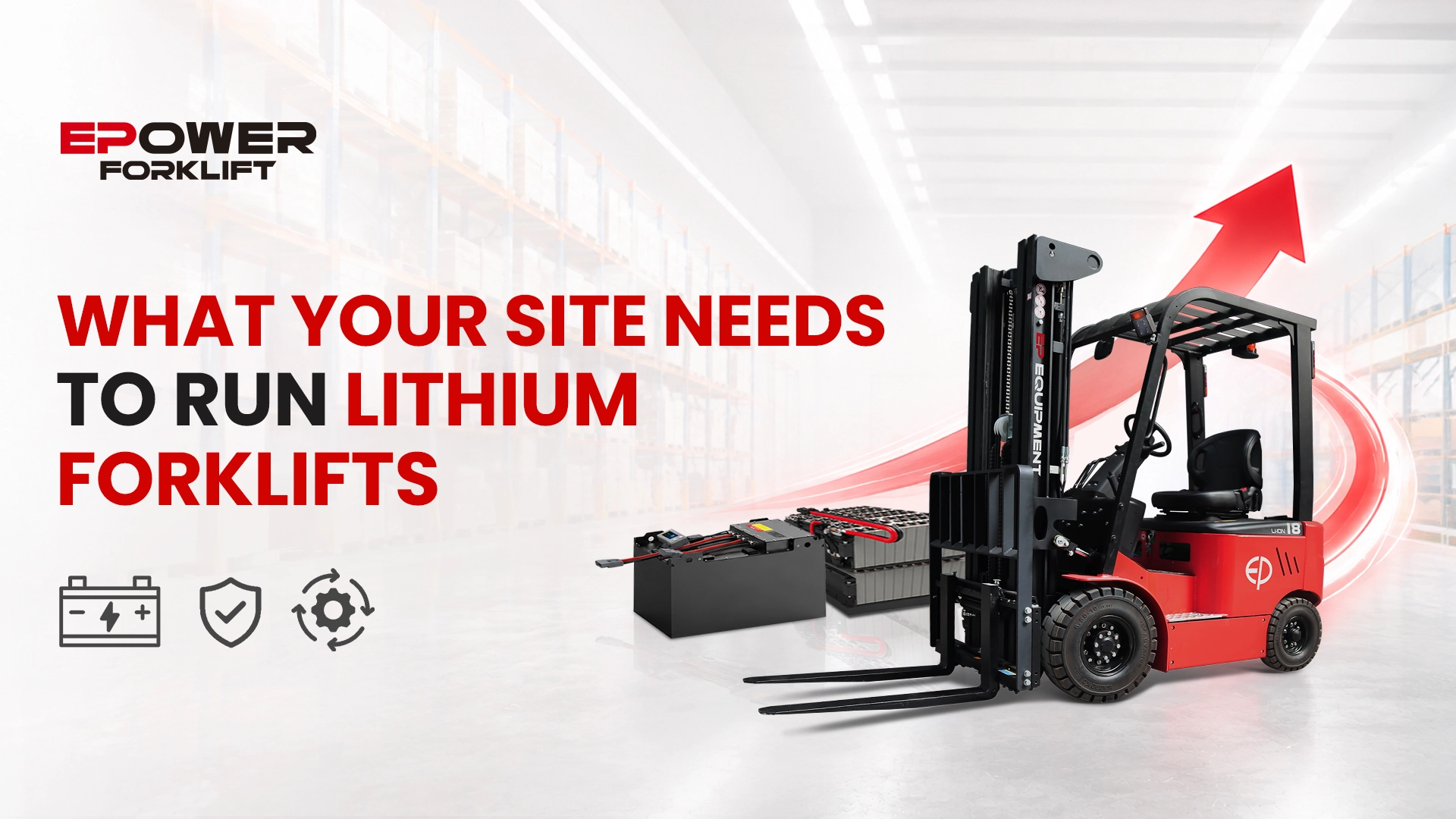
Many standard warehouse sites can switch to lithium forklifts without major infrastructure changes. The important step is confirming the basics before delivery: the charger must be compatible with the lithium battery, the power supply must suit the charger, and the charging location must be safe for daily operation.
Problems usually appear when a site assumes its existing lead-acid chargers, outlets or charging layout will work the same way for lithium. Before ordering or installing a lithium forklift, buyers should confirm charger compatibility, electrical supply, charge point location and emergency procedures with the forklift supplier and a licensed electrician where required.
What Makes Lithium Forklift Infrastructure Different from Lead-Acid?
Lead-acid infrastructure is centralised. One battery room, dedicated hydrogen ventilation, battery swap equipment, fixed charge schedule. Each forklift returns to the battery room for battery changeover or charging, and the depleted battery charges overnight while a charged one goes back into service.
Lithium infrastructure is distributed. No battery room, no hydrogen ventilation, no battery swap. The charge point should be positioned close to where the forklift naturally stops, but still within a controlled charging area that does not block traffic routes, pedestrian paths, emergency exits, or fire controls. The forklift plugs in during a lunch break, a loading pause, a shift changeover. It charges for 20 minutes and returns to work with meaningful additional run time.
Why Lithium Forklifts Are Replacing Fuel Models in Australia?
The infrastructure change is not just technical. It changes where things go on site and how the floor is used. Sites that eliminate a battery room may reclaim floor space that was previously unavailable for storage or operations.
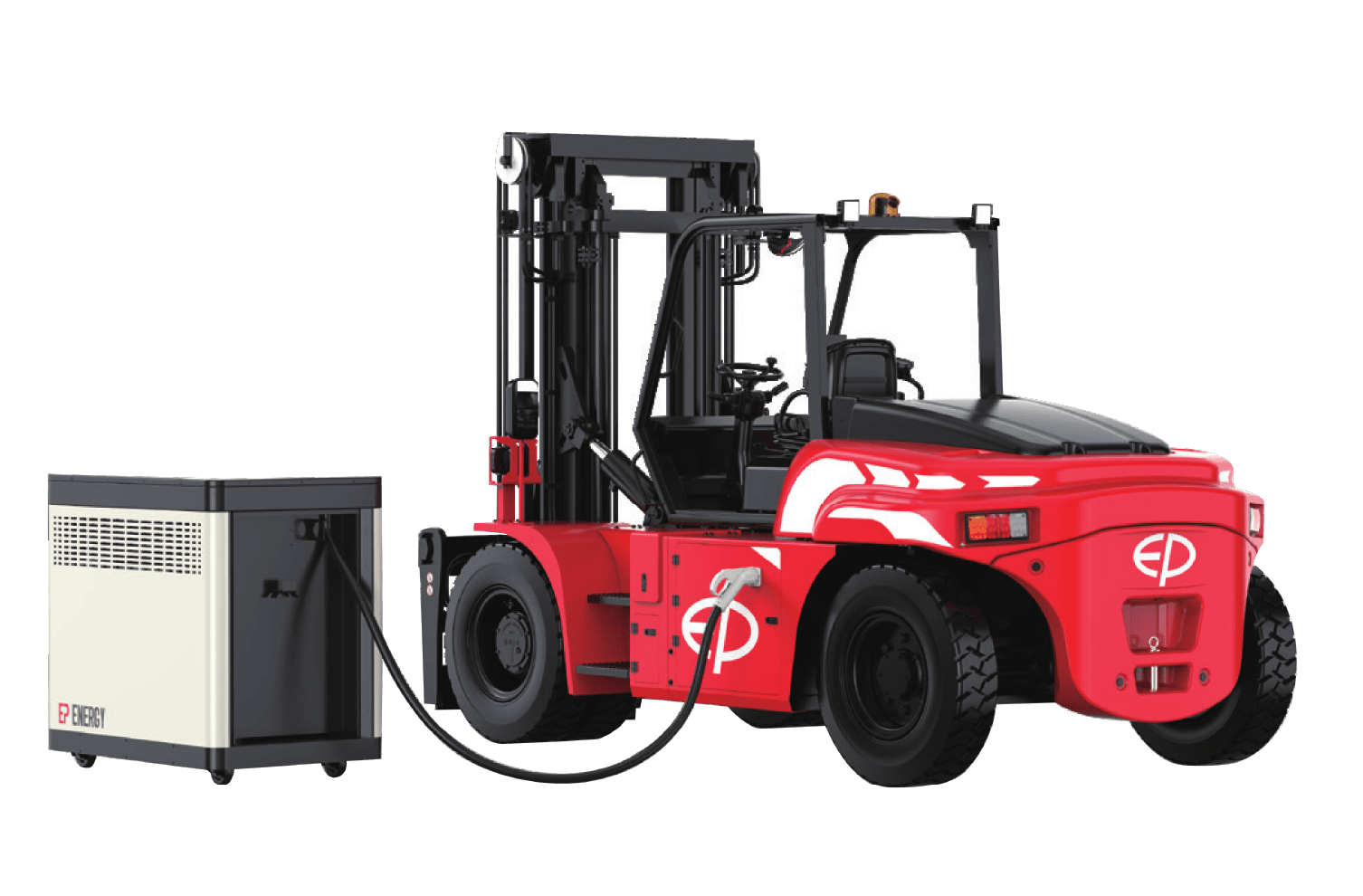
The one technical requirement that has no flexibility: the charger must be designed for lithium-ion and must communicate with the battery's BMS. A lithium-ion charger reads cell voltage, temperature, and state of charge from the BMS in real time and adjusts charge parameters accordingly. A lead-acid charger charges on fixed parameters — the battery has no way to protect itself. Using a lead-acid charger on a lithium battery is not a minor compatibility issue. It is a damage and safety risk.
In EPower’s experience, charger compatibility is often the first issue to check when a customer moves from lead-acid to lithium. Many sites already have functional lead-acid chargers, but those chargers cannot be assumed safe for lithium forklift batteries. Voltage alone is not enough. Before switching, confirm that the charger is approved for the exact forklift, battery chemistry, charge profile and BMS configuration being supplied.
What Power Supply Does Your Site Need?
Many EP Equipment forklifts in standard single-shift warehouse applications can be configured for overnight charging from a suitable dedicated single-phase outlet. Confirm the charger input requirements and circuit capacity for the exact model before delivery. This should not be assumed from general guidance or from another forklift already charging on site.
This is where mistakes happen in practice. A site may run one EP EFL181 from a dedicated 15A single-phase outlet. When volumes grow and the site adds an EFL253, it may assume charging is already sorted because a forklift already charges in that location. That assumption should be checked. The EFL253 uses a different battery and charger configuration, and may require three-phase supply depending on the charger supplied with the unit. It is not simply a larger version of the same connection. It may be a different category of supply.
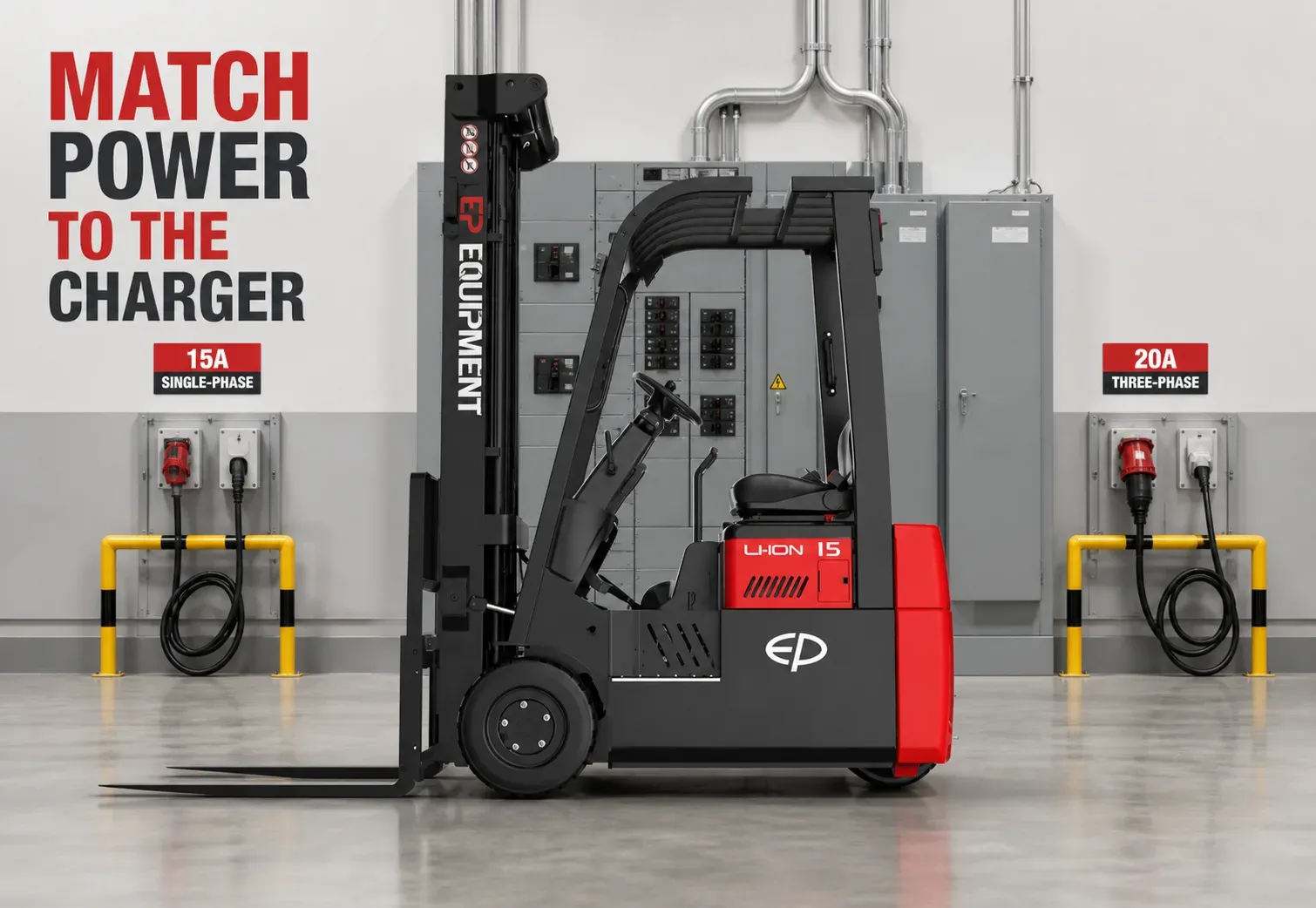
Three-phase power becomes relevant when the charger needs to recover more energy than a standard single-phase setup can practically supply within the available charging window. This is usually driven by higher-output charging, larger battery capacity, high-use equipment, multi-shift operation or limited downtime between shifts.
Fast charging, where supported by the specific forklift and charger configuration, uses higher power input to recover a substantial amount of battery capacity within a shorter charging window. Larger forklifts, high-use reach trucks and multi-shift fleets may require three-phase charging, but the requirement is model-specific rather than based on a fixed tonne rating.
Confirm the charger input requirements for the exact forklift, battery and charger configuration before delivery.
When multiple forklifts charge simultaneously overnight, confirm that the combined charger load does not exceed the site's main supply capacity. For fleets of six or more units charging at the same location, this is worth discussing with a licensed electrician before installation.
Any fixed electrical installation work required for charging infrastructure in Australia must be completed by an appropriately licensed electrical worker. Electrical installation work must be certified in line with the requirements of the relevant state regulator — in Victoria this is a Certificate of Electrical Safety issued by the licensed electrical contractor. Confirm the equivalent requirement for your state.
Electric Forklift Battery Charging Mistakes That Shorten Battery Life
What Forklift Charger Do You Actually Need?
EP Equipment forklifts supplied through EPower come with a compatible charger matched to the specific battery configuration in that unit. For most customers, the charger question is answered at the time of order.
The issue arises when a replacement charger is sourced independently, or when a site attempts to use existing chargers from a previous fleet. Voltage match alone is not the check. The charger must use a CC/CV charging profile with a cutoff voltage matched to the battery chemistry, and it must communicate with the BMS via the correct protocol. A charger that matches voltage but lacks BMS communication charges on fixed parameters — and a battery that cannot signal its actual state to the charger has no protection against overcharging.
If a replacement charger is ever needed for an EP Equipment unit, confirm compatibility with EPower before purchasing.
Fast charging: if the operation needs forklifts available across multiple shifts without overnight recovery time, fast charging may be considered where supported by the specific forklift, battery and charger configuration. It uses higher power input to recover a substantial amount of battery capacity within a shorter charging window. Confirm the charger compatibility, expected charging time and site power supply with EPower before specifying fast charging capability.
Charger location: subject to site risk assessment and WorkSafe Victoria guidance on charging area controls, lithium chargers do not require the same hydrogen ventilation fittings that govern lead-acid battery rooms. The charger must be protected from forklift impact and, where there is water ingress risk, must have an appropriate weatherproof rating. WorkSafe Victoria recommends that charging areas be separated from areas where people work and be equipped with appropriate fire detection and suppression.
Where Should Charging Points Be Located on Site?
This is the infrastructure decision that most directly affects whether lithium's productivity advantage is realised in practice.
Lithium batteries benefit from frequent short charges across the shift rather than a single long overnight charge. A forklift plugged in for 15 to 20 minutes during a meal break, a loading pause, or a shift changeover adds meaningful run time. This only works if the charge point is accessible from where the forklift already stops.
The practical guideline is simple: locate charge points at the natural stopping points in the forklift's daily route, such as the dock face, aisle end near the break area, or staging zone. The charging area must still be controlled, clear of traffic routes, pedestrian paths and emergency exits, and aligned with site fire controls. WorkSafe Victoria guidance recommends dedicated charging areas separated from where people work, with appropriate fire detection and suppression in place.
This is where two sites with the same roster can get very different results. At one site, the charger may sit beside the dispatch door where the forklift already parks during pauses, so operators plug in naturally. At another site, the charger may be installed near the switchboard at the far end of the building because that is where power was easiest to access. Operators rarely use that charging window, and the site concludes the battery is too small.
In many cases, this is not a battery specification problem. It is a layout problem. A charging window only creates value when the charger is positioned where operators can and will actually use it. This is one of the more common layout mistakes EPower sees when customers plan lithium charging around power availability rather than operator behaviour.
For fleet sizing, single-shift operations typically need one charge point per forklift for overnight charging. Multi-shift operations with distributed opportunity charging may be able to run multiple forklifts per charge point, but only if those points are accessible from operating zones. Confirm the right number based on the fleet size, shift pattern and real charging behaviour.
For cold storage operations, charge points inside a cold zone require chargers rated for the zone temperature. Confirm charger operating temperature range with EPower before installing charge points in refrigerated areas.
Why Cold Storage Operations Are Switching to Lithium-Ion Forklifts?
Why Should Battery Sizing Be Based on Real Forklift Use?
Lithium battery sizing should be based on what the forklift actually does, not just the shift roster. A forklift assigned to an eight-hour shift is rarely moving for eight full hours. It may wait at docks, pause between picks, sit through breaks and spend part of the shift idle.
Start with the hour meter and the real duty cycle. A practical walk-around can confirm operating hours, shift count, typical load weights, attachment use, charger locations and known seasonal peaks.
For high-use or multi-shift sites, workload intensity and idle time may need to be observed across a full working week. One “typical day” can hide the peaks, and the peaks are where batteries usually run short.
Charging windows must also be realistic. A window only counts if operators can and will plug in during it. The amount of charging downtime the operation will accept is a business decision: the less downtime accepted, the more battery capacity or charging power may be required.
If the battery is too small, the site gets low-charge interruptions late in the shift. If it is too large, the business pays for extra capacity, weight and charging time without moving more pallets.
What Safety Requirements Apply to Lithium Forklift Charging in Australia?
Lithium forklift charging has a different safety profile from lead-acid — simpler in some areas, requiring specific awareness in others.
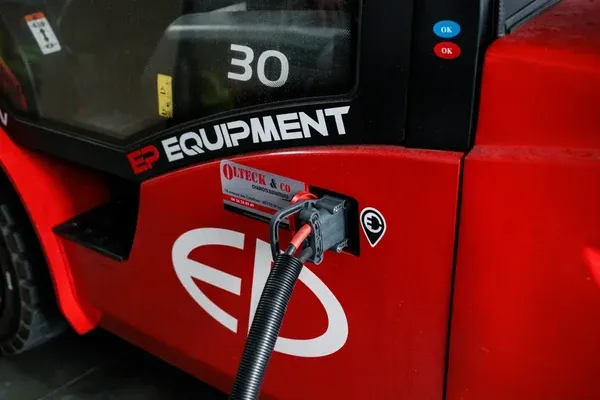
What lithium normally does not require compared to lead-acid:
Lithium does not produce hydrogen gas during charging, so the dedicated hydrogen ventilation systems and explosion-proof electrical fittings required for flooded lead-acid battery rooms are not applicable. Lithium charging does not normally require eyewash equipment for acid exposure in the way flooded lead-acid battery handling can — but emergency equipment on site should still be determined by the site risk assessment. No battery cooling period before charging is required, and no battery watering maintenance applies.
What lithium does require:
Follow the manufacturer's approved charging temperature range. Some lithium systems restrict charging at high cell temperatures or below freezing unless battery heating or low-temperature protection is specified. For EP Equipment units, confirm the approved charging temperature range with EPower for the specific model before operating in temperature extremes.
Compatible charger — covered above, but worth restating in the safety context. One of the most preventable lithium forklift charging risks is a mismatched charger. A battery operating with a compatible charger, within the manufacturer's approved conditions, presents a more manageable risk profile.
Thermal runaway awareness
Lithium thermal runaway has a different hazard profile from lead-acid hydrogen risk. Lithium battery fire response should be set through the site emergency plan and relevant fire-service guidance. Workers should evacuate, isolate the area where safe to do so, and call emergency services. Do not assume a standard extinguisher is suitable for a lithium battery fire unless the site has assessed the hazard and trained workers accordingly.
Australian compliance
WorkSafe Victoria publishes guidance on managing lithium-ion battery risks, including requirements for dedicated charging areas, separation from where people work, appropriate fire detection and suppression, and emergency planning. These obligations sit under the general duty provisions of the Occupational Health and Safety Act 2004 (Vic). Confirm current requirements with WorkSafe Victoria before commissioning charging infrastructure.
Is Your Site Ready for Lithium Forklifts?
Before switching to lithium forklifts, confirm the following points for the exact forklift, battery and charger configuration being supplied:
| Site requirement | What to confirm |
|---|---|
| Existing chargers | Confirm whether any existing chargers are lithium-rated. Lead-acid chargers should not be reused unless the forklift supplier confirms compatibility. |
| Charger compatibility | Confirm the charger is approved for the exact forklift, battery chemistry, charge profile and BMS configuration. |
| Power supply | Confirm whether the charger requires a dedicated single-phase circuit or three-phase supply. |
| Larger models or fast charging | Confirm whether three-phase power is available at the intended charge point. |
| Multiple forklifts charging together | Confirm total charger load with a licensed electrician if several units will charge at the same time. |
| Charger location | Position charge points near natural stopping points while keeping the area controlled, protected and clear of traffic routes, pedestrian paths and emergency exits. |
| Battery sizing | Check actual forklift use from the hour meter and real duty cycle, not the shift roster alone. |
| Charging windows | Confirm that operators can and will plug in during the planned charging windows. |
| Fire and emergency controls | Review fire detection, suppression, emergency isolation and lithium battery incident procedures. |
| Cold storage or harsh environments | Confirm charger temperature range, battery protection, IP rating and cold-zone suitability. |
| Electrical installation | Use a licensed electrician and confirm Certificate of Electrical Safety requirements where electrical installation work is completed. |
When Might a Lithium Forklift Not Be the Right Choice for Your Site?
Lithium is not automatically the best commercial fit for every operation.
The business case may be less compelling when:
- An existing lead-acid system is performing reliably and is not near replacement.
- The site does not have practical charging access.
- Electrical upgrades are disproportionately expensive.
- The existing forklift is not technically approved for lithium conversion.
- The operation cannot provide controlled charging positions.
- Extreme-temperature requirements have not been addressed.
In these situations, retaining a reliable existing system, improving the charging setup or waiting until the next fleet-replacement cycle may provide better commercial value. The decision should be based on whether a lithium system can reduce downtime, maintenance, energy use or operational risk enough to justify the complete installed cost.
Frequently Asked Questions
Can a lithium forklift use a normal power point?
Some compact models can use a suitable dedicated single-phase outlet, but a normal power point should never be assumed suitable. Check the approved charger input specification and have any required electrical work assessed and completed by a licensed electrician.
Does a 48V lithium forklift require a 48V wall outlet?
No. The 48V figure refers to the forklift battery’s DC output. The forklift lithium battery charger converts the site’s AC electrical supply to the voltage and current required by the battery.
Can I replace a lead-acid forklift battery with lithium?
Not without a technical assessment. Voltage, physical dimensions, battery weight, counterbalance, connector design, charger compatibility and communication between the BMS and forklift controller must all be confirmed.
Do lithium forklifts need a battery room?
Lithium forklifts can reduce or remove the need for a traditional lead-acid battery room with watering, spill-control and battery-changing equipment. They still require a designated charging position with appropriate electrical, traffic and fire controls.
Can lithium forklifts be opportunity charged every day?
Yes, when the manufacturer permits it. Opportunity charging should follow a planned schedule using the approved charger, while repeated deep discharge and unsuitable charging temperatures should be avoided.
Conclusion
The most valuable lithium forklift advantages are flexible opportunity charging, fewer battery-handling tasks, reduced routine maintenance and more consistent shift performance. Before finalising a lithium forklift order, confirm the charger type, power supply, charging location and expected duty cycle for the exact model being supplied. If you are planning a fleet transition to lithium, EPower can help review the forklift, battery and charger configuration against your site’s operating pattern before delivery. Talk to EPower Forklift