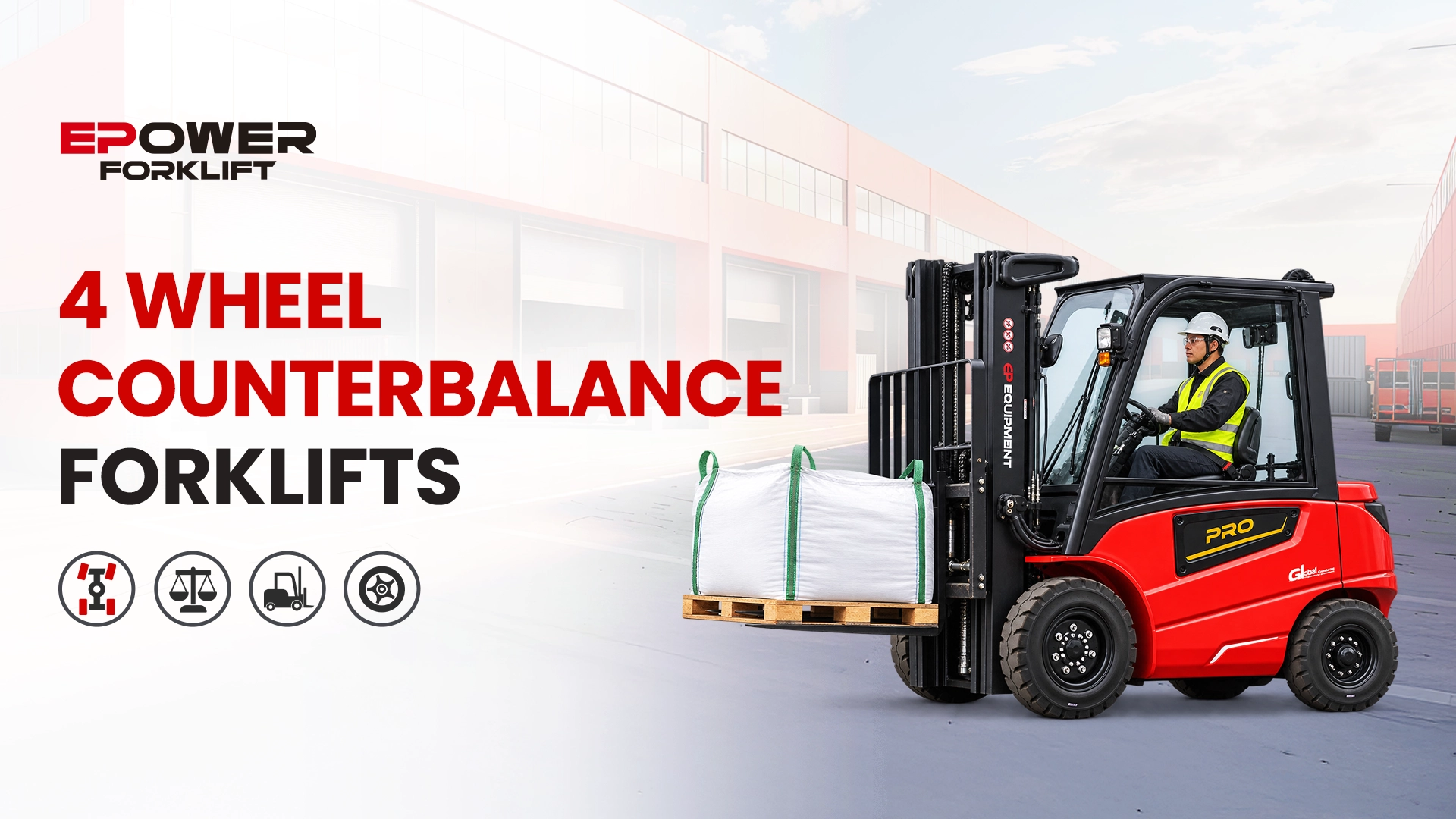
The best 4 wheel counterbalance forklifts are not automatically the largest or most expensive models. They are the trucks that can safely carry your real load at the required lift height, turn inside your working aisle, travel over your actual surfaces and complete the planned shift with practical charging windows.
A four-wheel counterbalance forklift is a sit-down industrial truck with a rear counterweight and a four-wheel chassis. It can approach a pallet without reach legs, making it a versatile choice for truck unloading, block stacking and mixed indoor–outdoor transport. If you are still confirming the equipment category, start with EPower’s electric counterbalance forklift buyer’s guide.
This shortlist covers current EP Equipment models offered by EPower. It is an application guide—not a claim that one model is best for every Australian worksite.
3 Wheel vs 4 Wheel Forklift: What Is the Practical Difference?
In a 3 wheel vs 4 wheel forklift comparison, a three wheel truck generally prioritises a tighter turning envelope, while a four wheel truck generally provides a broader capacity range and better suitability for mixed warehouse, loading dock and sealed yard work. Actual aisle requirement, stability characteristics and gradeability remain model specific.
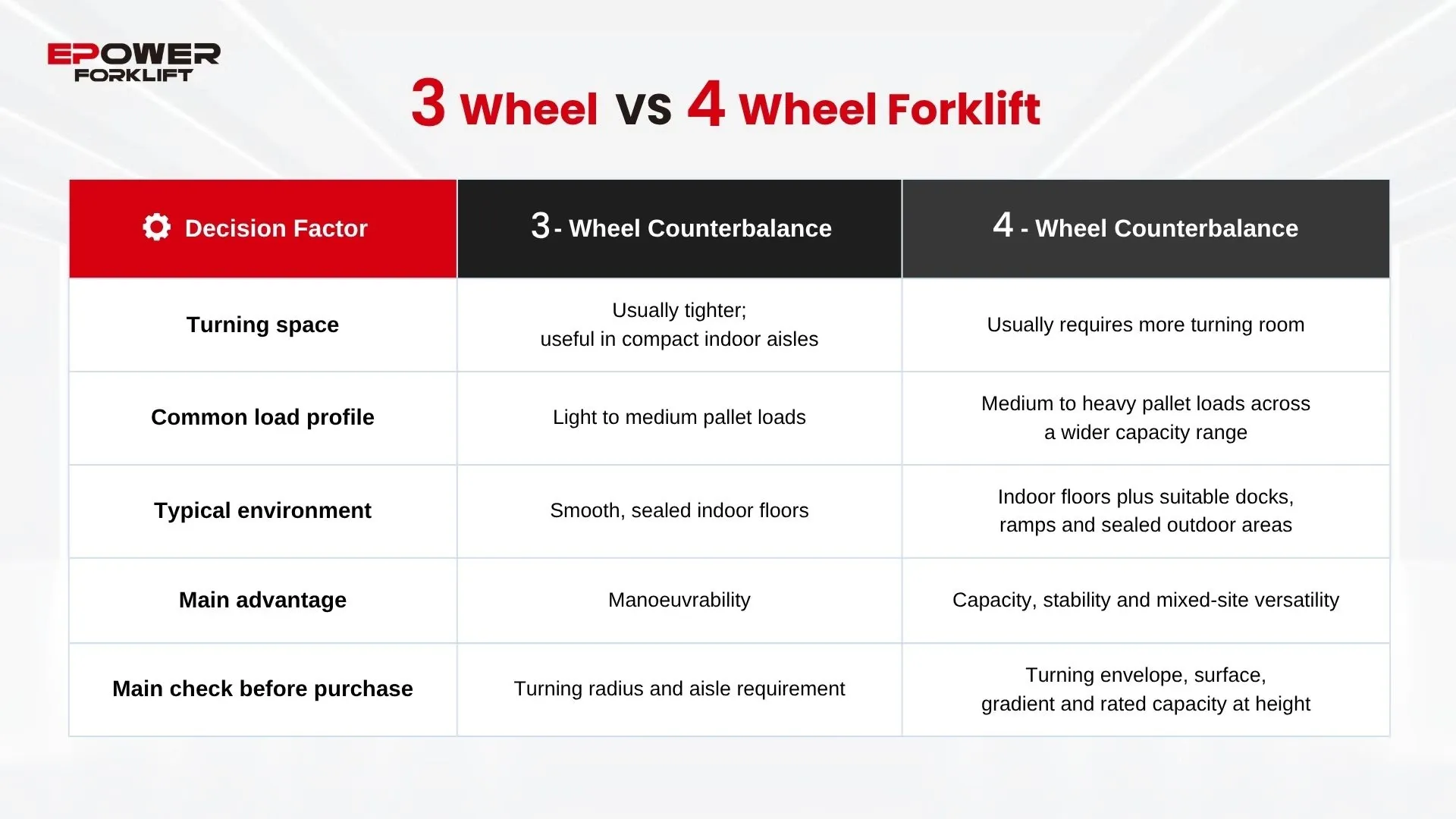
Choose three wheels when every centimetre of aisle space matters and the work is predominantly indoors. Choose a 4 wheel forklift truck when the route crosses doorways, dock areas or suitable outdoor surfaces, or when the load profile exceeds the practical range of a compact three wheel model.
Do not make the decision from wheel count alone. Compare the manufacturer’s turning radius and stacking aisle figures against measurements taken with the pallet size used on your site.
How to Choose an Electric 4 Wheel Forklift for Your Operation?
Before comparing an electric 4 wheel forklift for sale, record seven site facts: the heaviest load, maximum lift height, load dimensions, narrowest aisle, surface and gradient, productive hours per shift, and required attachments. This converts a product search into a defensible equipment specification.
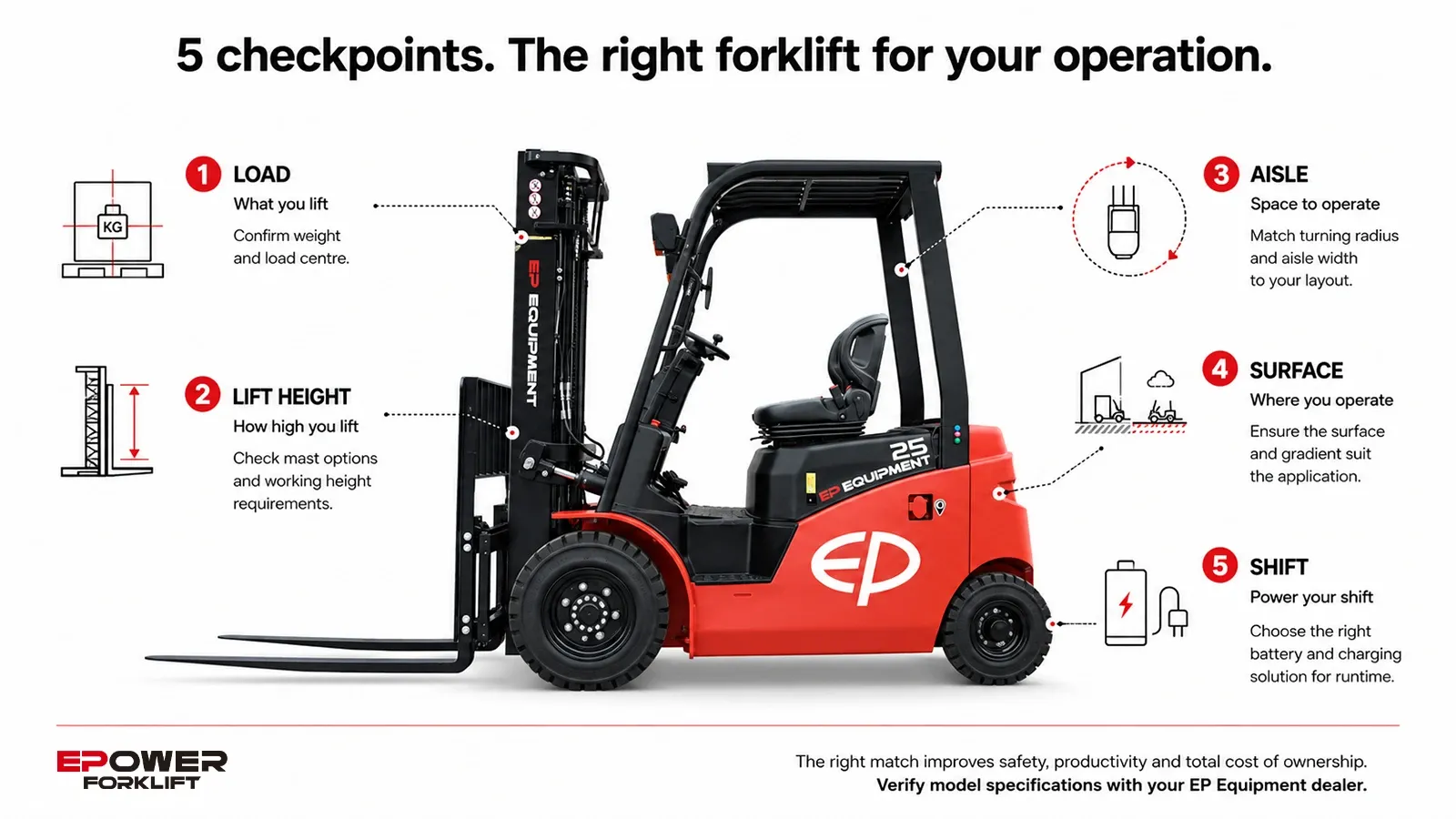
1. Specify Capacity at the Working Height
Nominal capacity is not the same as usable capacity in every configuration. Mast height, load centre and attachments can reduce the load a forklift may safely lift.
WorkSafe Victoria’s purchasing and hiring guidance recommends considering the maximum height and weight of the load, the load type and the operating surface when selecting capacity. WorkSafe Victoria guidance is referenced here as an example. WHS obligations differ by state—confirm current requirements with your state or territory regulator.
Ask the supplier for the residual capacity at your required lift height and load centre.
2. Measure the Complete Turning and Stacking Envelope
Measure more than the narrowest straight aisle. Include pallet depth, rack clearance, aisle end turns, doorways, columns, bollards and the space needed to square up to a load.
Compare those measurements with the model’s technical data sheet. A trial on site is especially useful where the layout contains blind corners, short cross aisles or shared traffic routes.
3. Match the Truck to Surfaces and Gradients
Map the full travel route from receiving to storage and dispatch. Record dock plates, thresholds, ramps, drainage channels, wet areas and transitions between indoor concrete and sealed outdoor surfaces.
Then confirm tyre specification, ground clearance, braking and gradeability for the proposed configuration. Four wheels increase application flexibility, but they do not turn a standard counterbalance forklift into a rough terrain truck.
4. Size the Battery Around the Duty Cycle
Record productive travel and lift time over several representative days. Include peak periods rather than relying on an average shift, then identify realistic charging windows during breaks or handovers.
Lithium-ion batteries support opportunity charging, but the charger, electrical supply and charging routine must match the battery. EPower’s guide to electric forklift battery charging mistakes explains why charger compatibility and planned charging behaviour matter to battery life.
5. Verify Attachments, the Capacity Plate and Support
A sideshifter, fork positioner, clamp or longer tynes can change effective capacity and load centre. WorkSafe Victoria’s forklift attachment guidance states that the attachment should be manufacturer approved, rated and listed on the forklift’s information or load capacity plate.
Before accepting delivery, check that the final truck, mast, battery, tyres and attachment match the quotation and documentation. Also confirm local parts access, service response and who will support the machine after commissioning.
Best 4 Wheel Counterbalance Forklifts by Application
EFL181: Best for Light, Short Duty Warehouse Work
The EP EFL181 is a 1.8 tonne lithium ion model with a listed 4.5–4.8 m lift range and 3–5 hour runtime. Its single phase charging requirement can suit smaller businesses that do not have a dedicated three phase charging point.
It is the practical entry point for light pallet handling, intermittent loading and shorter single shift duty cycles. If the truck must work continuously or spend significant time on gradients, move up to a configuration with more battery and performance headroom.
EFL203: Best Step Up for 2.0 Tonne Applications
The EP EFL203 is a 2.0 tonne lithium-ion model with a listed 3–6 m lift range, 4–10 hour runtime and three phase charging options.
It fills the capacity gap between the compact EFL181 and the 2.5 tonne EFL253. This makes it a practical option when loads regularly exceed the comfortable range of a 1.8 tonne truck but the operation does not need the size or capacity of a 2.5 tonne model. EPower’s current configuration information also shows flexible integrated and external charger options, which should be matched to the site’s electrical supply and available charging windows.
EFL253: Best All Round 2.5 Tonne Choice
The EP EFL253 sits in the capacity band used by many warehouses, wholesalers and logistics operators. EPower lists a 2,500 kg capacity, lift options from 3–6 m, a 4–9 hour operating window and three phase charging.
This model makes sense when one truck must unload vehicles, move pallets across a warehouse and work on suitable sealed outdoor areas. Three phase charging must be confirmed before delivery, and the final battery should be matched to the real shift rather than selected from nominal runtime alone.
EFL303: Best for 3 Tonne Warehouse and Industrial Loads
The EP EFL303 is a 3.0 tonne lithium-ion model with a listed 3–6 m lift range, 3–8 hour runtime and three phase charging.
It is a better fit than a 2.5 tonne unit when routine loads genuinely approach three tonnes or when a business needs more operational margin for dense pallets. For a deeper capacity specific comparison, see EPower’s 3 tonne electric forklift guide.
EFL353: Best for Regular 3.5 Tonne Handling
The EP EFL353 is a 3.5 tonne lithium-ion model with a listed 3–6 m lift range, 3–8 hour runtime and three phase charging.
Typical applications include manufacturing inputs, building products and dense industrial pallets. The purchasing decision should still be based on residual capacity at the target height, not the 3.5 tonne headline alone.
EFX5-351: Best for Demanding 3.5 Tonne Mixed Site Work
The EP EFX5-351 is a 3.5 tonne lithium-ion model with a listed 3–6 m lift range, 3–5 hour runtime and three phase charging.
EP Equipment’s official product documentation describes a reinforced chassis and modular lithium-ion architecture that can use one or two 80V/280Ah battery modules. This allows the energy configuration to be scaled around workload intensity while supporting demanding indoor and outdoor material handling applications.
The EFX5-351 is therefore a distinct alternative to the EFL353 rather than an automatic upgrade. Buyers should compare the two models against the real surface, gradient, travel distance, shift pattern and charging opportunities at the site.
CPD50L1: Best for Dedicated 5 Tonne Applications
The EP CPD50L1 extends EPower’s listed four wheel electric range to 5,000 kg, with mast options from 3–6 m, a listed runtime of 3–6 hours and three phase charging.
This is a specialist choice for heavy loads rather than a default upgrade. A buyer should confirm load dimensions, load centre, attachment, floor loading, access width, gradient and daily energy demand before specifying a 5 tonne electric truck.
Which 4 Wheel Counterbalance Forklifts Are Best in 2026?
For lighter single shift work, the EFL181 is the compact entry point. The EFL203 provides a step up to 2.0 tonne capacity with a longer listed operating window, while the EFL253 is the strongest all round choice for common 2.5 tonne applications. The EFL303 and EFL353 suit progressively heavier warehouses and industrial loads.
At 3.5 tonnes, the EFX5-351 adds a modular energy system and reinforced chassis for more demanding mixed site work. The CPD50L1 covers dedicated 5 tonne handling where the site, load centre and attachment are correctly specified.
| Model | Listed capacity | Listed lift range | Listed runtime | Charging supply | Best matched to |
|---|---|---|---|---|---|
| EFL181 | 1,800 kg | 4,500–4,800 mm | 3–5 hours | Single phase | Light warehouse work and shorter duty cycles |
| EFL203 | 2,000 kg | 3,000–6,000 mm | 4–10 hours | Three phase | General 2.0 tonne work requiring longer listed shift coverage |
| EFL253 | 2,500 kg | 3,000–6,000 mm | 4–9 hours | Three phase | General warehousing, logistics and mixed site use |
| EFL303 | 3,000 kg | 3,000–6,000 mm | 3–8 hours | Three phase | Higher capacity pallets and industrial handling |
| EFL353 | 3,500 kg | 3,000–6,000 mm | 3–8 hours | Three phase | Dense loads and demanding material movement |
| EFX5-351 | 3,500 kg | 3,000–6,000 mm | 3–5 hours | Three phase | Demanding mixed site work with modular energy requirements |
| CPD50L1 | 5,000 kg | 3,000–6,000 mm | 3–6 hours | Three phase | Heavy industrial loads with a verified duty cycle |
Current EPower listing data reviewed in August 2026. Runtime is an operating guide, not a site guarantee; battery size, load, travel, hydraulics, gradients and temperature affect the result. Confirm the final configuration and Australian capacity plate before ordering.
Final Recommendation
The best 4 wheel counterbalance forklifts are selected by application. The EFL181 suits light, shorter duty work. The EFL203 provides a 2.0 tonne step up with a longer listed operating window, while the EFL253 is the balanced general purpose option. The EFL303 and EFL353 cover heavier routine loads. The EFX5-351 adds a modular energy system and reinforced chassis for demanding 3.5 tonne mixed site applications, while the CPD50L1 serves verified 5 tonne requirements.
If two models appear suitable, compare them on your heaviest load at the required height and along the real travel route. That test exposes capacity, manoeuvrability and charging constraints that a brochure cannot show.
To narrow the choice, browse EPower’s current electric forklift range or talk to EPower Forklift with your load, lift height, working environment and postcode. The next step can be a model check and quote—not a commitment to purchase.
Frequently Asked Questions
What is a four wheel counterbalance forklift?
A four wheel counterbalance forklift is a sit down industrial truck that uses a rear counterweight to balance a load carried on front forks and runs on a four wheel chassis.
Is a 3 wheel or 4 wheel forklift better?
A three wheel forklift is usually better for very tight indoor turning, while a four wheel forklift is usually better for broader capacity requirements and mixed warehouse, dock and sealed yard work.
What capacity four wheel forklift should I buy?
Choose the capacity that safely handles your heaviest load at the required lift height and actual load centre, including any reduction caused by the mast or attachment.