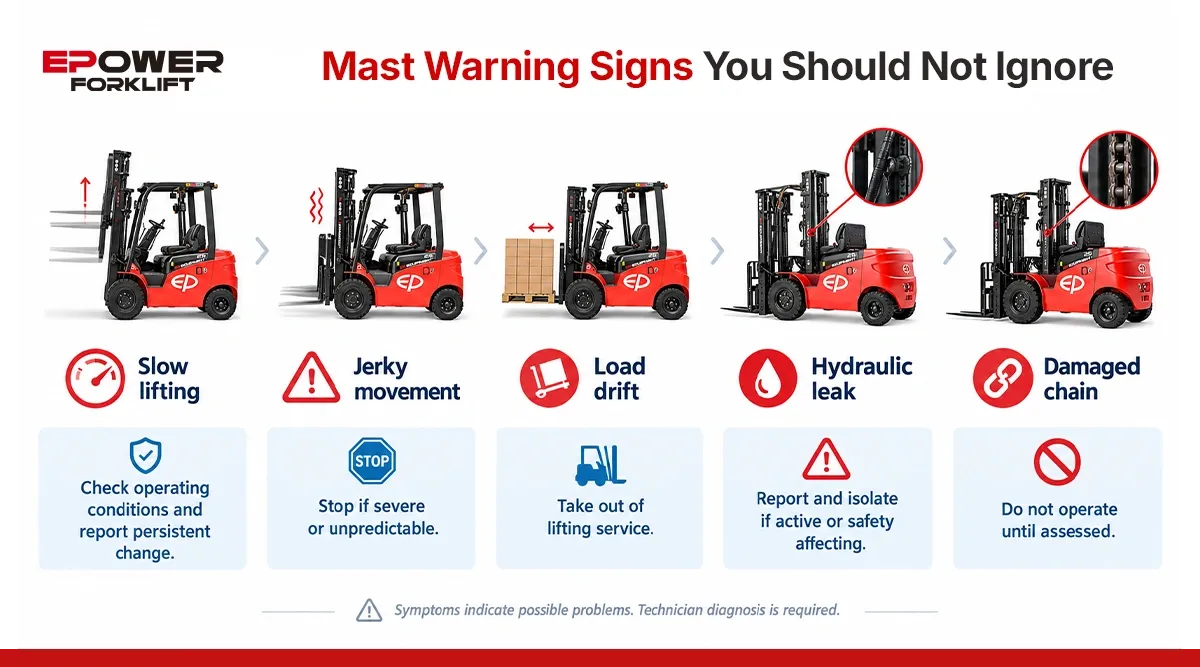
Forklift mast problems usually show up as a change in lifting performance before the mast stops working completely. Slow lifting, jerky movement, uneven carriage travel, hydraulic leaks, load drift, chain damage and unusual noises can all indicate a developing fault.
Most mast faults are hydraulic or mechanical. On electric forklifts, battery state and electrical warnings can also affect lift performance, so these should be checked before assuming the problem is inside the mast or hydraulic system. The operator’s role is to recognise the symptom, carry out safe visual and basic operational checks, record useful information and report the fault.
What Do Common Forklift Mast Symptoms Usually Indicate?
A mast symptom does not identify one failed component by itself. The table below helps narrow down the likely fault area.
| Symptom | Possible causes |
|---|---|
| Mast will not lift | Low hydraulic fluid, hydraulic leak, pump or lift motor fault, control valve issue, cylinder fault, electrical fault or low battery state on electric models |
| Mast lifts slowly | Load condition, low battery state, hydraulic fluid or flow restriction, pump performance or valve issue |
| Mast moves jerkily or sticks | Roller or rail wear, chain condition, lubrication issue, contamination or inconsistent hydraulic flow |
| Carriage or forks move unevenly | Fork positioning, chain differences, roller wear, rail damage or mast distortion |
| Forks drift down | Internal hydraulic leakage, cylinder sealing problem or control valve fault |
| Hydraulic fluid is visible | Hose, fitting, seal or cylinder leak |
| Lift chain is damaged or unusually slack | Wear, corrosion, lubrication issue or damaged chain links |
| Grinding, clicking or squealing noise | Chains, rollers, rails, lubrication, hydraulic components or foreign material |
Note: This table is a troubleshooting guide, not a diagnosis chart. One symptom can come from several components, so persistent or safety-critical mast faults still require a competent technician.
Forklift Mast Types Explained: How to Choose the Right Mast?
What Can an Operator Check Before Calling a Technician?
Before calling a technician, an operator can safely check the load condition, battery status on electric forklifts, visible hydraulic condition and accessible mast components. These checks can provide useful diagnostic information without dismantling the forklift.
Check 1: Load, Load Centre and Rated Capacity
Start by confirming that the forklift is being asked to perform within its rated limits. A mast that appears slow or weak may not have a mast fault if the load, load centre, lift height or attachment configuration is outside the forklift’s rated capacity.
Check:
- actual load weight
- load centre
- required lift height
- capacity shown on the data plate
- attachment configuration, if fitted
- whether the load is centred and supported correctly
A forklift rated at 2.5 tonnes at ground level can not retain the same usable capacity at greater lift heights or with a longer load centre. For more detail, see EPower’s guide to reading an electric forklift load capacity chart.
Check 2: Battery State and Dashboard Warnings on Electric Forklifts
On an electric forklift, low battery state or battery-management protection may reduce hydraulic performance or prevent normal mast operation.
Check the battery state-of-charge indicator and any warning light or fault code shown on the dashboard. If the battery is low, charge the forklift according to the manufacturer’s instructions and retest the mast. If mast lift slows while drive remains normal, battery state and dashboard warnings are still worth checking before moving to hydraulic diagnosis.
Record any fault code before restarting or clearing the display. That information may help the technician identify the fault more quickly. If mast performance returns after charging and no warning remains, review the site’s charging routine. If the problem persists despite adequate battery charge, take the unit out of service and continue with the remaining checks.
Check 3: Hydraulic Fluid, Hoses and Visible Leaks
For lift-performance problems, hydraulic fluid condition is one of the first areas to check.
Follow the operator manual for the specific forklift when checking hydraulic fluid. Reservoir location, mast position and acceptable fluid range can vary by model. If the fluid is below the specified range, stop using the forklift and follow the manufacturer or site procedure for topping up the system.
With the mast lowered and forklift switched off, visually inspect accessible:
- hydraulic hoses
- fittings
- lift cylinders
- tilt cylinders
- areas beneath the mast
Look for fresh hydraulic oil, wet fittings, hose cracks, bulges or active leakage. A leaking seal, hose or fitting can contribute to inconsistent mast performance even while the reservoir still appears adequately filled. Do not tighten fittings under pressure or work beneath an elevated mast.
Check 4: Chains, Rollers, Rails and Carriage
The mast’s mechanical guidance system should also be checked visually.
With the mast fully lowered and the forklift switched off, look for:
- corrosion or damaged lift-chain links
- abnormal chain slack
- noticeable differences between the left and right chains
- forks that are not correctly seated or aligned
- carriage movement that does not appear square
- visible scoring or damage to mast rails
- accessible rollers that appear damaged or out of position
Unequal movement does not mean the chain is the cause. Chains, cylinders, rollers, mast rails and carriage components can produce similar symptoms.
Operators should limit this to visual inspection. Chain wear measurement, tension adjustment, roller adjustment and mast alignment require appropriate procedures and competent service personnel.
When Should You Stop Operating the Forklift?
A forklift should be taken out of service when a mast problem affects predictable lifting, lowering or control of the load. Operator checks are not sufficient where the symptom indicates a safety-critical fault.
Stop operation and arrange inspection if you observe:
- uncontrolled mast or carriage movement
- forks or carriage drifting down
- visible broken, cracked or heavily corroded chain links
- active hydraulic leakage from a hose, fitting or cylinder
- bent, cracked or visibly damaged mast components
- severe jerking, sticking or binding
- abnormal carriage movement under load
- persistent fault codes or warnings affecting mast, hydraulic or drive operation
- inability to raise or lower the load predictably
WorkSafe Victoria recommends reporting defects and having a system to lock a forklift or attachment out of service where a defect makes it unsafe to use. The fault should then be assessed and rectified by a suitably competent person before the forklift returns to service.
For EP forklifts within the warranty period, contact EPower before arranging third-party repair of a mast fault, as unauthorised repair may affect warranty coverage.
How Can Forklift Mast Problems Be Prevented?
Consistent pre-start inspection and scheduled servicing can identify mast problems before they develop into more disruptive faults.
Before each shift, operators should follow the manufacturer-recommended inspection procedure and pay particular attention to:
- visible mast and carriage damage
- fork condition and alignment
- lift-chain condition
- hydraulic hoses and cylinders
- unusual leaks
- abnormal mast movement
- warning lights and fault codes
- new noises or vibration
- readable data plate information
- attachments and their visible condition
Scheduled servicing allows technicians to assess hydraulic components, mast guidance, lubrication, rollers and lift chains in more detail.
How the forklift is used also matters. Repeated impacts with racking, unsuitable loads, incorrect load-centre assumptions and inappropriate attachments can place additional stress on mast components.
There is no useful universal servicing interval for every mast. Maintenance should follow the forklift manufacturer’s schedule and consider operating hours, duty intensity, environment and site conditions.
For a broader operator inspection process, see EPower’s forklift pre-start checklist.
Conclusion
Forklift mast problems should be treated as warning signs, not something to work around until the forklift stops completely. Changes in lift speed, mast movement, hydraulic condition, chain condition or dashboard warnings can help operators identify when further inspection is needed.
Operators should carry out the manufacturer-recommended checks, record what they observe and report abnormal mast behaviour. Internal hydraulic faults, chain adjustment, mast alignment and component repairs should be handled by a suitably competent technician.
If a mast problem affects predictable lifting, lowering or load control, take the forklift out of service until the fault has been assessed and rectified. For EP Equipment forklifts, contact EPower with the model, fault code if available and a clear description of the symptom to support faster troubleshooting.
Follow EPower for practical forklift maintenance, safety, operation and troubleshooting guides to help you keep your fleet running safely and efficiently.
Frequently Asked Questions
What are the most common forklift mast problems?
Common forklift mast problems include slow or failed lifting, jerky movement, uneven carriage travel, fork drift, hydraulic leaks, damaged lift chains, roller or rail wear and unusual mast noises.
Why is my forklift mast lifting slowly?
Slow lifting may relate to load weight, load centre, lift height, battery state on an electric forklift, hydraulic fluid condition, restricted flow, pump performance or a control-valve problem. Check the operating conditions and basic indicators first, then arrange inspection if performance remains abnormal.
Is it safe to use a forklift with a hydraulic leak?
An active hydraulic leak should be reported and assessed before normal operation continues. If the leak affects lifting, lowering or predictable load control, take the forklift out of service until the fault has been inspected and repaired.
When should a forklift be taken out of service?
Take a forklift out of service when a mast defect affects safe or predictable load control. Examples include uncontrolled movement, load drift, visible chain damage, active hydraulic leakage, structural damage, severe binding or faults that prevent normal raising or lowering.